

Office Fit-Out Costs Are Rising—Here’s Why
A complex mix of factors is behind this surge, the latest JLL research finds.
When it comes to fitting out office space, landlords and users aren’t catching many breaks lately, JLL has reported. Globally, the average cost to fit out an office is up by between 2 percent and about 6 percent over the past year, according to the company’s 2026 global office fit-out costs guide.
Although the rising construction materials prices that have bedeviled the fitting-out process for a few years have stabilized, JLL stated, “a complex mix of geopolitical instability, rising energy prices, skilled labor shortages and increasingly complex technology requirements” has boosted fit-out costs substantially.
The result, JLL reported, is that the global benchmark for a medium-quality corporate office fit-out is now $205 per square foot ($2,150 per square meter).
Unhappily for U.S. owners and tenants, North America remains the most expensive region for fit-outs, with costs averaging $295 per square foot ($3,200 per square meter). That’s significantly higher than average costs in Asia Pacific ($1,550 per square meter), Latin America ($1,800 per square meter) and EMEA ($2,300 per square meter).
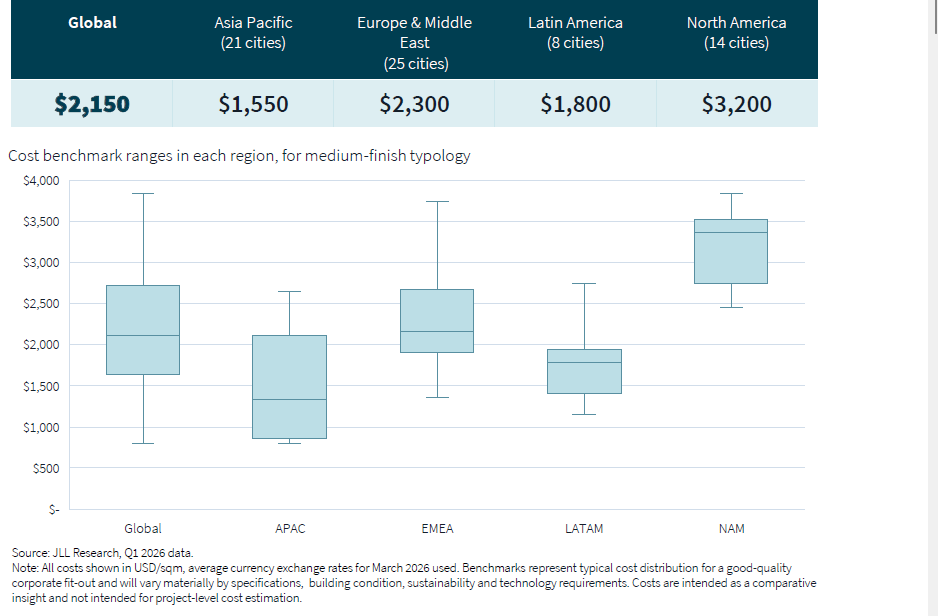
Not only are New York City, San Francisco and Boston the top three most expensive cities globally for office fit-outs, but 12 of the 20 most expensive cities are in the U.S.
“While we saw some stabilization in material prices in 2025, the story for 2026 is one of compounding complexity. It’s no longer a single issue, but a confluence of persistent labor shortages, volatile energy prices and new geopolitical uncertainty that is now baked into project pricing,” Ruth Hynes, JLL’s global project and development services research lead, as well as one of the report’s authors, told Commercial Property Executive.
READ ALSO: M&A Activity to Rebound This Year
There are specifics and intricacies beneath these larger numbers, of course. As just one example, rising copper prices are a behind-the-scenes factor in the costs of mechanical and electrical services, and in premium AV systems for hybrid work and the infrastructure needed for AI.
Coping strategies
Fortunately, JLL advises, there are some strategic decisions that can ease the pain, or at least predict it somewhat.
“In major markets such as New York City and San Francisco, strategic decisions around typology and specification have become increasingly important, as these choices can influence project costs by over 25 percent,” Daniel Pomfrett, JLL managing director of cost management for the Americas, project and development services, told CPE.
The report classifies office typologies as “open and agile,” “highly spatial” and “structured,” based in large part on how open vs. enclosed the layout is, underscoring current office space trends. JLL stated that “choosing an office layout typology is a major cost determinant, with the potential to vary project costs by 10 percent to 13 percent before accounting for quality of finishes.”
Further, employees’ ratings of different types of spaces (such as conference rooms, collaboration spaces, quiet spaces and outdoor spaces) as being less or more important for the workplace experience vary substantially.
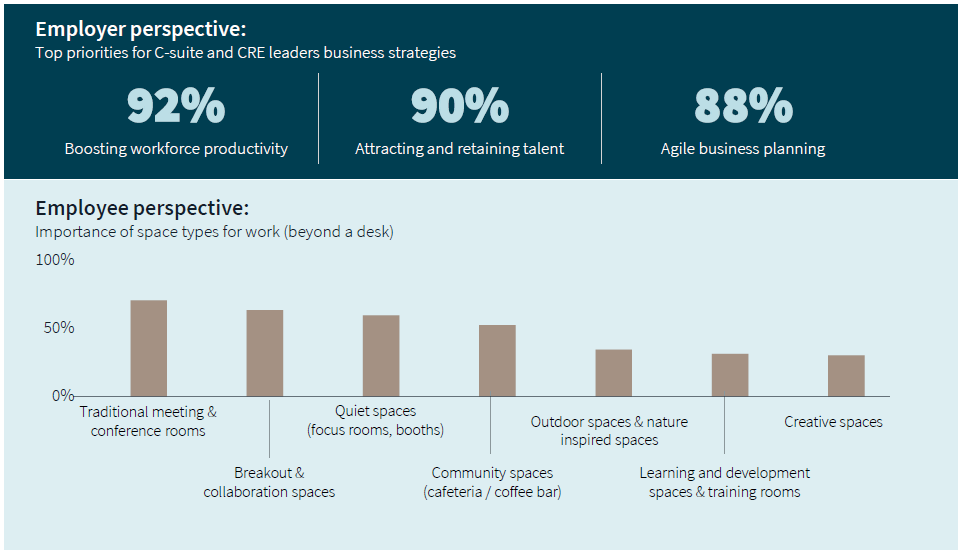
The report presents analyses based on first-quarter 2026 data only, from 68 cities worldwide. Regarding the most recent geopolitical upheaval, JLL cautioned, “The unfolding Iran conflict is causing disruption to energy markets and prices, but at the time of writing it is impossible to gauge specific impact.”

You must be logged in to post a comment.