


Unlocking Hidden Value in Obsolete Hotels
Aging hotels get a second look from investors—with some reservations.
If there’s one asset class undergoing a generational shift due to changing consumer preferences and tight capital markets, it’s hospitality.
Even though the industry remains resilient overall, the 400- to 500-key full-service behemoths that once anchored downtown areas and secondary markets have seen better days. And it’s not just major flags that have been under pressure. Underperforming, undercapitalized hotels are in a tough spot across the board.
Rather than shying away from these past-their-prime properties, many hospitality investors are acquiring them because of their distressed nature, seeing ample opportunity for value-add renovations, rebrands or outright conversions to apartments. Some have even built entire business lines around hotel adaptive reuse.
Defining outdatedness
For hospitality investors targeting these assets, obsolescence is both a tangible and an intangible concept.
“It’s either not going to make sense functionally for what it was designed or built for any longer; it’s in a location that can no longer take on the scope of people necessary to keep it afloat; or it has some physical or structural issue that needs to be addressed,” said Kaunteya Chitnis, managing director of hospitality at Portman Holdings.
In addition to deterring potential guests, out-of-date rooms, aging building infrastructure and obsolete amenities—such as oversize ballrooms and dining areas—can often trigger a hotel’s removal from a franchise or system, which in turn can lead to steep revenue losses.

“That’s significant downward pressure on value, because it’s hard to replicate what Marriott would deliver to your location if you get kicked out of the Marriott system—which does happen,” reported Daniel Peek, president of JLL’s Hotels & Hospitality Group.
Still, investing enough to stay on brand is easier to justify in principle than in practice.
“In a zero-interest-rate environment, you do a large renovation on one of these assets and it would still pencil,” noted Eli Evans, principal of acquisitions at AWH Partners, a private investment firm that specializes in distressed hospitality investments. “But when the cost of capital is significantly greater, it makes it a much higher hurdle to try and get these things back into the ordinary stock of hotels.”
Conversely, a strong location, core building or market position can outweigh a property’s shortcomings. “Even though the guest profile has moved away from these hotels, these are solvable challenges if the land and its value are good, and they’re in great markets,” Evans added. “Even if the bones are obsolete, there are developers and investors who can find a way around it.”
Buildings and brands
That assessment is often a good starting point for investors evaluating whether a hotel is a value-add opportunity, a redevelopment candidate or something in between. But what makes the most sense depends heavily on the property’s unique circumstances.
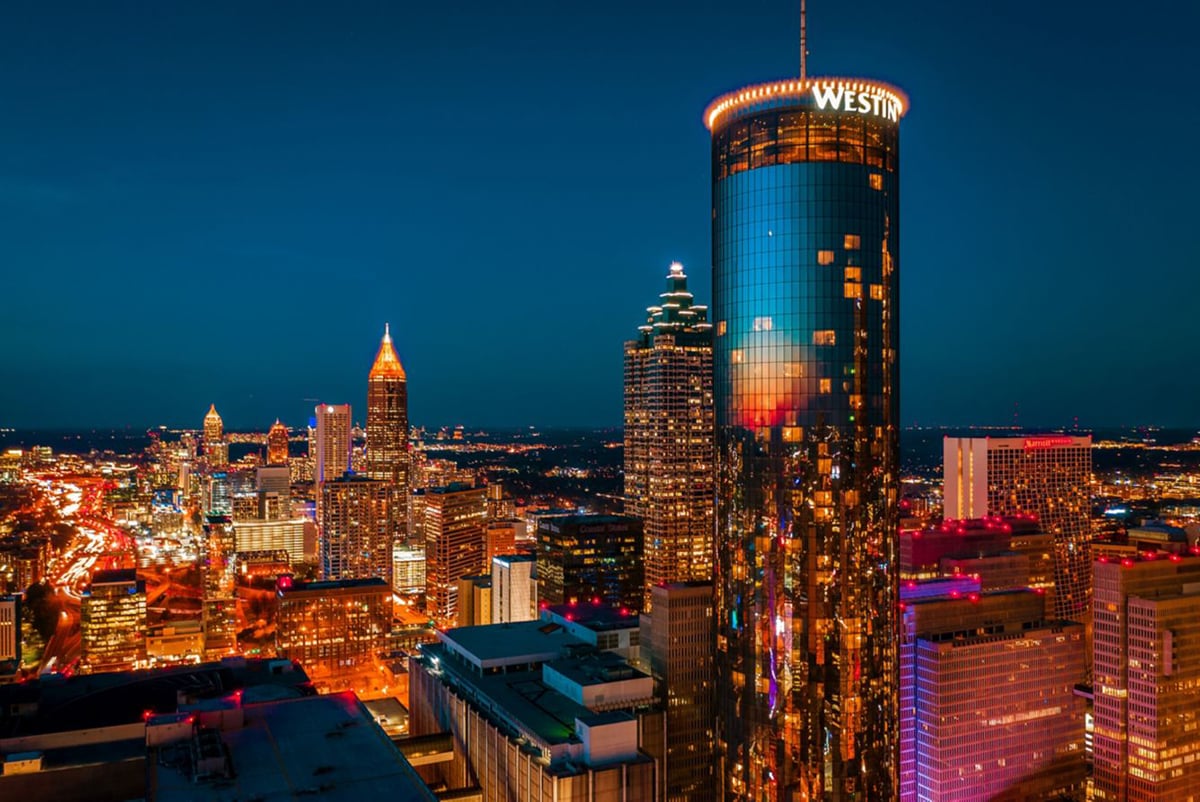
Take Chitnis’ latest project, for example. In May, his firm, via its first dedicated hospitality fund, acquired The Westin Peachtree Plaza, a 1,073-key full-service hotel in downtown Atlanta that Portman originally completed in 1976. At that time, it was the tallest hotel in the world. Half a century later, that alone isn’t enough to keep guests booking rooms, particularly as the city prepares to host the 2028 Super Bowl.
Following the acquisition, the company plans to upgrade guest rooms, meeting areas and other public spaces, with the goal of finishing the work before the big game. The Westin flag definitely matters, but Portman is also taking advantage of the property’s place in Atlanta’s skyline and history.
“Definitions vary, but the way I see it is that this building would be very difficult if not impossible to build today,” Chitnis said. “The brand is there, and a repositioning path would yield a great risk-adjusted return on the investment of renovating the hotel.”
While other hotels may not have The Westin Peachtree Plaza’s stature or recognition, it’s often a property’s brand name or location that investors lean toward when making a value-add play. Encore Hospitality, the hotel-focused arm of Encore Enterprises, selects assets based on their brand, because it’s a major selling point for capital partners.
“We focus on Hilton and Marriott because lenders like those the most,” shared Glenn Pedersen, Encore’s president. “They’re widely considered as having the best reservation and loyalty systems in the industry.”
Through this lens, Encore evaluates whether a hotel can meet current brand standards around room quality and services through targeted upgrades to the building’s infrastructure. According to Pedersen, the goal is to increase the revenue per available room to a given market’s standard. The company also scrutinizes operations, with an emphasis on essential services over large ballrooms or extensive meeting spaces.
“We’re always looking at the revenue management and the food-and-beverage offerings, if there are any in the first place,” he noted.
A different kind of demand
Even though a brand name may work to the benefit of some properties, it can also be a drawback. This is especially the case if the asset is in that clunky 400- to 500-key range and lacks the selling points of more modern construction.
The solution? Break a single, large hotel into multiple smaller concepts with different stay options.
“Half of the property could be a more flexible extended stay option like a Residence Inn, while the other could be a Courtyard,” Evans noted. “This at least gives you two angles for your potential guests.”
Some investors get even more niche, leaning toward locally owned properties in smaller, tourism-driven markets.
We’re not overbuilt, we’re under-demolished. There’s a lot of much older product that exists in the market today that probably wants to be something else.
—Daniel Peek, President, Hotels & Hospitality Group, JLL
Outbound Hotels, the hospitality arm of Waterton Residential, for example, focuses on independent resorts in outdoor-oriented vacation destinations. Many of these properties are at a generational crossroads.
“A lot of times, when we acquire these properties, they’ve been transitioning from one generation to the next, where the younger generation might not want to put the requisite dollars into maintaining them,” detailed Matthew Mering, the company’s co-founder.

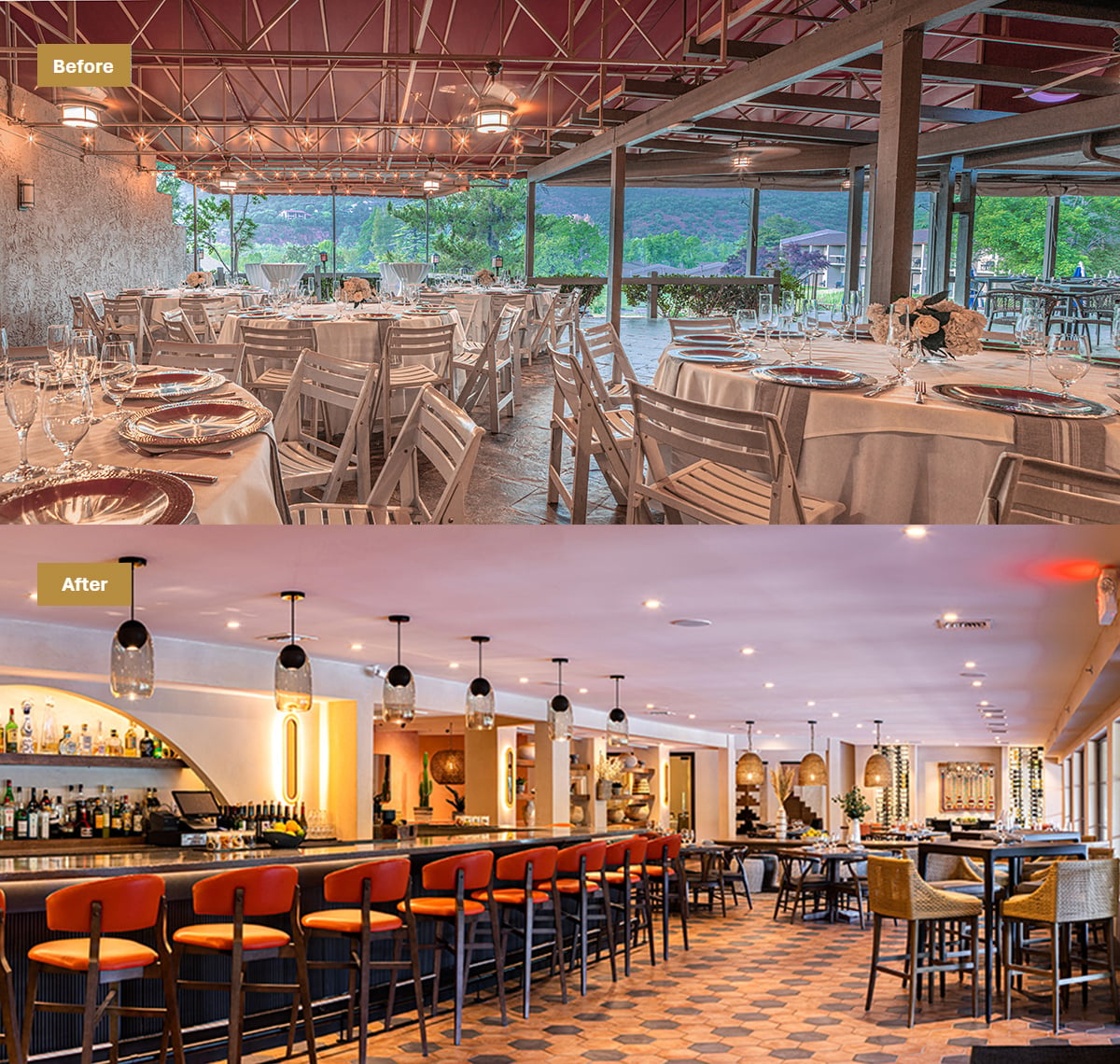
Due to this local approach, no two assets are alike. Outbound targets properties for a value-add operation based on their distinctions, and when the company upgrades rooms, lobbies, infrastructure and dining areas, the design choices are often highly localized.
“We like interesting, quirky buildings, and we try to embrace the bones of a lot of these historic properties since travelers like authentic, unique experiences,” Mering added. “When you’re staying at our property in Jackson Hole, Wyo., you want it to have a Western vibe to it. That’s very different from the rooms in Stowe, Vt., which have more of a Northeastern, New England kind of aesthetic meant to attract skiers.”
When hotels become housing
Even though a value-add play can work under the right circumstances, many obsolete properties are too far gone to renovate.
“We’re not overbuilt, we’re under-demolished,” observed Peek. “There’s a lot of much older product that exists in the market today that probably wants to be something else.”
Increasingly, that something else is apartments. According to the latest RentCafe data available, hotels accounted for 37 percent of all commercial real estate types converted to apartments in 2024, with more than 9,100 units coming online. Office properties ranked second, accounting for 24 percent.
The financials, alongside a lack of new studio apartment construction, certainly justify hotels’ candidacy for conversion.
“It’s a much higher value when it comes to revenue vs. hospitality, in part because we can purchase these properties for a much lower cost than traditional multifamily,” said Ross Hubbard, co-founder & CIO at Sage Investment Group, a company that specializes in hotel-to-multifamily conversions.

To date, Sage has converted 32 hotels across six states to apartments, totaling 3,000 units. The firm typically targets garden-style and exterior-corridor hotels under 75 feet tall, usually in cities with a minimum population of 150,000.
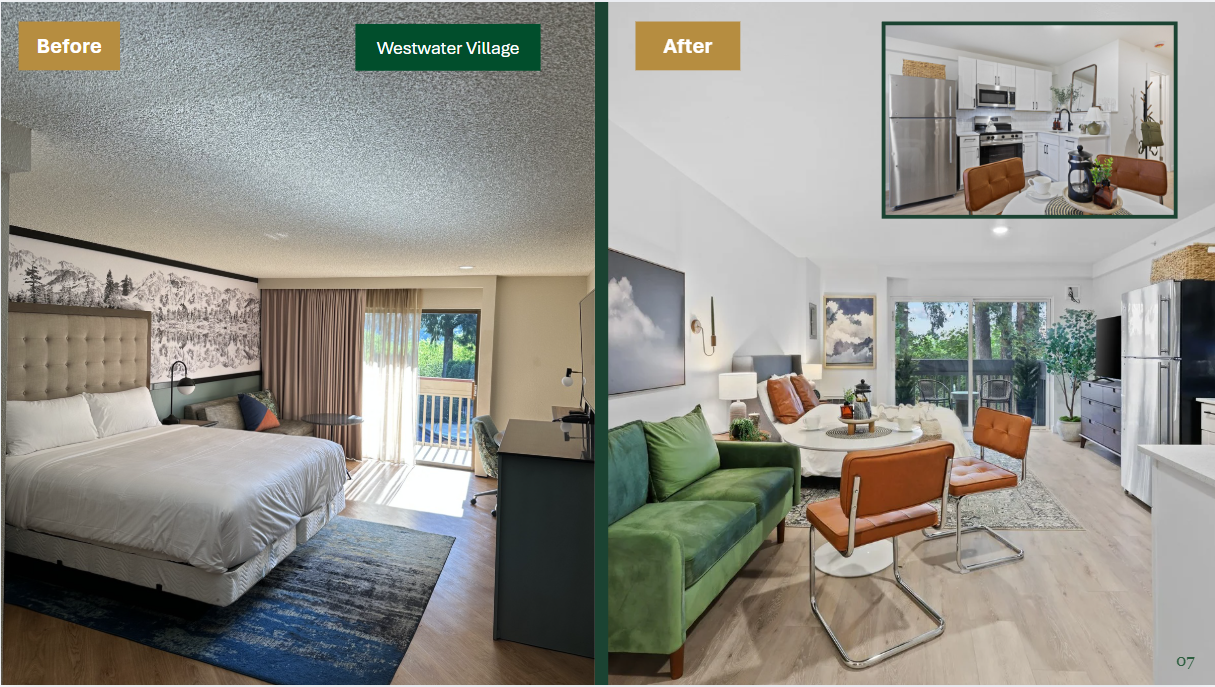
Core work includes replacing plumbing, electrical and fire-suppression systems, most of which can be accessed and upgraded from within the apartments. But the other half of the conversion process is all about residents’ quality of life. Kitchens with full-size ranges, fridges and sinks, along with full bathrooms and closets, are common features. However, a truly successful conversion is often defined by unit size and how the property fits into the surrounding housing market.
“The way you convert successfully is with a more holistic approach against the property,” observed Chris Loeffler, CEO of Caliber Cos.
Through a preferred equity opportunistic fund, Caliber is currently converting a 160-key hotel in Phoenix into a 104-unit multifamily community. By reducing the total unit count, the company plans to increase the size of the overall units to create a highly desirable product in the marketplace.
The project is located near TSMC’s $165 billion semiconductor manufacturing campus, and is expected to provide housing for plant employees. It’s this external demand driver that Loeffler believes will get the project across the finish line.
“People should be looking for big returns on these projects, because they’re taking a big risk,” Loeffler said.
The most important audience
Regardless of a given property’s age, brand or prior use, the end goal is to create an experience that feels as close to new construction as possible, a task that’s often easier said than done.
A developer’s biggest obstacle may be inexperience, which contributes to their inability to get funding. Additionally, hotel conversions require technical know-how and the ability to work with local governments that may be wary of adaptive-reuse construction. But the most important qualification is not necessarily a track record of success with these projects but the ability to convince cities, lenders and prospective renters that the product solves a real need.
“The cities are not in a position where they can tell you what to do or how to do it, but you can always propose to them what you’ve done before and why that works,” Hubbard advised. “They’ll be happy to validate that.”
For investors today, obsolete hotels are tests of whether old hospitality real estate can be reintroduced to the market as something more useful, more financeable and, ultimately, more in demand.




You must be logged in to post a comment.