

SIOR Special Report: AI’s Big Questions for Brokerage
The new technology can complement traditional practices in productive—and surprising—new ways.
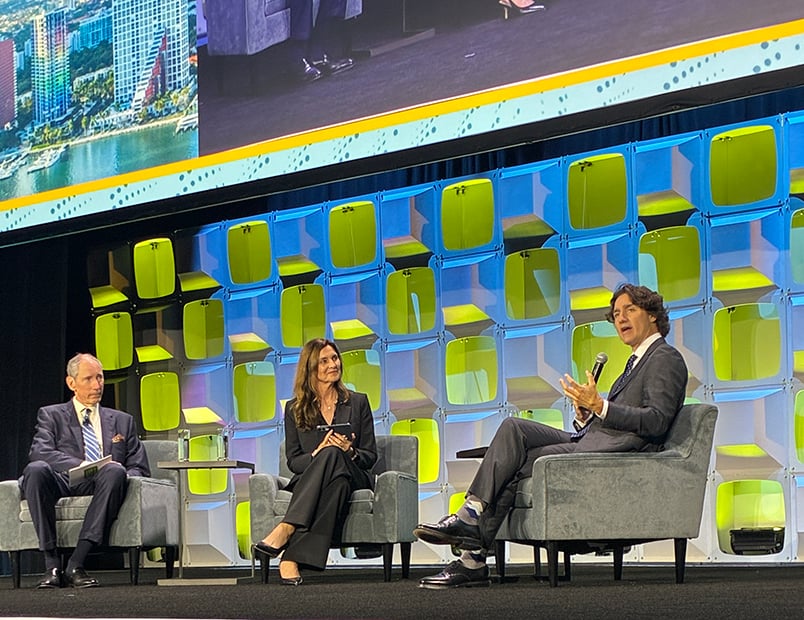
How should the brokerage profession evolve in the brave new world of artificial intelligence? At SIOR’s Fall Event in New York City, the challenge of finding the right balance elicited some surprising ideas.

When it comes to implementing the new technology, the industry’s largest advisory shops—its “big ships,” as the session’s title called them—offer financial resources and advantages of scale.
At Coldwell Banker Commercial, AI has fostered sharing of ideas and information among the firm’s 3,000-plus professionals, reported Daniel Spiegel, who leads the network as its senior vice president & managing director.
Because smaller advisory firms have fewer levels of approval, they can move and make decisions quickly. “I think it’s great to be a speedboat that can take corners fast and sharp,” commented Kim Ford, CEO of Pittsburgh-based Rise Commercial, a boutique tenant advisory firm.
Perhaps a distinction between the brokerage industry’s giant firms and its smaller participants is that “a lot of larger firms tend to focus on brand value, rather than the individual,” whereas at small firms, “you can be pretty effective and nimble,” according to Erik Edeen, principal & senior director of U.S. investment sales at Avison Young.
Professional shakeup
The new technology has shaken up professional practice for brokers on multiple fronts, as it had for the entire industry. “What AI has done is really democratize access,” said Daniel Correa, principal at JLL Spark, an affiliate of the advisory firm and investor in real estate technology startups. However, the commercial real estate sector is about five to seven years behind multifamily in adaptation, he estimates.
Spiegel compared today’s AI environment to the expansion of the Internet a quarter century ago, “when there were a lot of cool solutions.” But as was also the case then, “Companies that are going to win are companies that encourage freedom and creativity of people to try stuff,” he added.
That has implications for the role of advisory firms as data providers. Proprietary data may be less of a competitive advantage. Moreover, “The days of clients coming to us because we have the listing book are over,” said Spiegel. “What clients are paying for is the interpretation of data.”
Advisory firms also face the question of how to build their AI platforms effectively. “One of the risks in an enterprise approach is that it isn’t something for what people in this room need, which is driving the business,” Edeen said. “I think AI companies are going to build the best AI, and the real estate companies will be one of the customers.”
Generational issues

The AI revolution also brings implications for training the next generation. “The new echelon of young brokers are going to have to be so smart with these tools,” said Edeen. The disappearance of some entry-level positions adds efficiency but also marks the loss of a crucial opportunity to train professionals in the basics.
“If you have no one to do the grunt work, when someone leaves, who steps in?” Correa said. “It’s a tough time to be early in your career.”
If anything, panelists said, AI is intensifying the importance of time-honored skills. “We’ve got to continue to focus on training people how to manage relationships,” said CBC’s Spiegel.
It may seem like a paradox, but AI tools can potentially build vital connections in a people-focused profession. For example, Edeen suggested use the technology help schedule relationships and keep them in front of you. With such strategies are adopted, “If AI is done right, it will make us all a little more human,” Correa predicted.
In the new age of AI, returning to traditional skills may well be a winner with clients. Rise Commercial has gone back to handwritten notes and takes a throwback approach to client thank-yous. As an alternative to sending conventional holiday gifts at the end of the year, the company now sends hand-knitted pumpkins in the fall. The results are telling: Client responses have ramped up from 14.5 percent to the year-end gifts to 87 percent for the pumpkins, Ford reported.
And as Edeen noted: “Nothing beats the canvasser, because not many people want to do it anymore.”




You must be logged in to post a comment.