


ULI Fall Special Report: Justin Trudeau on AI, Tariffs and Housing
The former Canadian prime minister told attendees to build communities—not just housing.
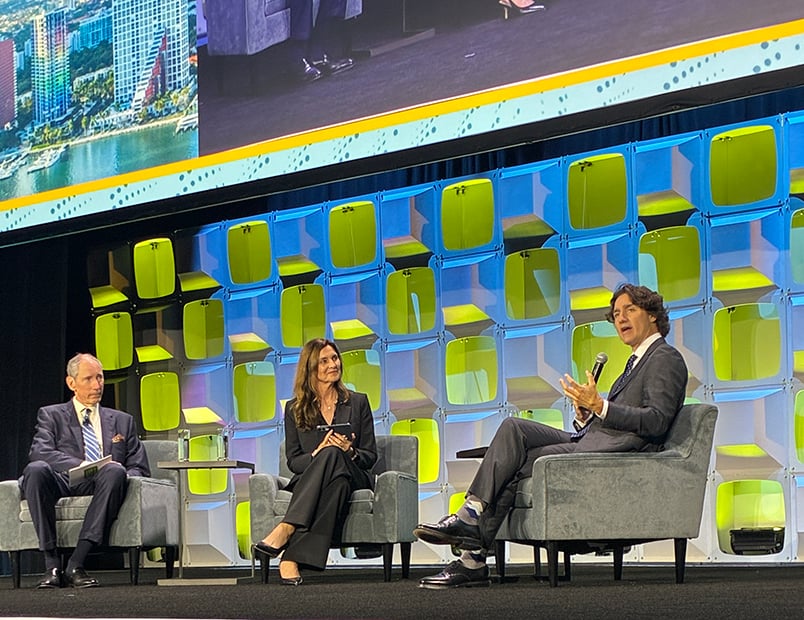
Artificial intelligence can be of great service to humanity if it doesn’t try to take over humanity, said former Canadian Prime Minister Justin Trudeau during the opening session of ULI’s Fall Meeting in Miami yesterday.
“AI is going to create tremendous wealth if we can make sure that that white-collar accountant still gets paid for five days a week when they only work for three days,” he said. “Then maybe we’re on the right track of that.”
Trudeau fielded questions from ULI board members Franz Colloredo-Mansfield of Cabot Properties and Kristina Raspe of Apple Inc.
On housing affordability
Government has a role to play in housing production, Trudeau said, but the actual building should be left to the private sector. His administration used tools like the $4 billion Housing Accelerator Fund to incentivize “super-ambitious” municipalities to upzone residential lots and streamline approvals. It also made major investments in modular housing. “There are things we can do to shake up the system,” he told attendees.
Trudeau said it is important for governments and leaders to celebrate their achievements rather than simply moving on. “If you don’t talk about your successes, people won’t actually know about them in a way that will undermine eventually their faith in institutions and the very structures of democracy,” he said.
On building resilient cities
When asked by Raspe what ULI members should be doing to ensure cities thrive, Trudeau returned to the topic of housing and urged attendees to incorporate into their projects parks, community centers and walkable hubs around transit stations—things that build resilient communities.
“Housing isn’t an isolated bubble,” he said. “It’s part of a community. People want to be in a community.”
READ ALSO: How the Middle East Conflict Is Impacting CRE Investment
On global tensions
The former prime minister said current global tensions have led countries to hunker down rather than gathering together to solve big problems like climate change, which Trudeau noted we have understood since the 1980s. There is also pressure to come up with short-term fixes instead of long-term solutions.
He also spoke of an “anti-globalization” backlash, which has led to what he called “anti-trade” and “anti-prosperity” policies like tariffs.
For ordinary citizens, this is a time for “extraordinary anxiety” he said, and there is a growing cynicism among young people globally who dont believe they will achieve the same prosperity their parents did.
“They don’t see that the system is actually working for them the way it worked for previous generations, and that’s fomenting anger in some places,” he said. “It’s fomenting disaffection and cynicism and apathy in other places.
Trudeau served as prime minister from 2015 to 2025, He is currently a public speaker and co-founder of Hope & Hard Work, an entertainment and media company. “Telling the right stories about where we are going is interesting to me,” he said.



You must be logged in to post a comment.