

CMBS Choices: Conduits vs. the Competition
Is conventional securitization still a viable option?

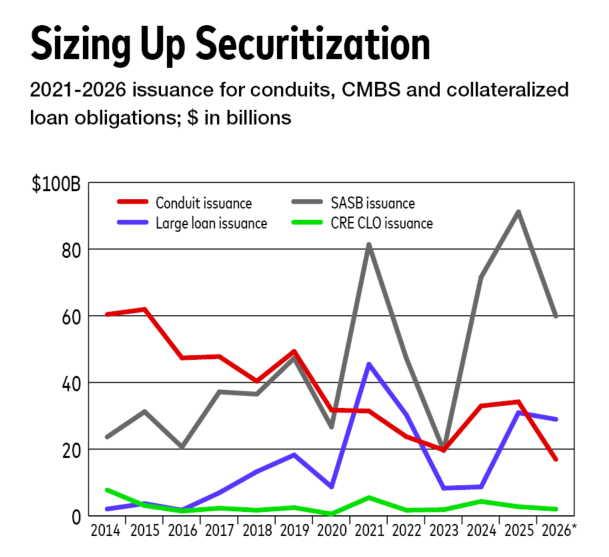
Intensifying competition and shifting preferences among bond buyers are adding to the complexity of investors’ securitization strategies. At midyear, conduit volume stood at nearly $17 billion. That placed the category on track to match the full-year totals of 2024 and 2025. Yet the balance of power among securitized finance categories continues to shift.
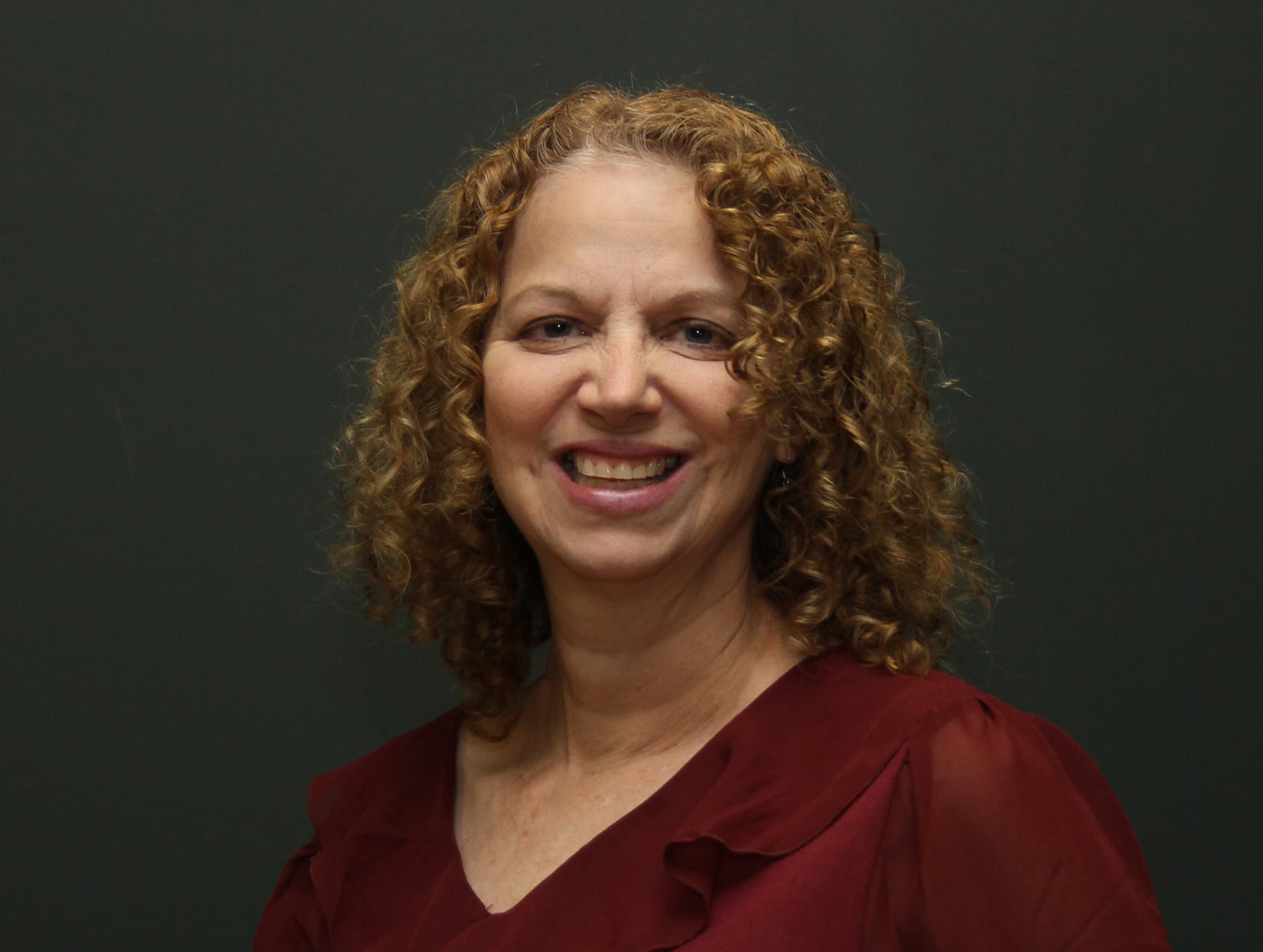
“The conduit market has certainly seen a slowdown,” Lisa Pendergast told CPE before her recent retirement as the CRE Finance Council’s president & CEO. “But we’ve also seen the ascendancy of the SASB market across all asset types. It’s the preeminent securitization structure right now.”
The securitization options offer some similar benefits. CMBS borrowers have a better opportunity to secure a cash-out refinancing, noted Sam Immediato, director of capital markets for Greysteel. At the end of July, his firm was in the process of structuring a five-year CMBS cash-out loan for the owner of a retail property in Staten Island, N.Y., and the spread had compressed more than 20 basis points from a month earlier, he reported.
“In a CMBS execution, lenders are looking at the collateral and its cash flow, whereas banks want to generally have a business relationship and deposits,” Immediato added. “So, oftentimes banks may have a different view on how to gauge a financing, which can make it harder for them to underwrite deals based on their framework compared to a CMBS lender.”

Both conduit and SASB loans offer advantages that may be unavailable from balance-sheet lenders, including nonrecourse and full-term, interest-only provisions. SASB deals often receive more favorable underwriting on the strength of the sponsor’s assets and track record. But that’s not the whole story. Immediato noted that conduit CMBS spreads have largely remained steady despite geopolitical volatility, expectations of inflation returning and other market worries.
Current CMBS market dynamics represent the latest stretch in a roller-coaster ride that dates back more than a decade. Once CMBS regained its footing after the Great Recession, conduit volume from 2014 through 2016 was roughly double SASB issuance, according to Trepp. But in 2017, it began to dive again. By 2021, conduit issuance had slipped to $23.75 billion while SASB deals spiked to $81.3 billion. By mid-2026, SASB issuances were nearing $60 billion while conduit securitizations had reached less than $17 billion, according to Trepp.
Losing share
“The drop-off in conduits isn’t due to any single catalyst – it’s a confluence of things that are resulting in a lack of interest in the structure,” relative to other options, said Lonnie Hendry, chief product officer at Trepp. “There are a lot more competitors, and borrowers have a lot more optionality in this market.”
Meanwhile, CMBS bond buyers are favoring the type of larger, high-quality assets and portfolios in SASB issuances, Hendry added. For bond buyers, an SASB loan presents a clearer due diligence process than conduits, which require underwriting a portfolio of multiple and sometimes diverse loans.
Midsize banks have moved off the sidelines to offer new options to borrowers. In a similar vein, the growth of institutional debt funds is also curbing conduit market share. Because CLOs securitize short-term floating-rate debt and provide attractive flexibility, they have eaten into conduit executions, Hendry said. CLO volume has exceeded $30 billion in three of the last five years, according to Trepp. As of June, CRE CLO volume stood at $24 billion, up 39 percent compared to the same period of 2025, according to the same source.
Industrial sales today tend to be dominated by portfolio trades, which are typically too large to include in conduits. Data center loans are usually issued in a SASB structure for the same reason, noted Nitin Bhasin, global head of CMBS ratings for KBRA. Multifamily sponsors—many of them stung by the spike in supply and interest rates a couple of years ago—are driving those deals as they try to buy time to reach stabilization and qualify for permanent financing, Hendry added.
This year’s noteworthy SASB securitizations include:
Brookfield’s $800 million deal for 225 Liberty St., a 2.4 million-square-foot trophy tower in lower Manhattan. Co-originated by a consortium of banks, the package included a $173 million equity contribution from Brookfield.
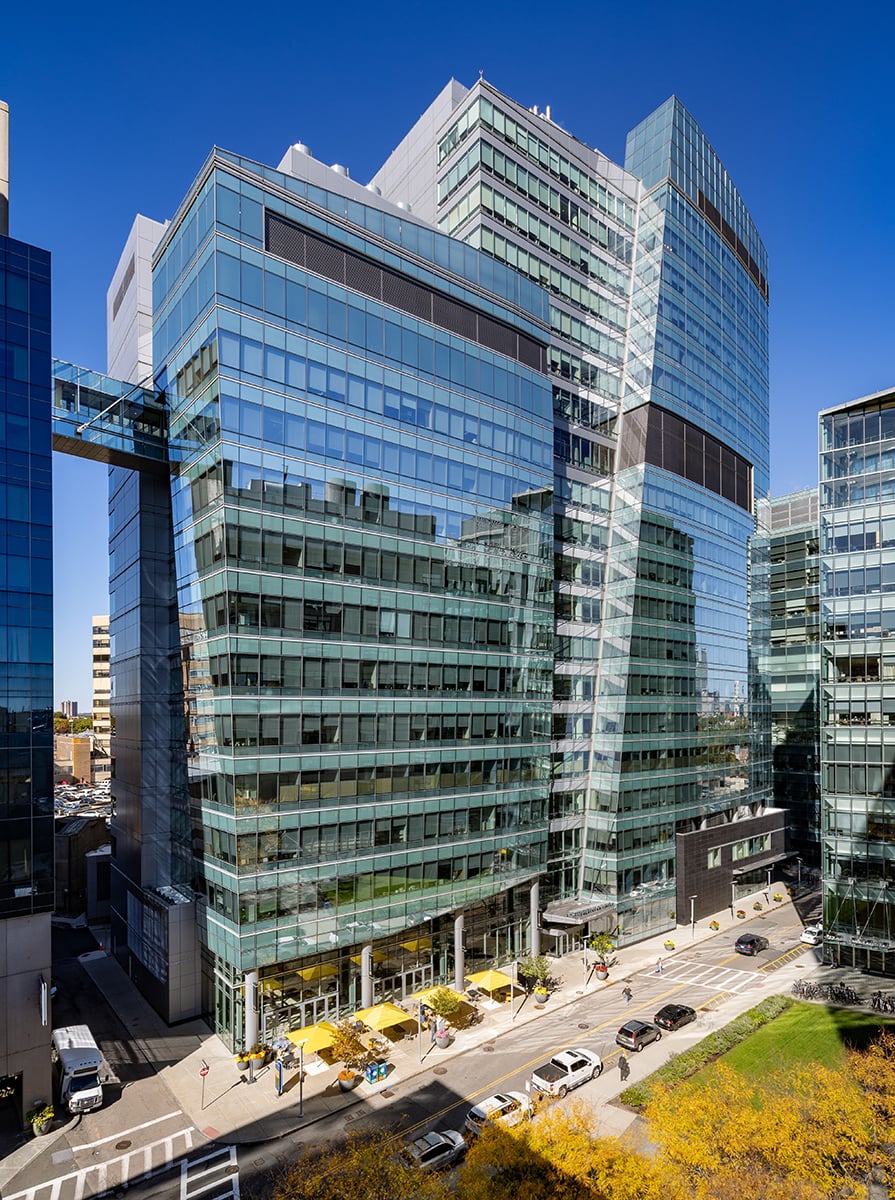
BioMed Realty’s $765 million refinancing of the Center for Life Science | Boston, a lab and office building.
The $708.5 million refinancing and recapitalization of Easton Town Center, a 1.6 million-square-foot mixed-use asset in Columbus, Ohio.
The $1.05 billion fixed-rate financing of adjacent data centers owned by CyrusOne in Allen, Texas. Terms for CyrusOne’s deal feature five years of interest-only with a 66.8 percent loan-to-value, CREFC reported in May.
Steady alternative
That doesn’t mean the conduit is at risk of extinction. Among other advantages is the structure’s diversification, which provides bond buyers with a cushion against heavy losses if a loan or two tank. Conversely, a default or other event that weakens the collateral in a SASB deal can lead to a heavy loss.
The CMBS conduit route proved the best solution for New + Found when it sought financing for City Foundry STL, the $254 million mixed-use redevelopment of the Federal-Mogul foundry site in St. Louis. Located in a tax increment financing district that encompasses the 15-acre site, the 338,000-square-foot property opened in 2021. It comprises offices, retail, entertainment and a food hall and is 92 percent occupied. Earlier this year, New + Found landed a five-year, interest-only $97 million loan. It was sold in two portions: a $75 million tranche in a $1 billion conduit and a $22 million loan as part of a $688.6 million conduit. The loan features an interest rate of 7.1 percent and represents about 61 percent of the property’s value, according to the offering prospectus.
“We have several income streams, and I think it can be hard for some single banks to understand the credit risk of a project like City Foundry and underwrite it cleanly,” said Mason Bikshorn, managing director for investment at New + Found. “By design, conduit pools absorb diversified income profiles and are pulling different risks across loans. But it comes down to execution, and between the rate profile, leverage and overall structure, CMBS is definitely more competitive than bank alternatives.”
For the redevelopment’s next phase, New + Found expects to secure agency financing for One Foundry Way, a luxury apartment project in lease-up at the site. A mass timber office building is also being planned, shared Bikshorn. The 83,000-square-foot project will be the first mass timber building in St. Louis.
The Cycle at Work
A rebound in conduit dollar volume is a question of “when” rather than “if,” given that market dynamics are likely to change eventually, Trepp’s Hendry predicts. The next presidential administration might consider commercial real estate underwriting by banks too loose and apply more regulatory pressure. Life insurance companies could find an investment alternative that reduces their allocation to the property sector, he said.
“Will conduits ever reach volumes that they did before, and will SASB volumes shrink? It’s hard to say,” Hendry observed. “But I think where conduits are now and have been for the last couple of years will be perceived as an outlier relative to what we’ll see in the coming years. Everything ebbs and flows.”




You must be logged in to post a comment.