


Can CRE CLO Continue Its Run?
Multifamily has accounted for 70 percent of the collateral this year.

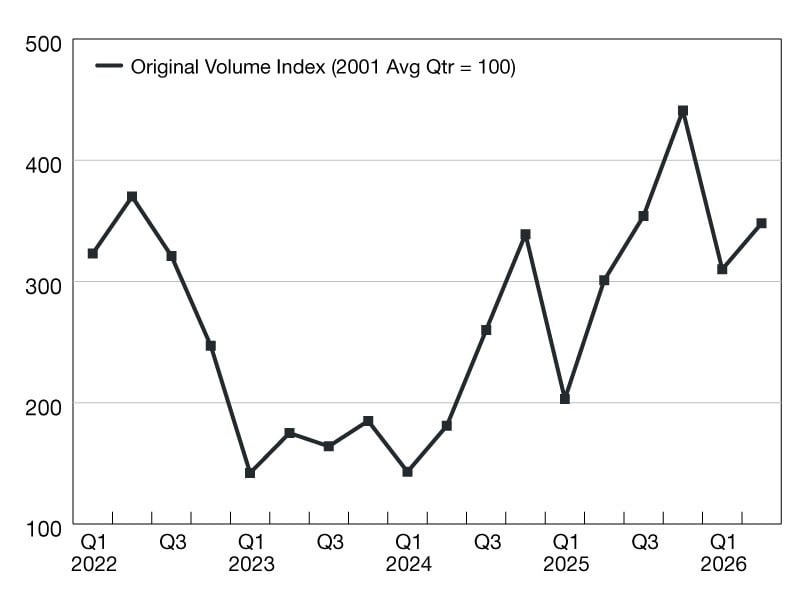
Total Collateralized Loan Obligation issuance surged in the the first quarter of 2026, with new loan and refinancing activity totaling $103.3 billion across 236 deals. But predictions on whether or not this will continue through the year depend on who you ask.
Trepp data confirms the upward spiral. As of June, it found CRE CLO issuance was just over $24 billion across 24 deals, up roughly 39 percent over the same period last year, Dr. Stephen Buschbom, Trepp’s head of applied research and analytics told Commercial Property Executive. However, he noted, the run rate for 2026 is slower than 2025, even as AAA spreads declined.”
Single-Asset Single-Borrower CMBS was also robust in Q1 2026, with issuance totaling $32.74 billion and marking the second busiest first quarter since just before the Global Financial Crisis, according to a Trepp report. The volume, though, represented a 12.8 percent reduction from last year’s first quarter, which was the busiest post-GFC start.
CLOs vs. SASBs
Buschbom drew a distinction between CRE CLOs and CMBS SASB debt, noting that CLOs are a structured finance product backed by a 150 to 300-plus diversified pool of below-investment-grade corporate loans sold to Special Purpose Vehicles that sell structured, tiered debt and equity tranches on the stock market. SASBs, meanwhile, involve a single, large loan of $200 million or more secured by one trophy asset or a portfolio of properties owned by the same borrower and traded on the secondary bond market among institutional investors.
“The driver is not corporate M&A or restructuring but rather the continued need to finance transitional commercial real estate,” Buschbom continued. “CRE CLOs are particularly useful for bridge loans, value-add business plans, lease-up strategies and borrowers that need future-funding capacity for renovations or repositioning.”

Multifamily remains the dominant collateral type for CLOs. So far in 2026, Trepp data shows multifamily represents about 70.5 percent of CRE CLO collateral, followed by industrial at 10 percent, lodging at 4.8 percent, office at 2.1 percent and retail at 1.5 percent.
“That said, I would not describe today’s CRE CLO market as a simple repeat of the 2021 boom,” Buschbom added. In 2021, issuance was fueled by extremely low interest rates and abundant liquidity.
Today’s market is operating in a much higher-rate environment, and the better deals tend to involve more conservative underwriting, realistic rent-growth assumptions and sponsors with credible plans to improve property income:. “If spreads remain stable and refinancing demand stays elevated, CRE CLO issuance can remain active through the year, but volatility in rates, credit spreads or property-level performance could slow the pace.”

The road ahead
While CRE CLO issuance remains resilient, the road ahead could get bumpier, as CLO lenders tighten spreads due to rising credit concerns and defaults and lower returns as well as increasing regulatory complexity, noted a report from the law firm of McDermott, Will & Schulte. Additionally, pooling leveraged CLO loans into exchange-traded funds democratized access to historically institutional-only markets, sparking a surge in demand that injected billions into the sector, actively tightening credit spreads and altering CLO pricing.

The CLO market expected the Trump administration to be pro-growth, but it has been a mixed bag for the CLO market, according to the McDermott, Will & Schulte authors. They noted that opportunistic borrowers took advantage of declining interest rates and re-priced or refinanced their outstanding debt. However, the resulting spread compression and relative loan price stability reduced returns to CLO equity, which made BSL (broadly standardized loan) CLO equity a less attractive investment to equity arbitrage investors, reinforcing the movement away from third-party equity to captive equity funds by CLO managers.
Due in part to a limited new BSL supply, equity return models remain low, perceived foreign investment diminished and momentum in the new issue market was subdued during the first quarter of 2026. Many CLO refinancings, resets and new issuances from 2024 will exit their non-call periods in 2026, which presuming economic growth and that interest rates stabilize should foreshadow increased refinancing and reset activity later this year, the McDermott, Will & Schulte authors stated.
Up and down factors affecting loans
A number of factors are driving loan origination and securitization issuance and both CRE CLOs and CMBS SASBs are seeing increases or decreases depending on differences in short- or long-term interest rates, underlying corporate property valuations and cash flow expectations, said Jim Dunbar, partner and head of real estate lending at Värde Partners. “Our CLO was the result of increased origination volumes for non-bank CRE originators, which has largely been a trend over the past few years,” Dunbar said.
The increase in CLO activity shows that capital is still active, but it is being more selective about risk, suggested Brian Connolly, founder & CEO of Feasibly, an AI-powered platform that provides market and financial feasibility studies. “Investors are looking for yield, and CLOs are attractive because they pool corporate loans into a structure where risk can be diversified, priced, and sold across different investor profiles.
“That same basic logic is helping CMBS recover, although more selectively,” he continued. “By pooling multiple CRE loans into securitized bonds, CMBS’ can reduce exposure to any single property, borrower, or market. That diversification makes the risk easier for investors to evaluate, especially compared with holding one large loan on balance sheet.”
“The difference is that commercial real estate has to clear a tougher asset-level test.” Connolly said, noting that a CMBS pool may reduce investor concentration risk, but each loan still depends on the strength of the underlying real estate.
That is why CMBS activity is improving in asset classes with clean fundamentals, such as multifamily, industrial, select retail, hospitality in strong markets, and data centers, he continued. “The demand drivers are easier to measure, the cash flow is easier to underwrite, and the exit story is more credible.
“So the broader point is simple: securitization works best when it combines diversification with strong underlying collateral,” said Connolly, noting that pooling can reduce risk for investors but does not fix weak project economics.
Securitized lenders are selective
The CMBS SASB market is recovering selectively, according to Buschbom. Private-label CMBS issuance year-to-date is $65.95 billion across 89 domestic deals through June, which was the busiest first two quarters of a year since before the Global Financial Crisis, with issuance almost reaching the level seen in 2005 when $68.7 billion in private-label CMBS was issued in the first half of the year.
“The big story is that SASB deals are driving issuance,” Buschom said. SASB accounted for 67 of the 89 deals in Q1 and Q2 and $51 billion of the total, or just over three-quarters of issuance,” he added, noting that of SASB deals issued in 1H 2026, 17 deals were larger than $1 billion.

In terms of property types, the strongest CMBS SABS appetite is for assets where investors can underwrite durable cash flow and institutional sponsorship, Buschbom said, noting that lodging showed a strong presence in the SASB market in 1H, with 10 SASB deals backed by hotel assets.
Office also saw selective financing activity and accounted for the highest number of SASB deals in 1H at 19 deals. But Buschbom suggested, “That should not be confused with a broad rebound in office lending. The market is open for high-quality, well-leased, well-sponsored office assets, especially in top submarkets, while weaker or commodity office assets still face significant financing stress.
In conduits, office exposure rose to 17.4 percent in Q1, from 15.7 percent a year earlier, while apartment exposure declined, partly because agency lenders remain a major financing channel for stabilized multifamily.
“The CMBS market is coming back, but it’s coming back selectively,” said Connolly. “Capital is still available, but lenders and bond buyers are being much more disciplined about where they put it. They want to see real demand, reliable cash flow, supportable occupancy, and a clear path to takeout or refinance.”
Multifamily is still the favorite followed by industrial, select retail, strong-market hospitality and data centers. “Office is still tougher because the fundamentals are harder to underwrite in many markets,” Connolly noted..
Recent large office SASB examples illustrate selectivity in the market.
- Soloviev Group secured a $1.8 billion CMBS refinancing for 9 West 57th St. in Manhattan, led by Bank of America with Wells Fargo and Citi also involved. The five-year loan refinanced prior debt and returned more than $500 million to the borrower, reflecting the strength of that trophy asset.
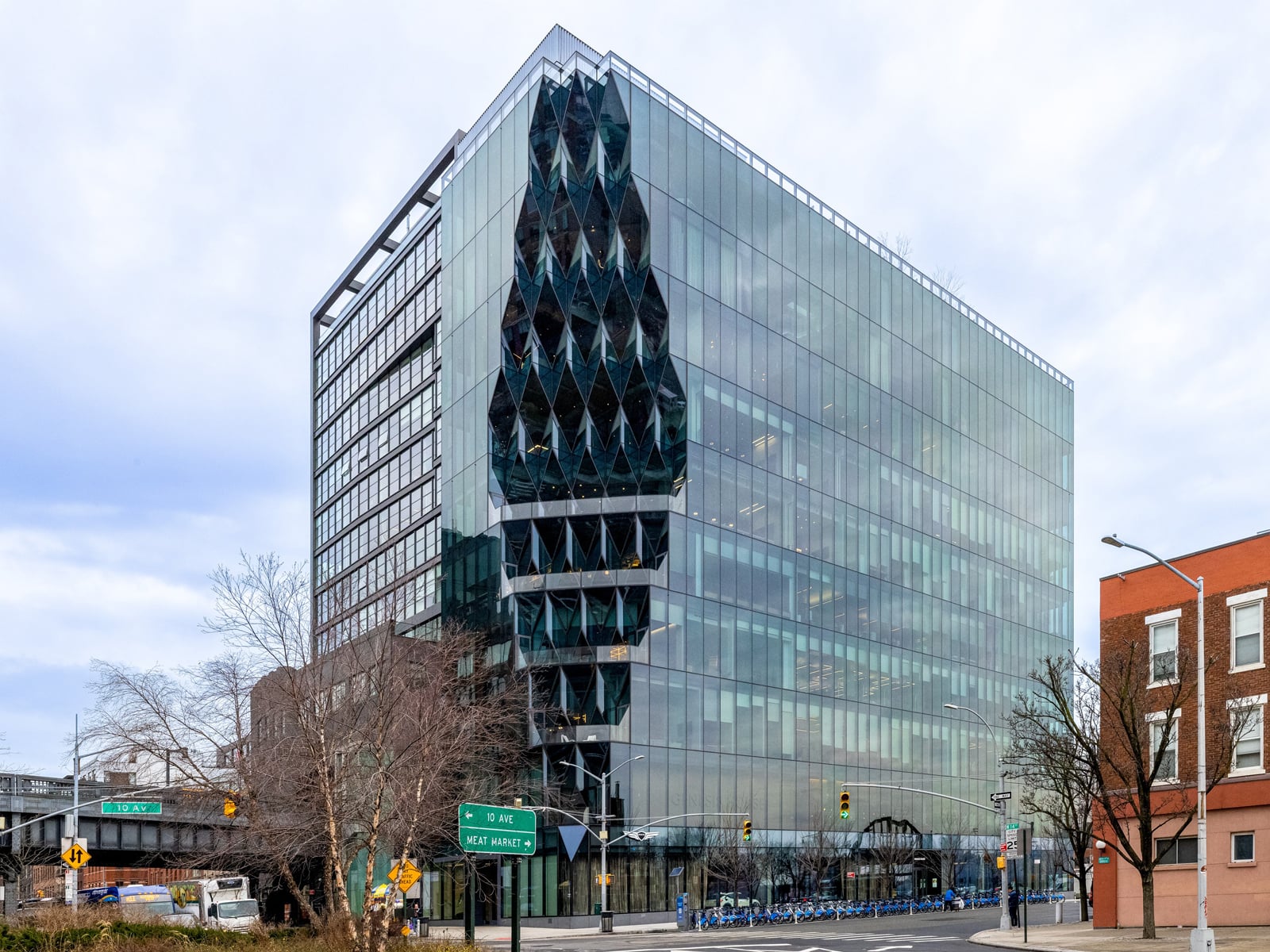
- Brookfield and Qatar Investment Authority also secured a $1.9 billion CMBS refinancing for 2 Manhattan West, a newer Hudson Yards office tower that was more than 96 percent leased as of April.
- Related and Oxford are also reportedly nearing a roughly $1.4 billion CMBS refinancing for 10 Hudson Yards, another highly leased, institutional-quality Manhattan office asset.
What’s driving SASB issuance
The increase in CMBS SASB is being driven by a few factors, according to Buschbom. First, the market has a large refinancing need, and many very large loans are coming due at a time when banks are more selective with balance sheet capacity. Second, SASB gives borrowers access to deep capital markets execution for very large loans that might otherwise require a club of banks or insurance companies. And, when bond spreads are stable, the securitization market can provide greater certainty of execution and efficient pricing for billion-dollar-scale loans.
“For borrowers, the appeal is usually size, execution certainty, non-recourse financing, interest-only structures, and the ability to match a large institutional asset with a broad base of bond investors, Buschbom said.
“The broader takeaway is that CRE debt markets are improving, but unevenly,” he continued. “The securitization market is not saying ‘yes’ to all CRE risk.” It is saying ‘yes’ to specific collateral: trophy office, strong lodging assets, durable retail or net-lease exposure, industrial/logistics and transitional multifamily where the business plan is credible.
“The capital is there, but it is being allocated much more selectively than it was during the low-rate cycle,” Buschbom stated.



You must be logged in to post a comment.