

Office Construction Lags, Coworking Gains Ground
Flex space expands as companies shift away from traditional office leases, while developers scale back office starts.
Coworking continued to expand its footprint, reflecting lasting shifts in the modern workforce’s behavior, according to the latest Yardi Matrix national office report.
The coworking national footprint reached 164 million square feet—a 16.5 percent increase over the past year, while its share of the total office inventory rose to 2.3 percent, up 30 basis points.
Hybrid work solutions are one of the factors driving this growth, which became a sought-after feature for many office workers years after the pandemic. As such, companies reduced their reliance on large, costly and long term leases.
Physical occupancy stood around 55 percent for the past three years, while daily office attendance ranges from 66 percent to 38 percent, depending on the days, according to Kastle’s Back to Work Barometer. Lower office utilization pushed tenants to reconsider renewals or to downsize, leaving owners with limited options as underused properties sell at steep discounts.
READ ALSO: Hybrid Assets Rewrite Net Lease Playbook
Office leasing strategies have evolved accordingly. Owners now offer shorter lease terms, more flexible exit options and even partnerships with established coworking providers for accommodating the needs of smaller tenants. At the same time, disruptive workforce factors such as AI or recession concerns continue to reshape demand. As companies struggle to commit to traditional spaces, smaller, amenity-rich offices have become the top choice.
The national office vacancy rate fell to 17.8 percent as of March—down 210 basis points from a year ago, as vacancy recovery continued among major metros. Austin kept the highest rate in the nation at 26.3 percent despite its 230-basis-point decline from its peak, in April 2025. The high value reflects excess supply that began to slow down only in recent months, as the metro’s pipeline contracts.
Miami recorded the lowest rate nationwide at 12.5 percent, followed by Manhattan’s 13.1 percent. As for vacancy improvements, San Francisco led the charts with a 540-basis-point decline. Markets that followed include Denver (-510 basis points) and the Bay Area (-380 basis points).
Asking rents averaged $32.80 per square foot in March—up one cent from a month ago and down 1.8 percent year-over-year. Manhattan remained the top metro for office rents, with listings reaching $69.80 per square foot, followed by San Francisco’s $62.73 per square foot.
Developers shift focus to medical office
Construction activity for general office space remains low. In 2025, construction starts comprised 21.6 million square feet. General office accounted for 47.6 percent of that volume, while medical office made up 25.8 percent of it and life science 10.9 percent.
Developers significantly reduced general office starts over the past decade, with volumes down 75.9 percent. Slow job growth and remote work being normalized will likely weaken the demand more. In contrast, medical office development proved more resilient, supported by steady job growth in healthcare sectors and high resistance to hybrid work trends. Over the past 10 years, medical office starts fell only 17.3 percent.
The U.S. office pipeline totaled 29 million square feet, representing 0.4 percent of existing stock. Boston office space led development activity, with nearly 4 million square feet under construction, followed by Manhattan with 2.9 million square feet underway and Dallas, with a pipeline of 2.3 million square feet. At the end of the first quarter of 2026, office completions totaled only 4.3 million square feet.
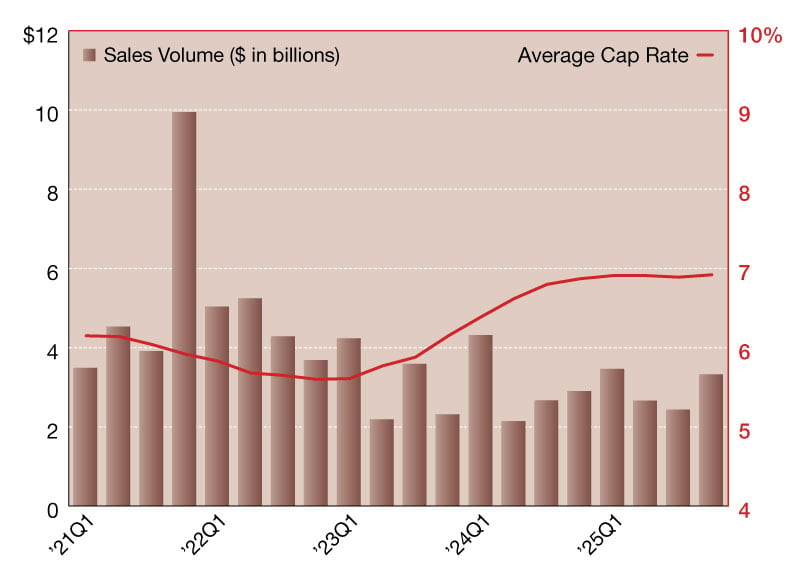
The U.S. office sector saw 549 transactions closed as of March, with assets trading at an average of $220 per square foot, for a total of $12.8 billion. Manhattan led the nation with $1.8 billion in sales, with assets selling at $707 per square foot. However, San Francisco again led for office pricing, with properties selling at $868 per square foot.
Last year, discounts in Los Angeles accounted for 54 percent of office sales based on repeat-sale comparisons. This marked the highest level of discounts, exceeding any year during Covid or the Great Recession. Los Angeles is on track for another record year, with 57 percent of properties selling at a discount as of March.
Read the full Yardi Matrix office report.


You must be logged in to post a comment.