


Climate Risk, CRE Insurance Are Changing the Pro Forma
Property-level scrutiny, lender requirements and questions about future insurability are pushing exposure deeper into the decision-making process.
Premiums, deductibles and coverage terms are pulling physical risk into the CRE pro forma. For owners, lenders and investors, climate risk and CRE insurance are increasingly linked through annual operating costs, loan requirements, acquisition pricing, capital planning and exit assumptions.
Still, insurance remains an imperfect climate-risk signal. Premiums also reflect inflation, reinsurance costs, litigation, construction pricing, claims history and market cycles. But because policies are renewed annually, shifts in those factors can move into property budgets relatively quickly.
U.S. commercial property insurance rate growth slowed from 5.6 percent in the fourth quarter of 2024 to 2.9 percent by the fourth quarter of 2025, according to Stephen Pantano, senior vice president of market transformation at the Urban Land Institute. He cautioned, however, that market cycles are short-lived and that volatility may be felt most acutely by smaller owners whose premiums cannot be spread across large, geographically diverse portfolios.
The new scrutiny is asset-level

The changing relationship between climate risk and CRE insurance is most visible in the level of detail carriers now expect from property owners.
James Stuart, corporate chief sales officer & practice leader for global insurance brokerage Hub International’s real estate specialty in North America, said underwriters are looking at factors including roof age and construction material, major system upgrades, wildfire defensible space and fire scores, crime scores, flood elevation certificates and even brush-clearance photos.
“A few years ago, two similar buildings a mile apart got similar terms. Today, one with hardening documentation can get materially better terms than an untouched twin,” Stuart said. In some cases, carriers even use drones to inspect properties against those criteria.
That puts a premium on verifiable property-level information. Owners increasingly have to demonstrate not only that resilience work has been completed, but what has been done and why it matters for the asset’s risk profile.
More granular underwriting does nor necessarily mean every line of coverage is becoming more expensive. Stuart said property rates softened in many markets in 2025 and 2026, while liability and umbrella coverage remained under pressure from habitability, negligent security, ADA, assault and battery claims and nuclear verdicts.
For physical climate risk, however, greater underwriting scrutiny means tow otherwise similar properties may no longer receive similar treatment. The quality of the asset and the owner’s ability to document it can increasingly influence the options available.
From closing checklist to credit committee
Lenders are applying similar scrutiny as they assess whether insurance adequately protects their collateral.
“There is significantly more attention to insurance by lenders trying to protect their collateral,” Stuart said. “Lenders are asking for carrier financial-strength minimums (A- or better), requesting insurance-to-value studies, and in some cases requiring 100 percent excess coverage as a loan condition. Insurance has moved from a closing-checklist item to an active credit-committee topic.”
READ ALSO: The Future of Green Building
The consequences can extend beyond higher costs. If insurance-to-value falls below actual replacement cost, coverage cannot be obtained or the structure of that coverage raises concerns, a transaction can be delayed, repriced or fail to close. During the life of a loan, coverage issues can also trigger force-placed insurance covenants.
Stuart said lenders have become more attentive after seeing loans underinsured during catastrophic events such as the California wildfires and the floods in the South. Some are now hiring insurance consultants to supplement their own requirements.
The result is a more complicated capital stack. Rising premiums may be the most visible cost, but reduced limits, higher deductibles, carrier-rating concerns and coverage gaps can also affect refinancing assumptions, reserves and loan compliance. In those cases, insurance can shift from an operating expense to a credit issue.
When insurability becomes an investment question

For investors, that credit concern broadens into a question of market liquidity: not only what a property costs to insure today, but what future insurance availability could mean for capital deployment, pricing and exit liquidity.
“There’s a price for everything,” said Uma Moriarity, senior investment strategist & global head of sustainability at CenterSquare Investment Management. “I do think the market is under-appreciating the potential systemic risk of the potential lack of insurance availability in certain markets that are experiencing today, or could experience in the future, outsized and consistent climate-related damages.”
The concern is market depth. If buyers, lenders and insurers become more selective in a region, an asset’s future exit may become harder to underwrite even if its current premium can still be absorbed.
How investors account for that risk varies by property type, lease structure and strategy, said Moriarity. The effects of physical damage and business interruption, for example, differs between a multifamily property and a triple-net-leased, single-tenant industrial asset.
She also sees a disconnect in public markets. Although REITs can theoretically reflect new information in real time, many investors tend to react after named storms or other events affect earnings rather than proactively incorporating those risks across large portfolios. Investors that evaluate them earlier may be able to identify missed opportunities.
Past experience may also become a less reliable guide in markets where insurance capacity is changing.
“The insurance market has only so much capacity to absorb rising climate risks,” said Moriarity. “We’ve already seen several instances where insurance companies are exiting certain markets. The insurability of certain markets is a systemic risk that is likely being underestimated by many who are simply depending on outdated historical data to make decisions.”
Turning resilience into an underwriting advantage

Against that broader uncertainty, one of the few variables owners can influence directly is the resilience of the asset itself and their ability to demonstrate it to insurers.
Pantano said making resilience a more routine part of underwriting requires earlier coordination among risk management, acquisition due diligence, asset management, investor reporting and insurance brokers.
Standardization may help. He pointed to tools such as ASTM’s Property Resilience Assessment for evaluating physical climate and natural hazard risk, as well as ULI’s CRE Guide to Natural Hazards and Property Insurance Underwriting, which identifies more than 50 data points tied to climate and environmental hazards and their potential premium impact.
Pantano said evidence suggests owners and investors that collect and share detailed construction, occupancy, protection and exposure data with insurers can see lower premiums and expanded coverage.
Stuart likewise sees resilience and hardening investments as one of the levers owners can pull, but only when insurers can verify the work. “Gone are the days ‘we plan to.’ Documentation and third-party certification—such as Wildfire Prepared or IBHS FORTIFIED—carry more weight than a narrative,” he said.
Resilience starts early

Documentation can help owners demonstrate resilience to insurers, but the underlying decisions that shape an asset’s exposure often happen much earlier.
Katie Mesia, design resilience leader & principal at Gensler, said location is often the single largest driver of climate exposure.
“Once a project enters design, several risks and opportunities have already been accepted, either explicitly or implicitly,” Mesia said.
If a massing concept is approved, a structural grid fixed or a major building system chosen before climate implications are evaluated, the range of available responses can narrow quickly.
Mesia groups hazards and responses into three categories: what a project can control, what it can influence and what it needs to prepare for.
A project may control whether onsite solar can charge batteries capable of keeping critical loads online. Wildfire resilience may depend partly on neighboring property owners and the surrounding community. Sea-level rise, once a site has been selected, may instead require decisions around ground-floor elevation, vulnerable uses, access and critical equipment.
This framework also forces owners to define what resilience means for the asset. An investor may prioritize whether the structure and floorplate preserve long-term optionality. An operator may care about shortening recovery after a storm. An employer may want a workplace that can function as a temporary haven during extreme heat, smoke or power outages.

Gensler transformed a late 1980’s Richard Seifert-designed brutalist building in London into a modern and sustainable workplace. Through the retrofit approach, new retail frontages and accessible entrances on Long Acre and Endell Street now seamlessly knit into Covent Garden’s urban fabric. All images courtesy of Hufton + Crow via Gensler 
At the centre of The Acre is a seven-storey naturally ventilated atrium, a civic heart that draws daylight deep into the plan. 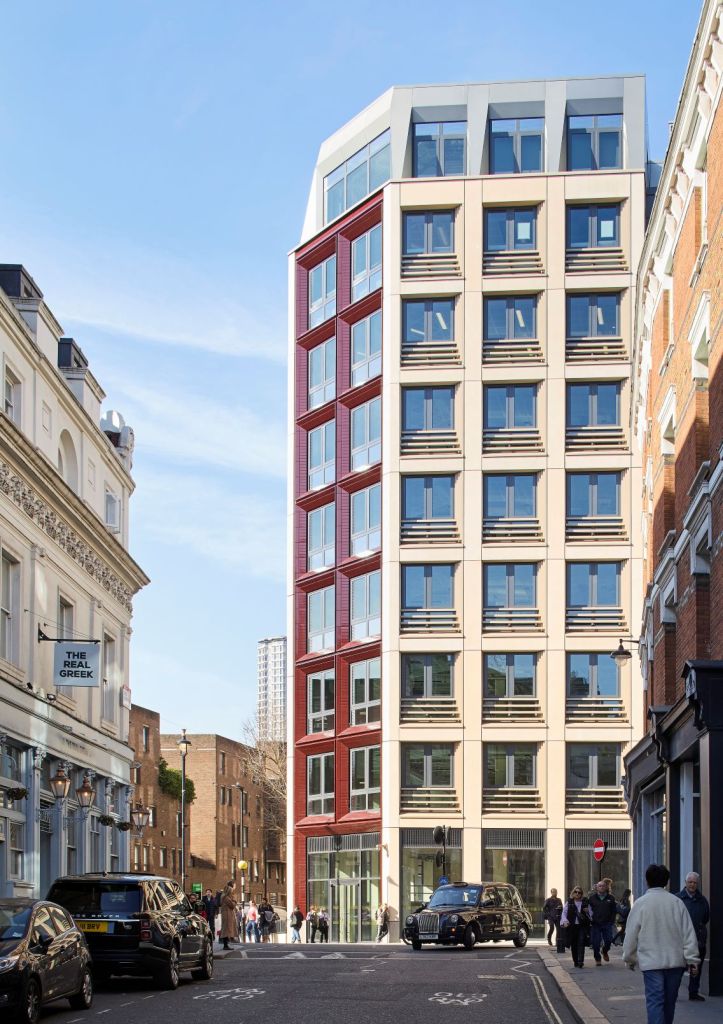
Once defined by its inward-facing character, The Acre now engages more openly with its surroundings. Gensler’s interventions reorientate key areas to seamlessly connect the existing structures.
For existing properties, that distinction is particularly important because resilience improvements often have to be phased across multiple capital cycles.
“Every capital project is also a resilience decision, whether the team frames it that way or not,” Mesia said. “When an owner cannot complete every improvement at once, the work undertaken today should advance the longer-term strategy without making future adaptation unnecessarily difficult.”
The risk is bigger than the premium
Those capital decisions affect not only how a property performs during and event, but how much risk ultimately remains with the owner. Higher deductibles, reduced limits and narrower coverage can shift more of that exposure back onto the asset even when insurance remains available.
“Insurance is no longer a fixed operating line item,” Stuart said. “It’s a significant variable that affects loan terms, exit valuation and hold-period IRR.”
Lower sublimits for items such as building ordinance coverage, for example, may leave owners with more retained risk than they realize, potentially influencing refinancing terms and cap-rate expectations at sale.
The same compounding effect can occur on the physical side of the asset.
“The larger concern is cumulative attrition,” Mesia said. “Resilience is rarely eliminated through one explicit decision. It is more often weakened gradually as individual measures are reduced without reconsidering their combined effect.”
The implications vary across the industry. Investors are weighing whether insurance availability could become a systemic market issue. Owners are being asked for better data and documentation. Lenders are scrutinizing coverage more closely, while design teams are trying to preserve options before key decisions become difficult or expensive to reverse.
The throughline is that insurance does not capture the full cost of physical climate risk, nor is it the only signal owners should watch. But because it increasingly touches annual expenses, coverage availability, financing, capital planning and exit assumptions, renewal season is too late to begin understanding an asset’s risk story.
For owners, the work starts with identifying exposure, documenting mitigation, coordinating with lenders and brokers early on, and treating each capital project as part of a longer resilience strategy. As climate risk and CRE insurance become more closely tied, properties that can explain their exposure—and demonstrate what has been done to manage it—may be better positioned than those that simply hope the next renewal comes in close to budget.

You must be logged in to post a comment.