
How the World Cup Boosts CRE in Secondary Markets
From Kansas City to Philadelphia to Atlanta, the 2026 FIFA tournament is reshaping commercial real estate in host cities.
This article first appeared in the CPE Sneak Peek Newsletter. Subscribe now for early access to exclusive content, in-depth analysis and key trends!
When the FIFA World Cup 2026 arrives in the U.S. this week, its impact on commercial real estate in host cities will extend far beyond global gateway markets.
Some of the most compelling and measurable effects of the World Cup impact are expected to emerge in a tier of high-growth, secondary markets where the tournament intersects with existing development momentum, infrastructure investment and evolving urban identity.
Markets such as Kansas City, Philadelphia and Atlanta offer three distinct but complementary case studies of the World Cup’s impact on U.S. secondary markets. Each combines a strong sports culture with an active commercial real estate pipeline, yet they differ in scale, maturity and positioning within the national investment landscape. For these markets, the World Cup is not simply a short-term demand driver—it’s a stress test, a deadline and, in some cases, a global coming-out moment.
READ ALSO: Inside Atlanta’s South Downtown Comeback
Across the hospitality, retail and mixed-use sectors, the tournament is expected to generate a sharp surge in demand, driving hotel occupancy and guestroom rates, increasing foot traffic in entertainment districts and accelerating leasing activity tied to experiential concepts.
But the longer-term implications of the World Cup impact may prove more significant.
From transit-oriented development in Kansas City to legacy infrastructure optimization in Philadelphia and large-scale mixed-use expansion in Atlanta, the event is amplifying trends already underway rather than creating them from scratch. That dynamic is what makes these markets particularly instructive.
Kansas City
Kansas City may be the smallest U.S. host market for the tournament, but from a commercial real estate perspective, it could capture some of the most outsize gains. With six matches scheduled—including a quarterfinal—the event is compressing years of visibility, investment momentum and tenant demand into a matter of weeks, creating a rare inflection point for a historically overlooked market.
What distinguishes Kansas City is not just the scale of the event but how it aligns with a decade-long urban revival centered on infrastructure and placemaking. The expansion of the KC Streetcar—including its 2025 Main Street extension linking the downtown to the University of Missouri–Kansas City—has reshaped development patterns, concentrating activity along a transit spine that connects the central business district, Midtown and the Plaza. That connectivity is expected to play a defining role during the tournament.
“In terms of retail and hospitality, the impact will vary from ‘busiest ever seen’ in the CBD, Midtown and Plaza areas along the Streetcar to ‘short periods of great performance’ in other parts of the city,” Matt Nevinger, research director at Cushman & Wakefield, told Commercial Property Executive.
Hospitality fundamentals are already reflecting the World Cup’s impact, particularly in hotel occupancy and guestroom rates. This will be one of the longest periods of sustained hotel demand Kansas City has ever seen, Nevinger noted, citing early booking data with rates running at roughly three times typical levels. While that spike will likely skew annual metrics, it also validates a wave of recent hotel development and renovation activity across the urban core.
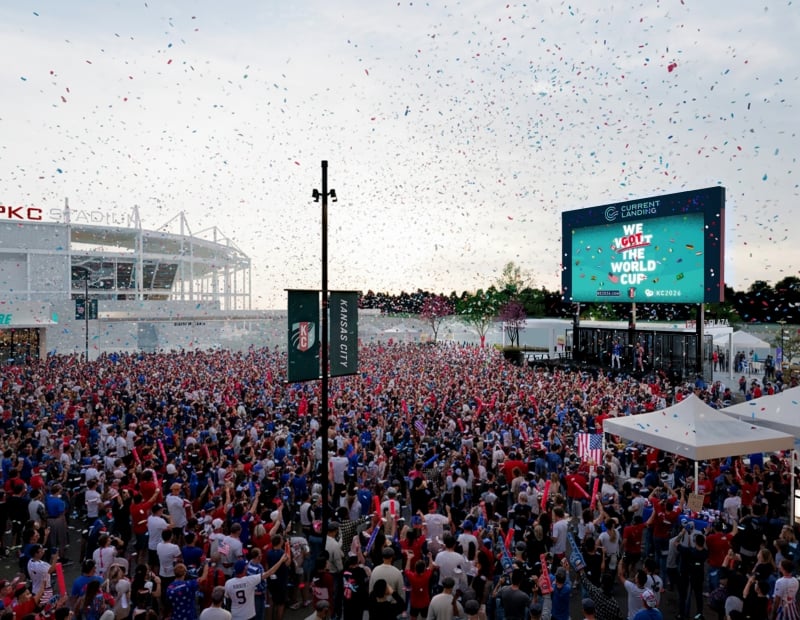
At the same time, the World Cup is accelerating timelines and leasing strategies across mixed-use developments, particularly along the riverfront. At Current Landing, a $1 billion sports-anchored district adjacent to CPKC Stadium, developers are fast-tracking delivery to capitalize on global exposure.
“We intentionally accelerated Current Landing’s Phase I plans to meet the moment for the World Cup’s influx of visitors,” said Mukul Sharma, partner at Palmer Square Real Estate Management. “It is important to showcase a vibrant riverfront to the world, and our construction timeline has been intentional about presenting as complete of a project as possible for guests to our city.”
Retail strategies are evolving in parallel, consistent with current retail trends.
“Several of our retail partners are also accelerating their plans to open during the World Cup or host pop-ups to meet international demand,” Sharma added, underscoring how short-term activations are becoming a defining feature of leasing activity tied to the event.
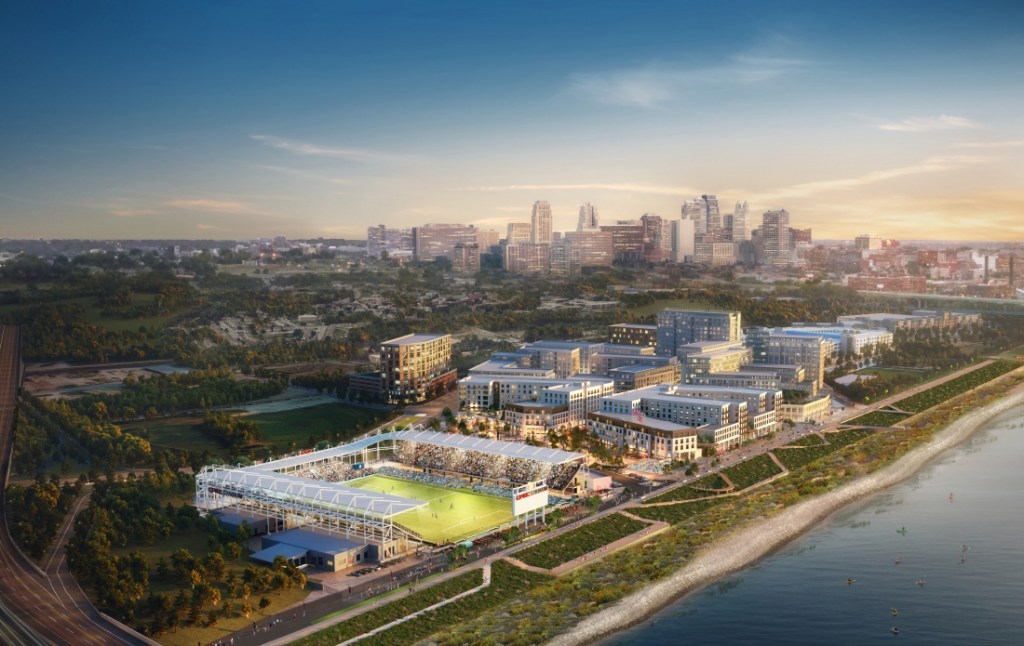
In Kansas City, Current Landing’s activated waterfront, pedestrian pathways and public gathering spaces will draw visitors during the FIFA World Cup and beyond. All renderings courtesy of Current Landing 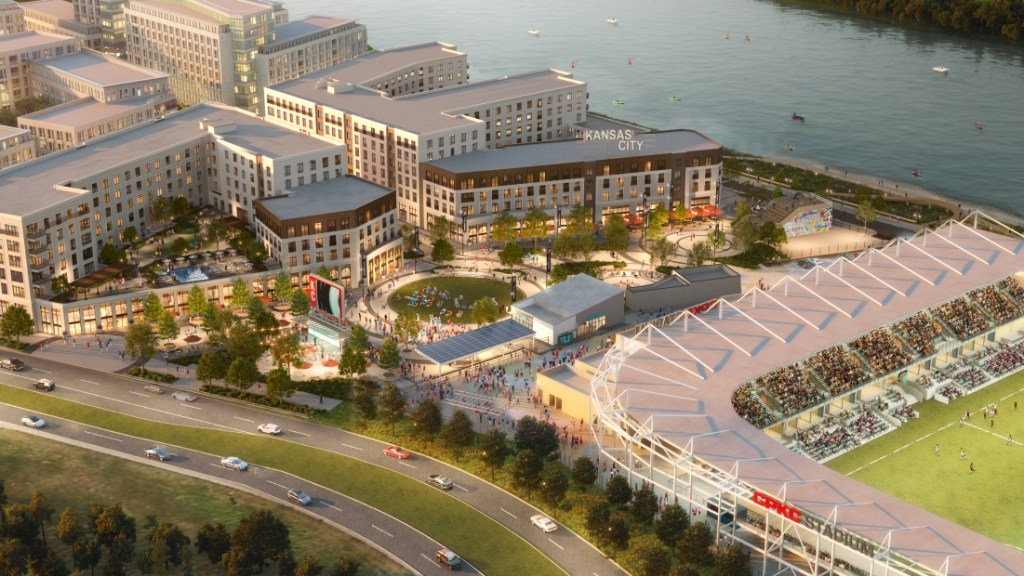
The $1 billion, 40-acre mixed-use district features residential, retail, hospitality and public spaces anchored by CPKC Stadium 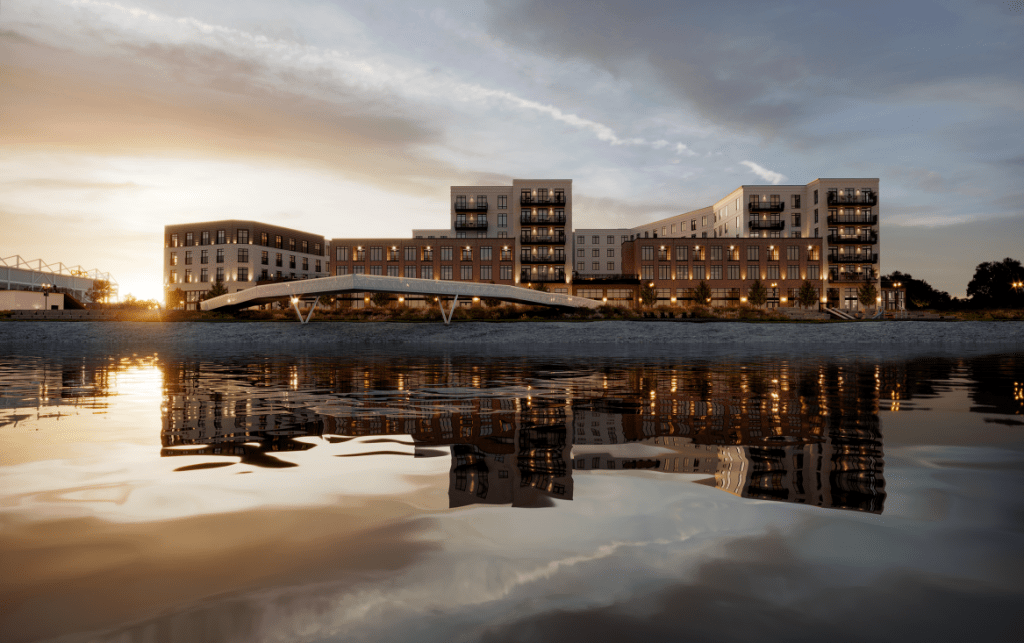
The project integrates flood-resilient infrastructure with flexible gathering spaces for events and everyday use 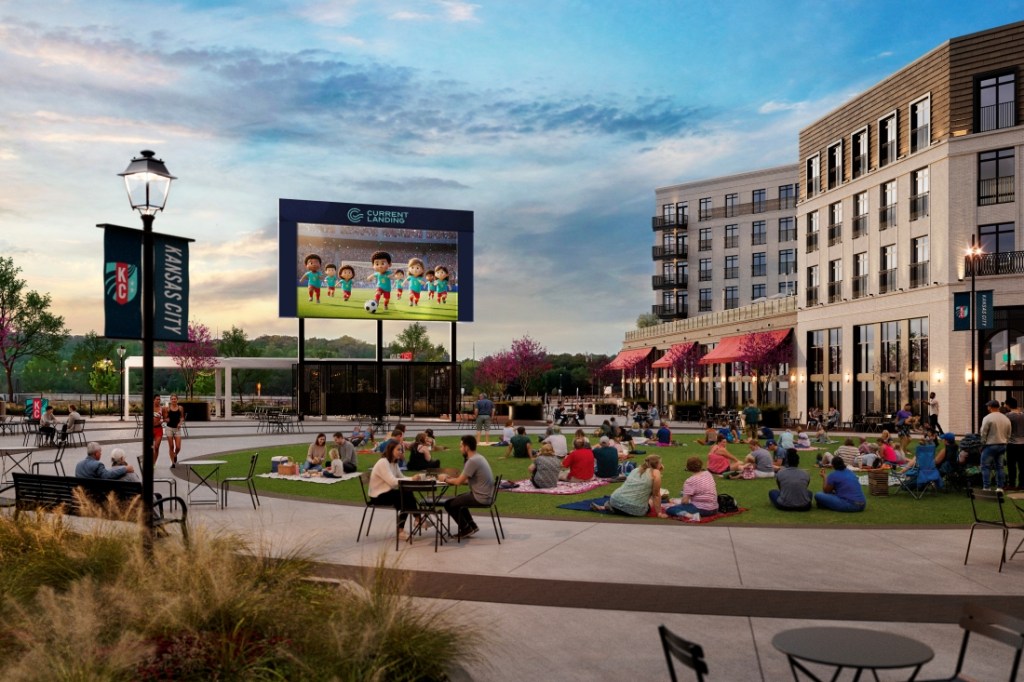
An outdoor movie night showcases the district’s flexible event spaces and community-driven programming 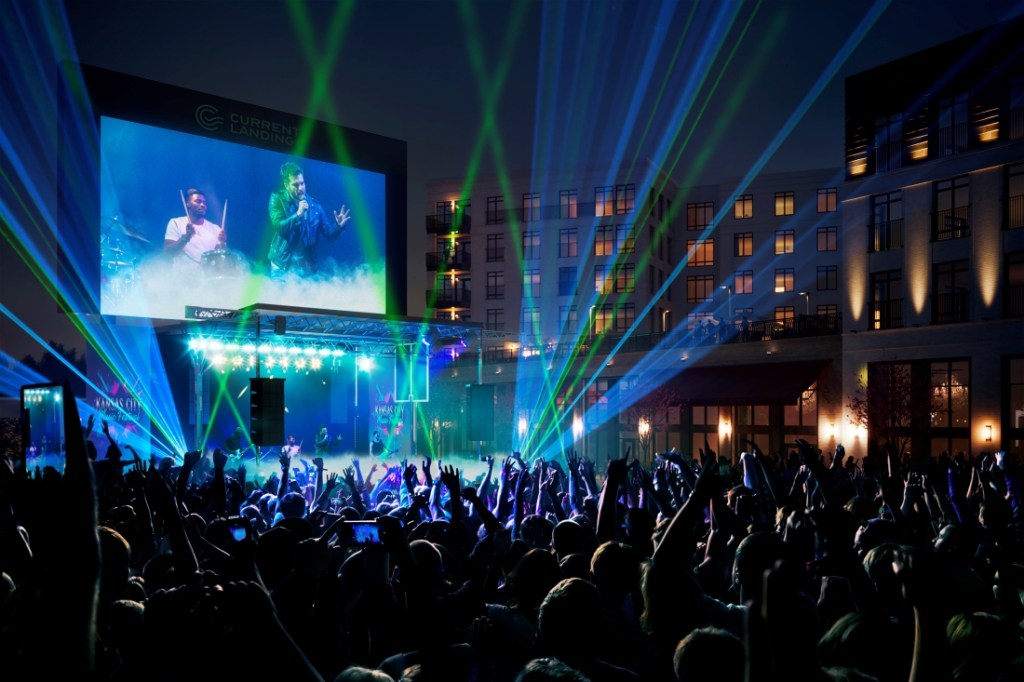
The project’s role is also as a dynamic entertainment hub designed to host large-scale events 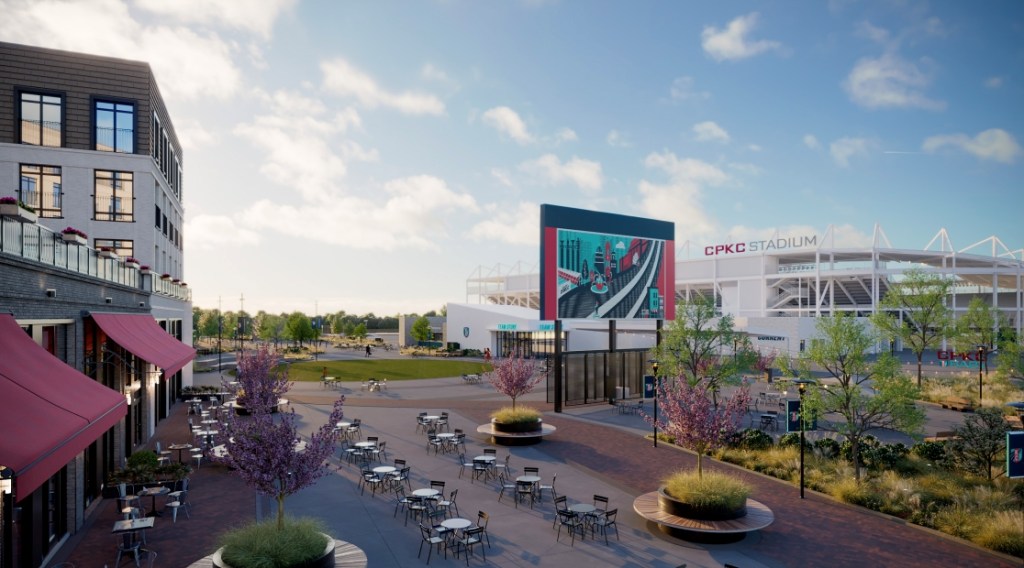
Current Landing’s central gathering spaces are designed to host fans and activate the riverfront during the FIFA World Cup 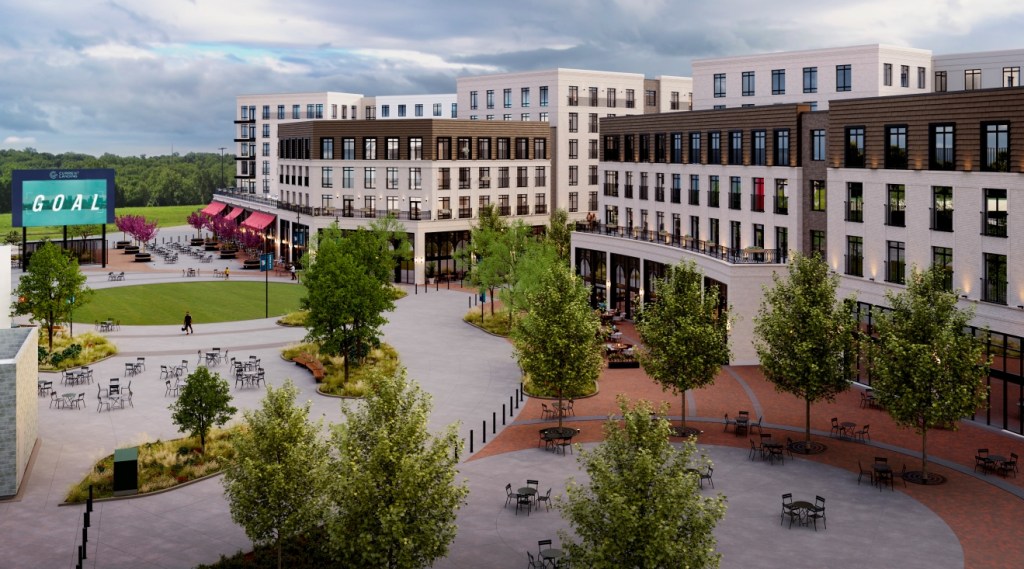
The Town Square represents the central civic gathering space designed for large-scale events, pedestrian circulation and World Cup activations 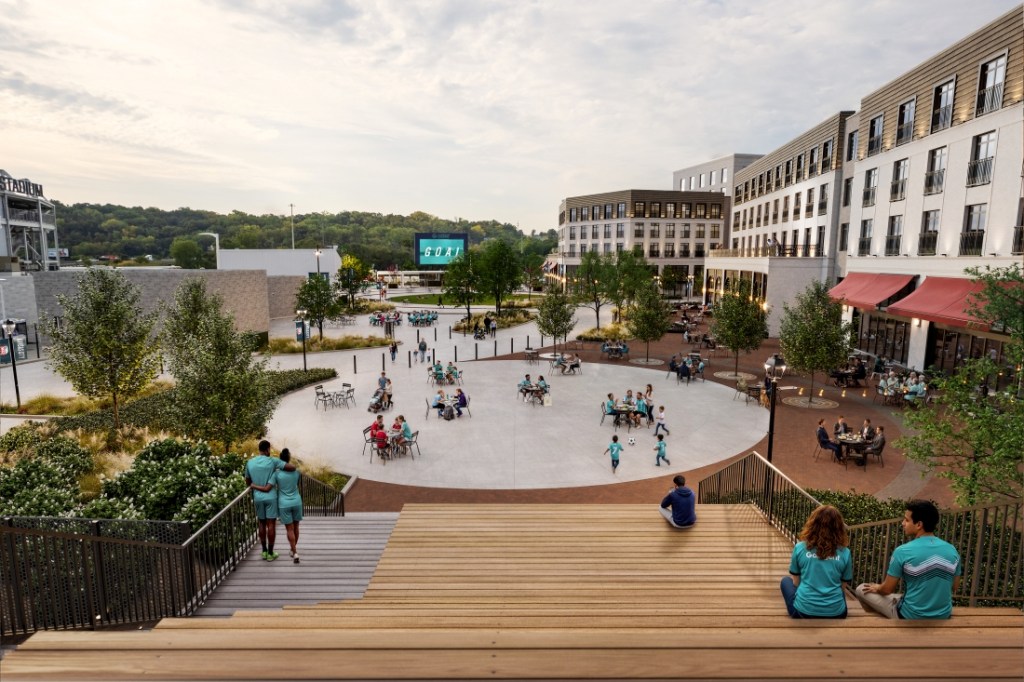
The Pump Station is located to highlight the landscape design, as well as enhance view corridors of Strand Street 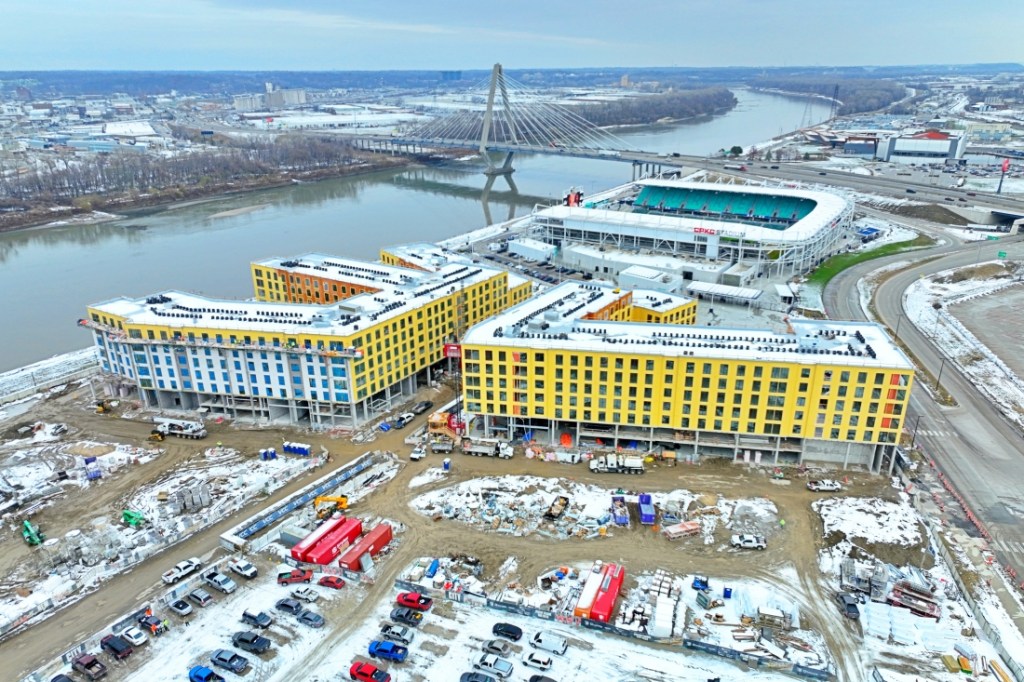
The ongoing buildout of Current Landing’s mixed-use waterfront district includes phased development blocks, infrastructure upgrades and early-stage structures
Beyond ground-up development, the tournament is also intersecting with a growing wave of adaptive reuse, particularly in the downtown area, where older building stock is being repositioned for new uses. For developers like Molzer Development, the World Cup is both a stress test and a catalyst.
The company’s projects—including the conversion of the historic Aladdin Hotel and the repositioning of the Holtman Building into luxury apartments with a rooftop bar—highlight how adaptive reuse is shaping Kansas City’s next development cycle.
“In the short term, businesses such as bars and restaurants will see an immediate uptick in activity. But the World Cup isn’t the end point—it’s the starting point. It has the potential to become a true catalyst for Kansas City’s long-term growth,” said Zach Molzer, founder of Molzer Development. He also emphasized the need for continued investment in public transit, infrastructure, housing, and local and small businesses.
Even projects not fully delivered in time for the tournament are being shaped by its presence. “The Aladdin will be open in mid-July, so we’ll obviously continue being under construction during the World Cup,” Molzer noted, adding that timelines were structured to minimize disruption rather than chase short-term revenue. Meanwhile, the Holtman Building is expected to come online just ahead of kickoff, contributing to the surge in experiential retail and nightlife offerings.
That long-term upside is ultimately what sets Kansas City apart. The World Cup is not creating a development story from scratch, but rather amplifying one already in motion. With strengthened infrastructure, a growing pipeline of mixed-use and adaptive reuse projects, and unprecedented global exposure, the city is positioning itself not just for a successful tournament but for a sustained evolution in how investors, tenants and visitors perceive its potential.
Philadelphia
If Kansas City illustrates how the World Cup impact can elevate an underestimated market, Philadelphia shows how a mature secondary market uses the tournament to reinforce—not reinvent—its commercial real estate narrative.
As one of the most established U.S. secondary markets, Philadelphia’s advantage lies in its deep infrastructure, dense urban core and a sports-anchored development ecosystem centered around Lincoln Financial Field and the broader South Philadelphia complex.
That distinction is shaping how the World Cup is influencing commercial real estate across the city.
“From a commercial real estate perspective, 2026 represents a defining moment for Philadelphia, with the World Cup serving as a global platform that reinforces the city’s position as a mature, event-capable market,” said Megan Moyer, real estate attorney at Saul Ewing. “The city already has the core infrastructure, hospitality base and urban density needed to support an event of this magnitude, allowing activity to build on existing fundamentals rather than respond to a short-term catalyst.”
The World Cup’s effect on hospitality underscores how large-scale events can influence commercial real estate performance without fundamentally altering an already mature market.
READ ALSO: Where Opportunity Lies in 2026
That “build-on-what-exists” dynamic is evident across sectors, particularly in hospitality. Philadelphia is entering what could be a record-setting year, driven not only by the World Cup but also by a convergence of major events and national celebrations.
“Philadelphia’s hotel market is on the cusp of an unprecedented year in 2026, with a convergence of major sporting events and national celebrations expected to drive record-breaking tourism and economic impact,” Christine Bang, manager of hotel capital markets research at JLL, told CPE. “While the influx should support strong hotel occupancy, the event’s most significant impact will be a pronounced increase in average daily rates, which will be the primary driver of RevPAR growth for the year,” she added.
With six matches scheduled—including a round of 16 games coinciding with July 4 celebrations—Philadelphia is expected to see a concentrated spike in pricing power, alongside extended stays from international visitors. That demand will ripple beyond hotels, tightening short-term rental inventory and boosting performance across retail, food-and-beverage and entertainment venues, particularly in Center City and transit-linked corridors.
It is also reshaping how the market accommodates that demand—particularly through flexible living formats. “We expect a meaningful short-term demand surge across hospitality and mixed-use assets, with multifamily and particularly furnished, flexible-stay product playing a complementary and increasingly important role,” said Ross McAlpine, furnished marketing senior director at AVE by Korman Communities.
One of Korman Communities’ recently completed projects, AVE Navy Yard, is part of Philadelphia’s emerging flexible-stay and mixed-use ecosystem, strategically positioned to absorb World Cup 2026-driven demand from extended-stay visitors, media crews and corporate guests as the nearby stadium district experiences a surge in global activity. The development at the Navy Yard is a two-building, $285 million project with 614 units delivered in March.
“Large-scale global events compress hotel inventory quickly, pushing overflow demand into alternative accommodations while activating mixed-use districts as hubs for dining, entertainment and experiential retail,” McAlpine added.
Beyond the urban core, that demand is expected to extend into surrounding submarkets. “Center City and stadium-adjacent corridors will be the primary demand epicenters, but we expect meaningful spillover into suburban submarkets,” McAlpine said, highlighting the role of accessibility, space and value in shaping where different visitor segments choose to stay.
Still, unlike smaller host markets, Philadelphia is not undergoing a fundamental reshaping. “The impact on hospitality and mixed-use is likely to be incremental rather than transformative. Philadelphia already has a strong base of hotels and mixed-use assets, so the emphasis is on upgrades, adaptive reuse and repositioning,” Moyer noted.
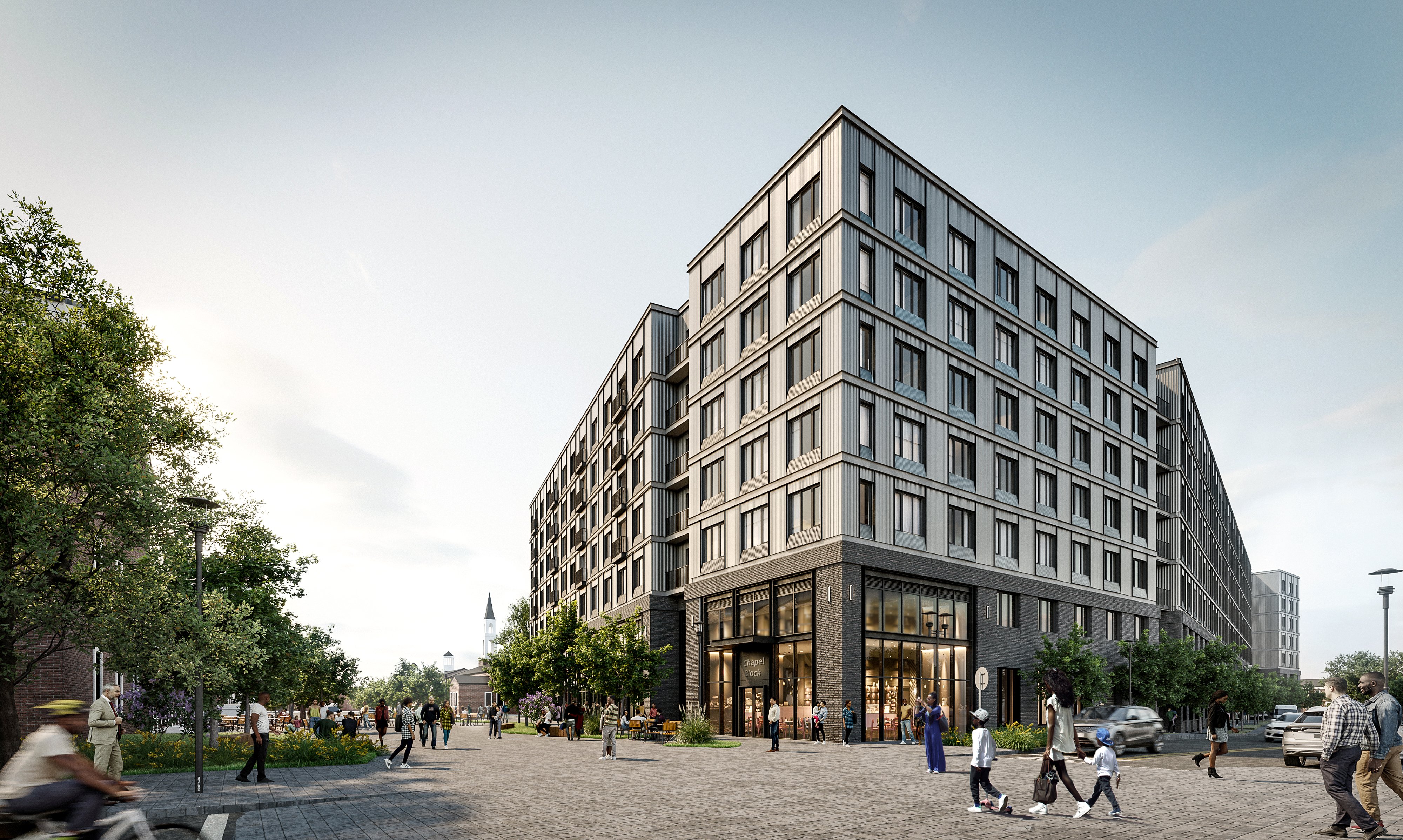
That incremental growth is unfolding alongside a broader wave of large-scale redevelopment.
“The stadium district, the emerging Bellwether District and the Navy Yard represent areas where significant transformation is already underway,” said Jim Galbally, senior managing director & co-head of capital markets in Philadelphia at JLL. Projects like the Bellwether District—a massive redevelopment of a former refinery site—and the continued evolution of the Navy Yard into a mixed-use, live-work-play environment are reshaping the city’s long-term growth trajectory independent of the World Cup.
Retail corridors are also benefiting from this underlying momentum. Galbally pointed to Rittenhouse Row as “one of North America’s premier retail destinations,” noting that the arrival of digitally native brands along Walnut Street reflects Philadelphia’s growing appeal as a retail investment market. While the World Cup may act as a short-term catalyst for these districts, the fundamentals are already driving activity.
Connectivity remains another defining advantage. Located along the Northeast Corridor, Philadelphia benefits from direct rail access to New York City and Washington, D.C., enabling significant tourism spillover during the tournament. Combined with its international airport and extensive transit network, that accessibility reduces execution risk and enhances the city’s ability to absorb large-scale demand.
Ultimately, the World Cup’s impact on Philadelphia is less about transformation and more about amplification.
“What makes 2026 so important is that it is both an opportunity and a statement,” Moyer added. “It is valuable because it highlights the strength of a city that is already built for major events.”
That positioning could prove critical long after the final match.
“Successfully hosting World Cup matches is likely to elevate Philadelphia’s status as a top-tier destination, enhancing its brand recognition and appeal to global and domestic travelers, serving as a precedent for future large-scale events like the Super Bowl, political conventions and international conferences,” Bang noted.

Atlanta
If Philadelphia represents legacy and Kansas City momentum, Atlanta sits somewhere in between—a high-growth Sun Belt market where the World Cup impact is accelerating an already powerful development trajectory. Anchored by matches at Mercedes-Benz Stadium, the city is leveraging the event to amplify its position as a hub for culture, commerce and large-scale investment across the Southeast.
Unlike smaller host markets, Atlanta enters the World Cup cycle with significant growth already underway, particularly in its urban core. Major projects like the $5 billion Centennial Yards are reshaping the downtown area with new residential, office, retail and hospitality components, while adjacent districts continue to evolve through a mix of adaptive reuse and ground-up development. The result? A layered commercial real estate story where the World Cup acts less as a catalyst and more as a schedule setter.
“The World Cup is providing a deadline that has accelerated some projects’ completion timelines,” said Chris Ahrenkiel, managing principal of Cushman & Wakefield. “Hotels will get a boost, as will retailers. Office and mixed-use are less affected. The city is focusing on infrastructure projects like repaving, lighting, bike and pedestrian lanes, and has made considerable progress in the past year.”
That infrastructure push is particularly important given Atlanta’s scale and reliance on connectivity. While the downtown will serve as the primary hub during the tournament—with eight matches and fan events concentrated around Centennial Olympic Park—the impact is expected to extend across multiple districts.
“Naturally, the areas downtown will benefit on game days, but the high-end dining and retail mecca of Buckhead and the cool, trendy restaurants on the BeltLine will also benefit significantly,” Ahrenkiel added.
Hospitality fundamentals are already reflecting that expected surge. Hotels have dynamic pricing, and major events like this allow them to significantly increase daily rates. Short-term rentals will benefit as well, Ahrenkiel noted, pointing to a familiar pattern in large event-driven markets—sharp but temporary spikes in performance metrics, particularly in average daily rate.
At the same time, Atlanta’s retail and entertainment landscape is uniquely positioned to capture that demand, thanks to a mix of destination-driven assets and experiential districts. Ponce City Market, owned by Jamestown, is expected to serve as a key gathering point for visitors, with its food hall, rooftop attractions and direct access to the Atlanta BeltLine creating a natural spillover environment between matches.
Downtown, however, remains the epicenter of activity—and increasingly, of experiential real estate strategies.
“Hotels, restaurants, bars and entertainment venues should see the earliest and most visible upside,” said Stephen de Haan, founder & chairman of RPB Management Group. “The official Atlanta World Cup planning has already centered key visitor activity in the downtown … which should create sustained movement through the downtown core rather than a single game-day spike.”
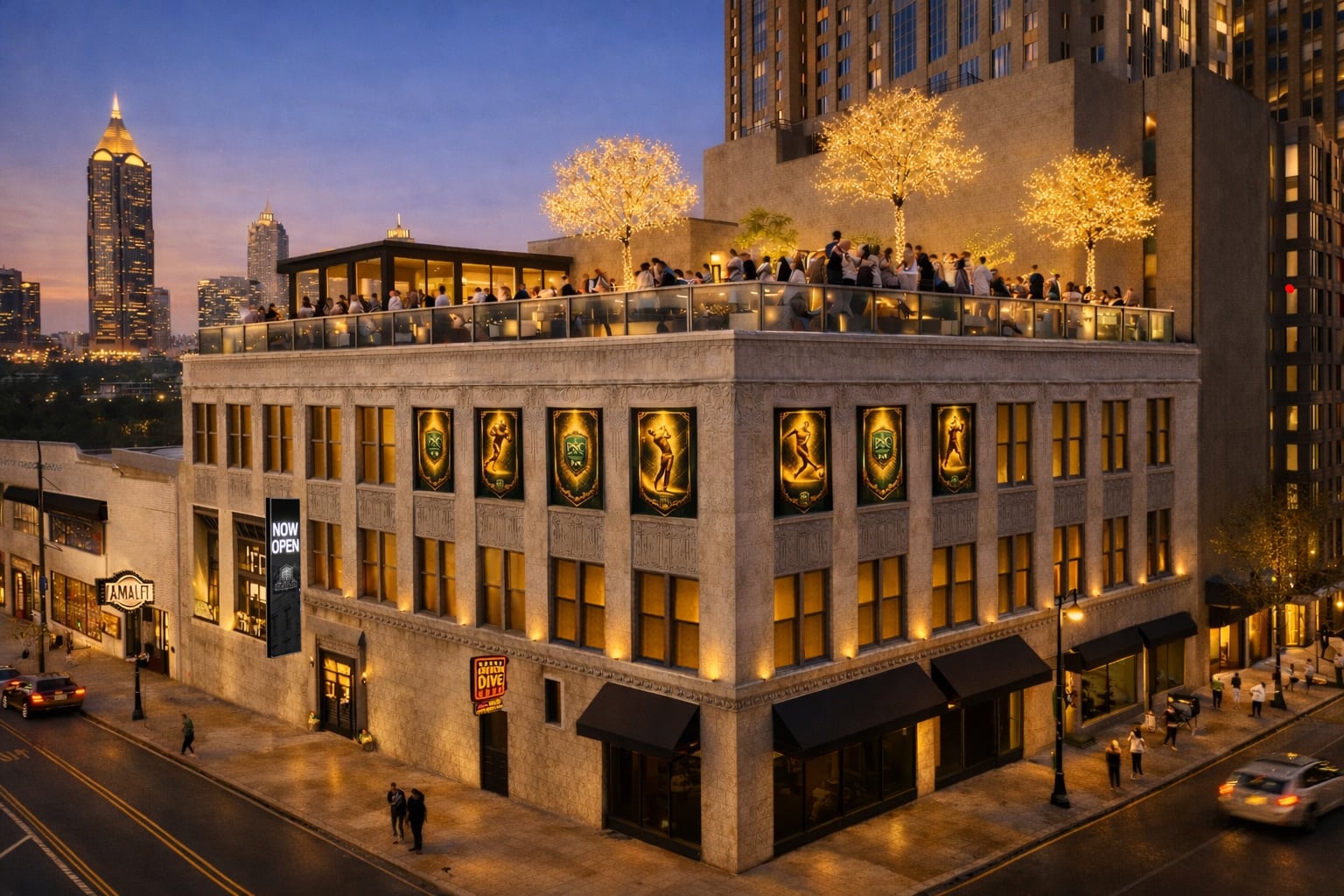
That sustained flow is driving a shift toward flexible, multi-use concepts. At 207 Peachtree, a hospitality-driven campus, operators are leaning into diversity of experience rather than single-use tenancy.
“What makes 207 Peachtree unique is that it is designed as one address with six distinct experiences … from Italian dinners and craft cocktails to watch parties, live music, rooftop gatherings and large private events,” said de Haan. “We expect that mix to matter during a major event because visitors do not all want the same thing at the same time.”
The World Cup is also reinforcing Atlanta’s position as a global gateway, particularly for corporate and institutional capital.
“It’s an excellent opportunity to brand our city to international companies and prospects,” Ahrenkiel noted, highlighting efforts by local organizations to showcase the region’s diverse neighborhoods and economic strengths.
Long term, that visibility may prove more valuable than the immediate demand surge. The long game is just as important as the event itself, according to de Haan. “If Atlanta uses this moment well, the long-term benefit is not just a few strong weeks in 2026. It is a stronger case for investing in downtown experiences that bring people back repeatedly.”
In that sense, Atlanta’s World Cup story is less about transformation and more about acceleration—of projects, of perception and of its emergence as a globally recognized, experience-driven commercial real estate market.
The World Cup’s impact on commercial real estate may not be defined by how much is built in preparation for 2026 but by how effectively these cities convert a few weeks of international visibility into sustained investment, tenant demand and urban growth.

You must be logged in to post a comment.