

High-Street Retail Regains Traction in the ‘New’ Downtown
As CBDs evolve, there will be more shoppers and more opportunities to serve them.
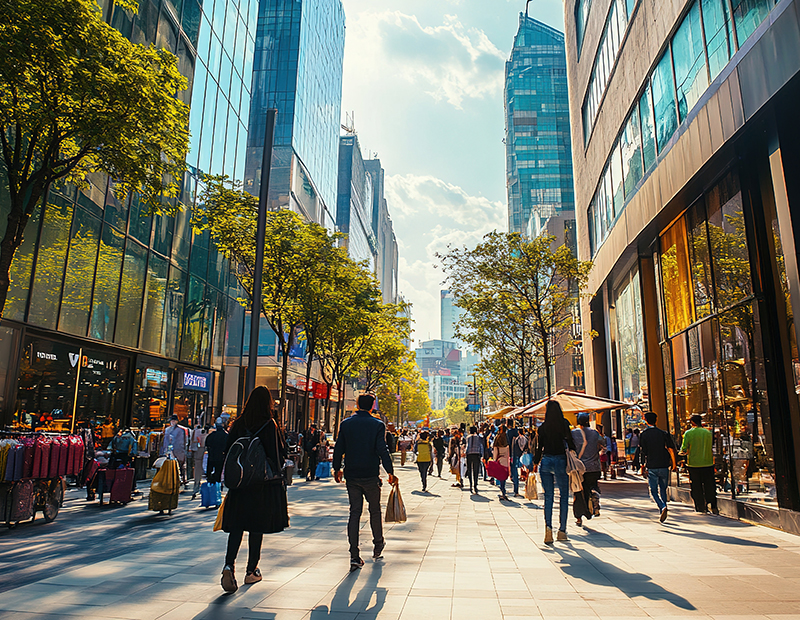
High-street retail in urban core markets has suffered along with office properties under hybrid and distributed workforce policies. But both sectors appear to be on the path to recovery.
Following the pandemic, high vacancy plagued major urban retail markets. In San Francisco’s Union Square/Post Street shopping district and Washington, D.C.’s central business district, for example, rental rates dropped by 30 to 50 percent in the aftermath of the pandemic.
Meanwhile, in D.C., for example, strong suburban retail markets and other urban submarkets like Georgetown and the 14th Street submarkets saw improved leasing because CBD retailers relocated to where the majority of the population lived, noted Michael Zacharia, CBRE executive vice president of retail for the D.C. region. Tighter vacancies and rising rents in the popular suburbs and other urban markets also led investors to refocus their efforts there, noted a CBRE report.
LIKE THIS CONTENT? Subscribe to the CPE Capital Markets Newsletter
Generally speaking, fewer retail establishments in the CBD has resulted in a bifurcated investment market, pointed out Meghann Martindale, a principal leading retail market intelligence at Avison Young. Investors have become much more selective about core downtown and high street retail deals due to higher leasing risk, more TI/commissioning costs, longer downtime and more underwriting around foot-traffic recovery.
“Capital has migrated toward mixed-use with more necessity-based and resilient retail in dense urban areas,” Martindale continued, noting that private investors are leading the riskier deals that require more value-add, repositioning and/or redevelopment.
CBD drivers return

But main-on-main retail is now showing signs of recovery as office occupancy increases and tourists return, according to Martindale. “Retail is following the office re-occupancy,” she said. “Unless there is a strong residential population or strong tourism, office occupancy and vibrancy is typically the key demand driver in urban cores for daytime and early evening retail.”
In D.C., office occupancy is up to 70 percent of pre-pandemic levels and expected to reach 80 to 90 percent next year, Zacharia noted, and that has led to an uptick for CBD retail. “Experiential, engaging retail activity is the driver in many deals,” he said.
Tourism is also helping to boost retail in core urban markets. “Domestic tourism bounced back first, but business tourism/conventions are still recovering, and international tourism has disproportionately impacted luxury, high-street and flagship corridors,” Martindale shared.
But higher operating costs—labor, insurance, utilities, common-area maintenance, security and rent in select markets—are adding pressure on viability for small businesses and mid-tier restaurants, she added.
“Downtown retail doesn’t necessarily need 100 percent office occupancy to work, but it does need consistency to plan operations, labor and products,” Martindale explained. “If the area is still limited in traffic or dayparts, the retail needs to become a destination others will frequent—not just convenience for surrounding employees.”
According to multiple industry resources, most urban core retail markets are seeing improvement in vacancy as well as rents. Manhattan retail rents are now just 8 percent below 2019 levels, downtown retail markets in San Francisco, Washington, D.C., and Chicago are 20 to 25 percent lower than pre-COVID figures and Seattle rents are just 13 to 14 percent lower—up from a 59-percent drop post-pandemic.
Los Angeles is an outlier, with downtown rental rates remaining stable throughout and following the pandemic, most likely because CBD retail offerings there consist mostly of essential retail and neighborhood services rather than the experiential-entertainment retail that today’s downtown residents demand.
A new urban retail landscape taking shape
The resurgence in CBD retail is primarily the result of developers/investors reimagining core downtowns into multi-functional community hubs that cater to evolving consumer behaviors. Owner-investors are employing a variety of strategies to make CBD retail more viable and less dependent on office occupancy and tourism by incorporating retail into residential mixed-use projects, repositioning vacant space to other uses and realigning retail offerings with the needs and preferences of residential customers.
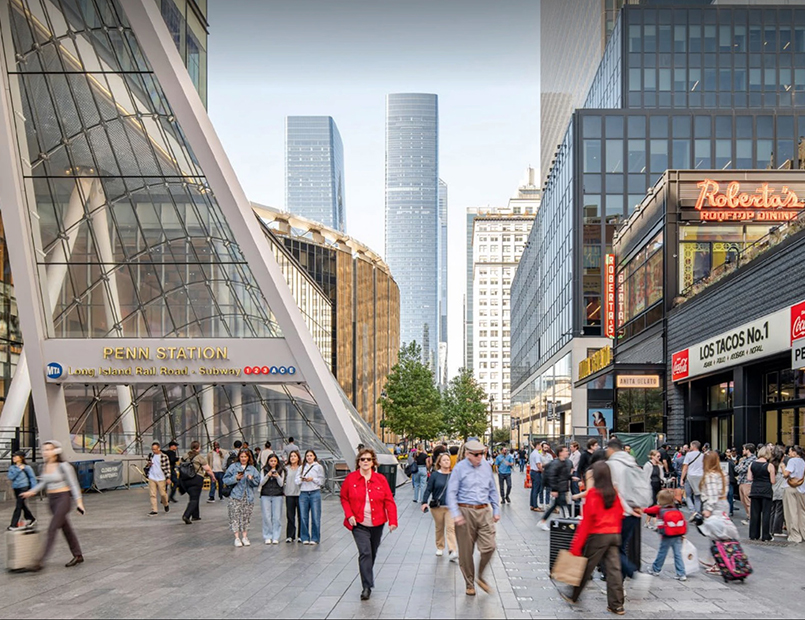
When Vornado Realty Trust redeveloped PENN 1 and PENN 2 office properties in Manhattan’s PENN District, for example, it repositioned approximately 150,000 square feet of retail at street level near PENN 1 and within the Long Island Rail Road concourse, while also adding roughly 100,000 square feet of prime retail along Seventh Avenue and the new pedestrian strip Plaza 33. The redevelopment project is helping activate a district once defined primarily by transit and office uses with new shopping, dining and public spaces that support foot traffic and encourage street-level engagement.
Vornado also has plans to expand the area’s residential base by developing a new 475-unit apartment building at 484 Eighth Ave. Leveraging tax incentives to include affordable housing, the company aims to transform THE PENN DISTRICT into a fully realized, transit-oriented neighborhood that integrates offices, housing and retail.
Incorporating retail amenities into projects generates premium rents, as ground-floor retail amenities, such as restaurants, cafes, bars and grocers, attract and retain renters, Zacharia noted.
“Mixed-use new supply can be a resilient channel because it offers a built-in customer base seven days a week if the retail is merchandised correctly,” said Martindale.
Residential drives demand for fitness, health & wellness, beauty services, food and beverage and small format specialty retail, she noted, while office can extend demand across various parts of the day—morning coffee, lunch and after-work happy hour.
“Studies show that foot traffic is between 20 to 30 percent higher in mixed-use properties as opposed to traditional retail centers,” said Joseph S. Latina II, managing principal at LMT Commercial Realty LLC/CORFAC International.
The benefit of built-in, all-day retail demand also helps to de-risk projects, where standalone retail can otherwise be harder to underwrite, pointed out Jared Cauffield, associate vice president at Western Retail Advisors, who specializes in the Phoenix retail market.
Additionally, when retail space in mixed-use projects is preleased, these projects become even more viable in the eyes of construction lenders.
“Values and investor confidence have certainly been affected by a combination of the decreasing number of retail establishments and borrowing rates remaining high,” said Latina. “Cap rates have ticked up on cash-flowing properties, however, developers are finding value in distressed retail and office properties for redevelopment into mixed-use projects.”
Mixed-use boosts Phoenix’s urban retail
Downtown Phoenix is increasingly leaning into mixed-use development, Cauffield said, and the recent surge in multifamily density is becoming a major catalyst for retail demand.
“For a long time,” he said, “the urban core lacked the residential base needed to consistently support main street retail. That’s changing quickly.”
Over the last decade, Cauffield noted, Phoenix has worked hard to improve and expand its downtown demographic by including not only office but also multifamily and hotel space, an award-winning convention center, major league sports destinations, university campuses and numerous museums—all supported by a strong light rail system.
With more residents now living downtown and fewer office workers on-site, CBD retailers have shifted their focus to serving local residents more, Cauffield added.
READ ALSO: What’s Driving Mixed-Use Design
Creative strategies fill retail gaps

Retail owners and brokers are also pursuing adaptive reuse opportunities to fill recent retail vacancies, noted Latina: “Health-care facilities, education centers, fitness spaces and food hall uses have become much more common in retail spaces. When appropriate, many retail owners are looking to convert space into apartments or condominiums.”
In addition, owners in core markets, like Manhattan and San Francisco, are adopting flexible leasing strategies to fill vacant spaces, offering space for temporary pop-up shops, short-term commercial leases and month-to-month options to minimize vacancy periods and attract new businesses, Latina continued. These strategies are popular with retailers as they provide opportunities for brands to test new markets, launch products or build buzz with less overhead and commitment than long-term leases.
Retail owners also are collaborating with city leaders to promote programs that boost downtown retail recovery. The City of San Francisco’s Vacant to Vibrant initiative, for example, provides incentives for temporary tenants.
As a result, retail owners are welcoming a diverse mix of experiential tenants and repurposing empty properties for nonretail uses like last-mile distribution, storage and coworking, with minimal capital investment.
Retail reset strengthens, reshapes CBD
But, according to Martindale, the “downtown retail reset” isn’t just about filling vacancies and relying on returning office populations. It’s also about reimagining a modern mixed-use demand engine that includes offices, residents, tourists, visitors, events, activations, medical, universities, sports and other unique destinations.
“The shopping corridors must feel vibrant, active, clean and safe and offer reasons for repeat visits and to dwell,” she added. “These areas must offer flexible footprints for retailers to offer products, services and experiences that appeal to the modern consumer.”
Mixed-use and major apartment projects in urban markets will help drive the “shift from the traditional office-tourist dependent retail model to a more balanced clientele, thereby allowing urban retail to not only survive but actually prosper in the years to come,” Cauffield said.

You must be logged in to post a comment.