


What Amazon’s Supply-Chain Push Means for Industrial
Experts discuss how the service could impact occupiers and third-party logistics providers.
This article first appeared in the CPE Sneak Peek Newsletter. Subscribe now for early access to exclusive content, in-depth analysis and key trends!
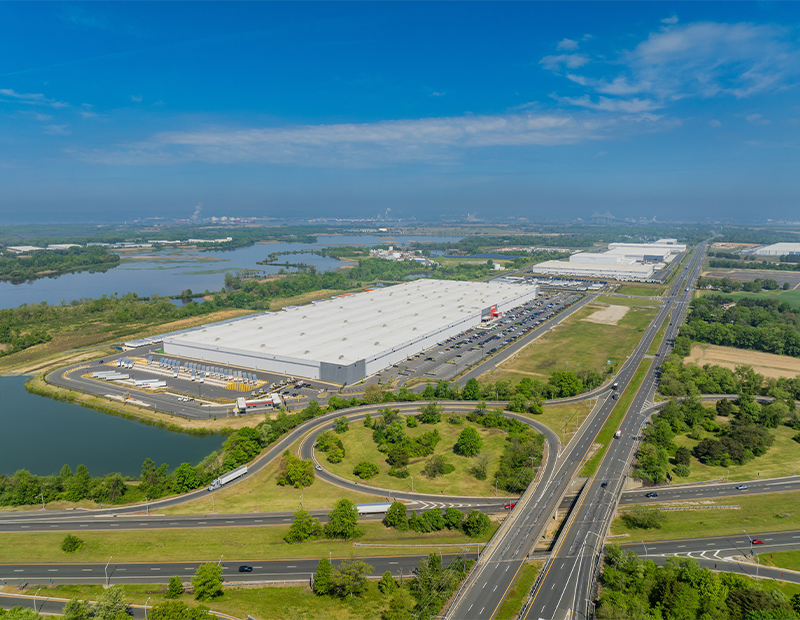
Amazon’s launch of Amazon Supply Chain Services is prompting industrial real estate professionals to reconsider how companies may approach warehouse networks, distribution operations and third-party logistics providers in the years ahead.
By allowing companies to tap into its freight, warehousing, fulfillment and delivery network, Amazon is introducing a platform at a time when industrial trends are increasingly focused on maximizing efficiency rather than aggressively expanding warehouse footprints.
“ASCS gives companies access to a much larger and shared network, potentially decreasing the number and/or size of dedicated warehouse space they need,” Michelle Comerford, industrial & supply chain practice leader at Biggins Lacy Shapiro & Co., told Commercial Property Executive.
Nevertheless, while ASCS may redirect some industrial demand into existing Amazon networks, widespread adoption could require additional facilities to support growing capacity needs, Comerford explained.
Who will feel the effects?
As Amazon expands its presence in third-party logistics, the impact is likely to be felt unevenly across the sector. The launch comes just as more companies are turning to outsourced logistics providers rather than managing distribution operations in-house, creating favorable conditions for 3PL services overall.

David Greek, managing partner at Greek Development, said that Amazon is entering the market at a time when demand for third-party logistics is growing, but since Amazon is such a large company this could increase the competition in the market among providers.
“Amazon coming in I don’t think changes the competitive landscape drastically,” Greek said. “It’s another player, albeit one that is very large and well-capitalized, and already has the largest domestic logistics network.”
Through the increase in competition, Greek believes larger 3PLs are better equipped to compete, while smaller regional operators may face greater challenges. He noted that consolidation has long been a feature of the fragmented 3PL sector, with smaller providers often being acquired by larger companies. The addition of another large, well-capitalized competitor could accelerate that trend.
“Those smaller 3PLs are going to struggle to compete against this, because they just don’t have the capital or the network to do it,” he said.
READ ALSO: Energy Shock Shifts Site Selection
The effects could spread beyond third-party logistics providers. Comerford expects the service to influence the way occupiers evaluate warehouse space and distribution networks. She does not expect the service to reduce demand for warehouse or industrial space overall.
However, she said some firms may reevaluate the number, size and location of their facilities as they gain access to Amazon’s broader logistics network.
“If ASCS becomes a logical solution for some, then companies will certainly need to change and adjust how they are thinking about their dedicated warehouse facilities and where those are best located,” she said.

The push for efficiency
Being able to plug into Amazon’s supply-chain network is also coming at a time when industrial companies are looking to do “more with less,” according to Adam Petrillo, executive managing director of Newmark’s industrial advisory group. He said that many companies in the last 18 months have been practicing this amid economic uncertainty.

Chris Mergenthaler, vice president at Darwin Realty/CORFAC International, said he is seeing the same trend across the industry. “The earlier part of this cycle was all about growth and scale; today, companies are ultra-focused on getting more out of the infrastructure they already have,” he said.
With this mindset taking hold across the industrial sector, Amazon’s ability to provide warehousing, transportation and fulfillment through a single platform could appeal to companies looking to optimize supply chains without making major investments in their own logistics infrastructure.
Petrillo added that Amazon’s advantages extend beyond its physical footprint. The company has spent years building the systems, software and operational expertise needed to manage inventory and move products efficiently across its network. Those capabilities make the service attractive to occupiers, alongside its warehousing and transportation infrastructure.
Petrillo also noted that companies are focused less on expansion and more on managing existing inventory and distribution networks efficiently.
“The broader industry, in and of itself, across all sectors, is in a mode of how do we deal with the inventory that we currently have,” he said.
In that environment, access to Amazon’s existing logistics infrastructure may offer companies another way to improve supply-chain efficiency without significantly expanding their own warehouse footprints.
READ ALSO: Does Industrial Demand Foreshadow New Development?
That shift toward efficiency is also influencing how occupiers approach logistics operations. Greek said he is increasingly seeing occupiers turn to third-party logistics providers rather than building and managing their own distribution networks. The trend marks a shift from the years leading up to and during the pandemic, when many large companies brought logistics operations in-house in an effort to gain greater control over inventory and delivery.
He points to rising interest rates and higher borrowing costs as reasons why those investments are less attractive right now, prompting some companies to outsource logistics functions rather than carry those expenses on their own balance sheets.
Flight-to-quality continues
As Amazon expands its presence in third-party logistics, industry experts say the launch could reinforce the flight-to-quality trend already underway across the warehouse sector rather than diminish demand for industrial real estate.
Gonzalo Vivanco, vice president of brokerage services & international advisory lead at First Capital Property Group/CORFAC International, said demand is likely to become increasingly concentrated around highly functional and strategically located facilities.
“I don’t believe warehouse demand will decrease. Rather, I think demand will become more concentrated around highly functional and well-located facilities,” Vivanco said.

The trend remains important for core logistics users and facilities that play a central role in distribution, according to Petrillo. He added that developers have adjusted specifications that align with operational demands for logistics users. This includes clear heights, loading docks, trailer parking and utilities.
“What you’ll generally see are adjustments to specifications to meet sort of that Amazon spec for clear height, column width, loading dock packages, trailer parking spots, energy and utilities,” Petrillo said.
While the service may influence how occupiers utilize warehouse space and structure distribution networks, experts expect demand to become increasingly concentrated in major logistics hubs and modern facilities. Established markets such as Northern New Jersey and Chicagoland may be particularly well-positioned to benefit from continued supply-chain optimization thanks to their transportation infrastructure, logistics networks and proximity to top markets.
“Amazon made its big infill real estate plays over the past five years, and today it’s optimizing what it already has,” Mergenthaler said. “That doesn’t reduce industrial demand; it fuels it.”




You must be logged in to post a comment.