


Retail Traffic, Sales Rise Despite Turbulent Year
Household formation is emerging as a prime regional differentiator for the sector.
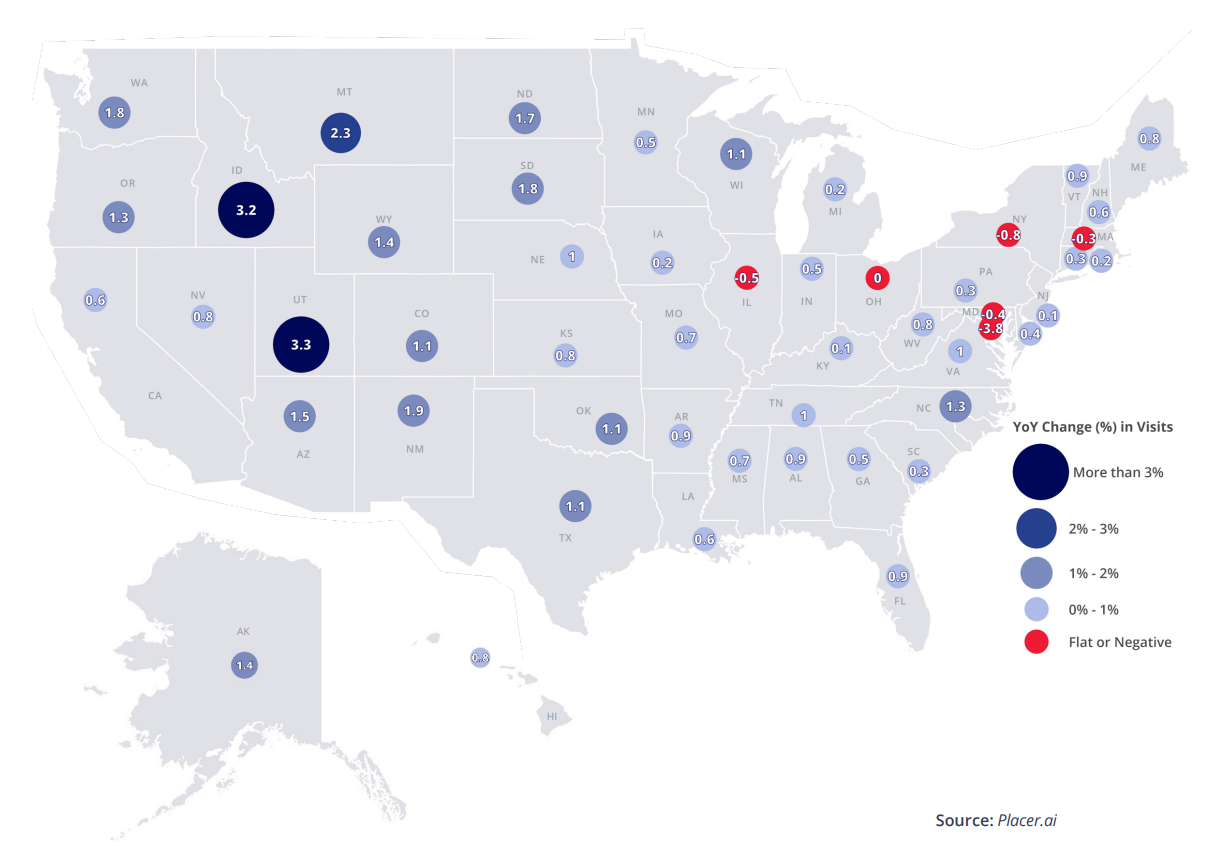
Tariff concerns and major promotional events drove consumer spending during the first half of 2025, although the crescendo softened significantly toward the end of the year, as more cautious behavioral spending patterns emerged.
Yet, this slowdown was not enough to depress retail foot traffic, which went up 1.8 percent annually in 2025, according to an analysis by Colliers. Retail sales also ticked up 3.7 percent year-over-year.
Household creation and housing supply expansion served as a regional differentiator for traffic, Nicole Larson, senior manager within Colliers’ national retail research division, told Commercial Property Executive.
“Several Mountain West states have been among the faster-growth markets recently, which typically translates into more day-to-day retail trips as new residents form routines. By contrast, the Northeast, as well as parts of the Midwest, saw much slower population growth, which can be a headwind for organic visit growth even when retail fundamentals are solid,” she continued.
READ ALSO: A Better Year for CRE?
Utah witnessed the sharpest increase in foot traffic, for a 3.3 percent gain, edging out Idaho (3.2 percent) and Montana (2.3 percent). Meanwhile, at the opposite end of the spectrum stood D.C. (-3.8 percent), New York (-0.8 percent), Illinois (-0.5 percent) and Maryland (-0.4 percent).
Such a diverging behavioral pattern may lead to retailers realigning their footprints as they start to “prioritize markets showing sustained consumer momentum,” Larson said. This recalibration could also impact vacancy rates amid a leasing adjustment.
“As brands shift investment toward these higher-performing regions, leasing momentum is likely to strengthen in fast-growing Sun Belt and select Midwest markets, particularly in mixed-use and suburban retail environments,” she pointed out.
Propelled by strong backwinds such as favorable demographics and population growth, retail markets including Salt Lake City, Reno, Nev., Indianapolis, Raleigh-Durham, N.C., and Tampa, Fla., are already excelling when compared to national averages.
Retail tenants to look out for
Overperforming tenant types included furniture firms (2.3 percent sales growth), grocery stores (2.7 percent), apparel shops (5.5 percent), restaurants (5.3 percent), as well as beauty and care (8.1 percent).
In terms of brands, the most successful in capturing consumers’ interest included Staples (up 12.5 percent year-over-year in foot traffic), followed by Hobby Lobby (10.2 percent), GameStop (9.9 percent) and Goodwill (9.8 percent).
“The top performers skew toward formats that win in a ‘selective consumer’ environment, such as value, essentials, resale/treasure-hunt, and convenience, rather than purely discretionary splurges,” Larson told CPE.
How will retail sales fare in 2026?
Looking at retail trends in 2026, spending likely remains just as selective and value-driven, with younger consumers trading down aggressively and high-income households maintaining the overall demand, Larson reasoned.
Elevated levels of consumer caution may continue to prevail this year, though without escalating into a broader pullback. As a result, retail sales growth is expected to slow down to 3 percent in 2026 amid a slower but stable environment.




You must be logged in to post a comment.