


Los Angeles’ Office Sector Holds Strong
The market continues to perform well across several key metrics, according to Yardi Matrix information.

Los Angeles’ office fundamentals showed signs of stabilization in October, according to Yardi Matrix data, as the sector continued its transformation. The metro performed well yet again across several key metrics.
The City of Angels’ office vacancy rate was one of the lowest nationwide in the 10th month of the year. The metro also retained the top spot in the U.S. for rising rents while maintaining a steady leasing momentum. Meanwhile, its coworking sector continued to expand.
Despite a sharp decline in construction starts, Los Angeles’ development pipeline remained among the nation’s largest. And investor activity reached $2.2 billion year-to-date, the metro’s sale prices surpassing once again the national average.
Listing rates growth, falling vacancy mark gradual recovery
Los Angeles’ office vacancy rate stood at 14.6 percent in October, marking a 120-basis-point year-over-year decline. The index also was 400 basis points below the national average of 18.6 percent.
In fact, the metro’s rate ranked fourth among the lowest in the nation. Manhattan led at 13 percent, followed by Miami (13.4 percent) and Tampa, Fla. (14.2 percent). San Francisco (26.1 percent) and Seattle (27.4 percent) were at the opposite end of the spectrum.
Average asking rents reached $46.62 per square foot, exceeding the national average of $32.81 per square foot. The metro’s listing rates witnessed a 10.4 percent rise year-over-year, the highest in the U.S.
Among gateway markets, Manhattan led at $67.97 per square foot, followed by San Francisco ($65.30) and Miami ($56.34). Chicago remained the most affordable office market, at $28.12 per square foot.
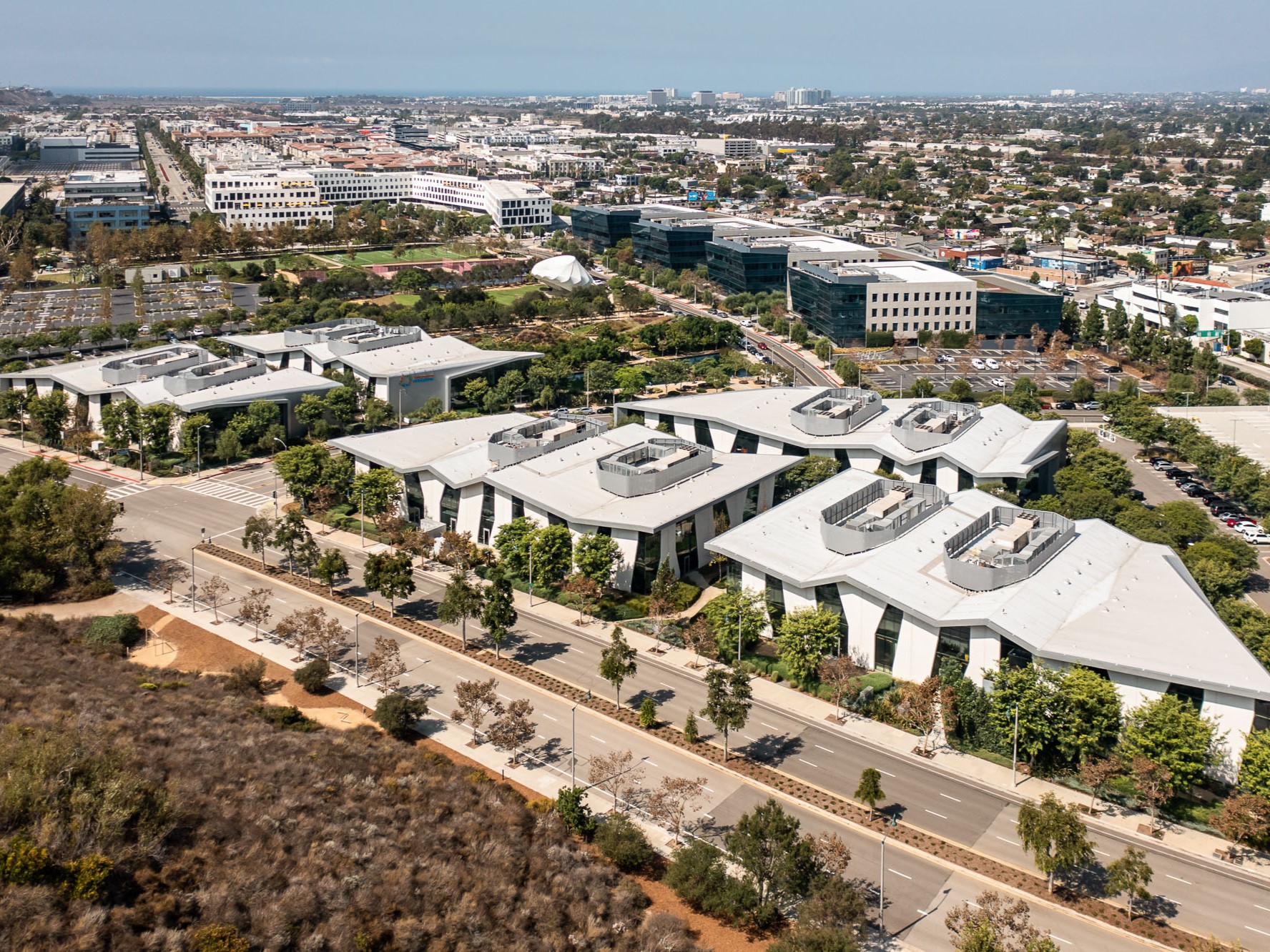
In one of the metro’s major leases, Spin Master committed to 132,300 square feet at The Collective, a five-building office campus owned by Tishman Speyer. The children entertainment company will move to the new location next November.
More recent deals included Canvas Worldwide’s 68,301-square-foot lease at 2330 Utah Ave. in El Segundo, Calif., nearly doubling its footprint in the metro. The independent media agency will relocate its West Coast headquarters to the NSB Associates-owned property in the first half of 2026.
Office sales and pricing keep L.A. competitive
Investment activity in Los Angeles amounted to approximately $2.2 billion year-to-date through October, placing the metro on the fifth spot among the top 25 U.S. markets. Among its peers, the City of Angels ranked third after Manhattan ($6.4 billion) and Washington, D.C. ($3.6 billion), while San Francisco ($1.2 billion) occupied the fourth position.
Los Angeles office space traded at $251 per square foot, well above the national average of $191 per square foot. This positioned the metro fourth among gateway markets. For context, Manhattan’s sale prices stood at $523 per square foot, followed by Miami ($360) and San Francisco ($279). At the other end of the spectrum was Chicago, where assets sold for just $64 per square foot.
As of October, the largest office transaction in the metro was Uncommon Developers’ $210 million purchase of Figueroa at Wilshire, a 52-story tower in the Financial District. Brookfield Properties sold the 1 million-square-foot asset in June, at a 41 percent discount from its previous $356.7 million trade.
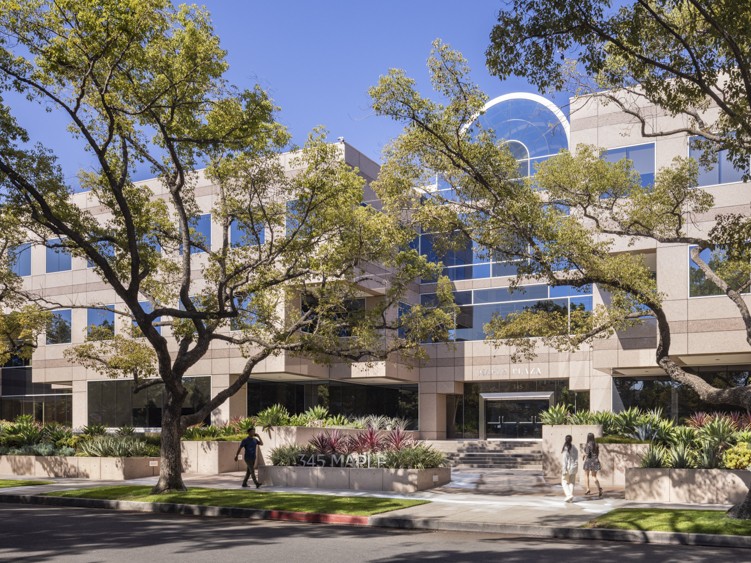
Another significant transaction was the $205 million sale of Maple Plaza, a 290,000-square-foot office building in Beverly Hills, Calif. Kilroy Realty Corp. acquired the property from Tishman Speyer, which had purchased it in 2005 for $101 million.
Pipeline holds steady as construction starts plummet
As of October, Los Angeles’ office sector had nearly 2.6 million square feet of competitive space under construction across 12 properties, representing 0.8 percent of its existing stock—slightly above the national average of 0.7 percent.
The metro had the fourth-largest pipeline among peers, with Boston leading at 5.6 million square feet, followed by Manhattan (3.3 million square feet) and Seattle (2.7 million square feet). By contrast, Washington, D.C., continued to post the smallest pipeline, with only 761,971 square feet underway.
Los Angeles’ largest office development remains Century City Center, by JMB Realty. The 37-story, 727,130-square-foot tower broke ground in 2023 and is slated for completion in April next year. Creative Artists Agency will anchor the property under a 400,000-square-foot commitment, while Clearlake Capital preleased 151,104 square feet and Sidley Austin LLP secured another 75,000 square feet.
At 388,000 square feet, BARDAS Investment Group’s office component at 5601 Santa Monica Blvd. is the second-largest project underway. The creative office and studio development is part of Echelon Studios, a 610,000-square-foot property considered Hollywood’s first new urban studio complex in more than 50 years.
However, developers broke ground on only three Los Angeles office projects totaling 207,646 square feet year-to-date through October, marking a 217.8 percent year-over-year drop in construction starts. Concurrently, office completions totaled 271,756 square feet across four properties, down 71.7 percent year-over-year as markets continue to absorb the space delivered over the past decade.
Coworking gains on par with national momentum
Los Angeles continues to show strong coworking momentum as flexible office demand expands amid hybrid work trends. As of October, the metro’s flex space inventory totaled 7.2 million square feet across 322 locations, according to CoworkingCafe, up from 6.5 million square feet it had at the end of December 2024. The City of Angels ranked third among its peers for coworking inventory, behind Manhattan (12.2 million square feet) and Chicago (8.9 million square feet).
Los Angeles’ amount of flex space accounted for 2.4 percent of the total leasable office inventory—above the 2.2 percent national average and on par with Manhattan’s. Miami led the gateway markets’ ranking, at 4.1 percent, followed by Chicago (2.6 percent).
Regus remained the largest coworking provider in the metro, with a footprint of 737,902 square feet. Other leading operators included WeWork (709,408 square feet), Spaces (685,608 square feet), Premier Workspaces (515,933 square feet) and Industrious (513,041 square feet).
In October, TailoredSpace expanded its Los Angeles presence with a new 25,000-square-foot space in Burbank, its 14th location in the metro. The same month, Premier Workspaces opened another location in El Segundo, bringing its Los Angeles footprint to 31 coworking spaces.

You must be logged in to post a comment.