

Life Science Sector Faces Vacancy Glut After Construction Boom
More than half of the space delivered between 2020 and 2025 remains empty, according to a report from Savills.

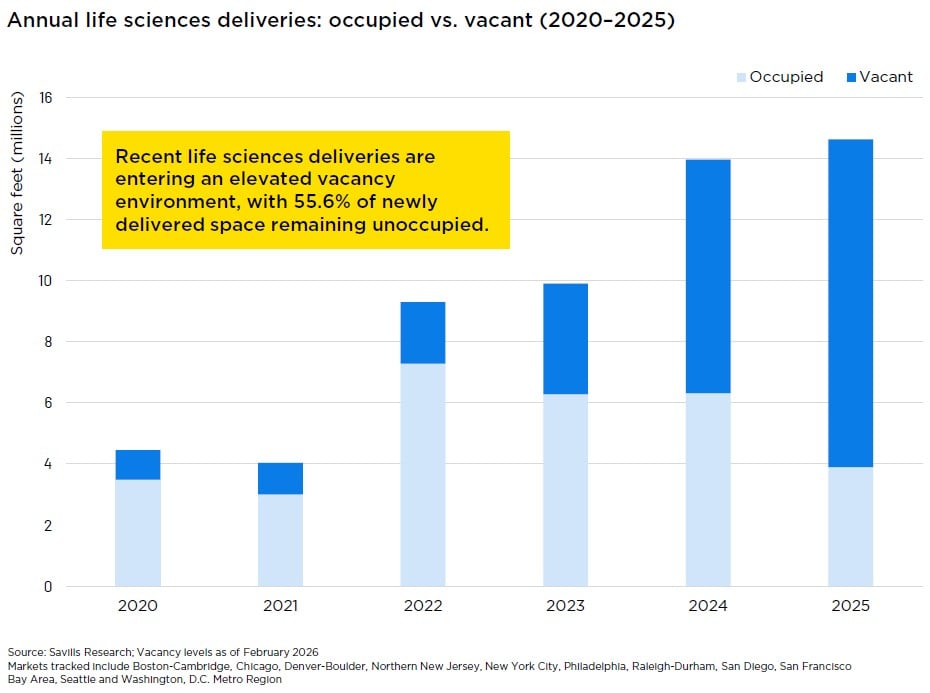
Nearly 60 million square feet of life science space came online in the U.S. between 2020 and 2025 in the 11 hubs tracked by Savills Research, but more than half of the space remains vacant, according to a new report from the firm. Much of that was high-profile, speculative lab developments launched during the COVID-19 pandemic.
The report noted approximately 55.6 percent of space delivered between 2020 and 2025 is vacant. The news is worse for projects completed last year, with 73.4 percent of 2025 deliveries still available.
In addition, since 2023, 34 life science buildings have been completed without securing a single tenant. About one-quarter of the space delivered between 2020 and 2025 was in the San Francisco Bay Area and 33 percent in the Boston-Cambridge market, according to Savills Research.
READ ALSO: AI Likely to Challenge Office Sector for the Rest of the Decade
The remaining 42 percent of deliveries were in other markets, including Chicago, Denver-Boulder, Northern New Jersey, New York City, Philadelphia, Raleigh-Durham, San Diego, Seattle and the Washington, D.C., metro.
Vacancy has climbed above 20 percent in several major markets, with much of the available space found in recently completed projects that lacked preleasing commitments. One of the examples cited is IQHQ’s 800 Pacific Coast Highway project in San Diego. The 782,430-square-foot Class A laboratory building was delivered without a single occupant. Another 465,000-square-foot, 15-story life science building developed by Greystar Real Estate Partners just outside Cambridge, Mass., delivered in early 2025 remains vacant, according to Savills.
However, there were several projects that have seen strong leasing, including Alexandria Real Estate Equities’ 10300 Campus Pointe Drive development in San Diego. Delivered in October 2025, the 427,000-square-foot building is fully leased by Bristol Myers Squibb.
Vacancies lead to competition, concessions
The large volume of newly delivered space has been hitting the market at a time of recalibration for a sector that has been impacted by decreased venture capital funding after pandemic-era highs, federal funding cuts and tariffs affecting drug pricing, the Savills report states. As capital has become more constrained, many companies have been scaling back research activity or delaying expansion.
The excess vacancy is increasing competition among landlords and driving greater reliance on concessions to secure occupancy. That’s good news for those companies currently seeking high-quality Class A laboratory space.
“There is still underlying demand for life sciences space and current market conditions present a clear opportunity for tenants to take advantage of more favorable leasing economics,” Brianna Friedman, the report’s author and life sciences research manager at Savills, told Commercial Property Executive. “Landlords are offering concessions such as free rent, increased tenant improvement allowances and potentially flexible lease structures, making Class A space more accessible than it was several years ago. This environment is positioning early movers to capitalize on a more tenant-favorable market.”
However, Friedman said capital availability is still a key driver of leasing activity.
“While we are beginning to see an uptick in venture capital funding, it continues to play a critical role in shaping tenant decision-making. Early signs of improvement in the first quarter of 2026 are encouraging and are expected to support a gradual increase in leasing activity going forward,” Friedman said.
High-profile projects continue
Friedman said there are still significant deliveries in the pipeline, with several projects expected to deliver this year.
“Despite the broader slowdown in construction activity, there remains a pipeline of notable, well-capitalized projects across the country,” she said.
In the Boston-Cambridge market, she cited BioMed Realty’s 585 Kendall Street project in Cambridge, which will be fully occupied by Takeda Pharmaceuticals as a research and developmental facility. BioMed, which broke ground on the 637,000-square office-and-lab building in October 2022, topped out the project in January 2025. A year earlier, BioMed secured a $683.1 million construction loan from Sumitomo Mitsui Bank.
Friedman also noted the $731 million Health & Life Science Exchange (HELIX) innovation district from developers SJP Properties and New Brunswick Development Corp. is currently underway in New Brunswick, N.J. Two of the three planned buildings are under construction, totaling nearly 1 million square feet.
Upon full completion, the campus will span approximately 1.5 million square feet. The H-1 building, totaling approximately 570,000 square feet, will house Rutgers Robert Wood Johnson Medical School and the New Jersey Innovation HUB. The building will include incubator and coworking space, along with 300 web lab benches, 80 dry lab benches and 13 large labs. The H-2 building, totaling approximately 350,000 square feet, will be fully occupied by Nokia Bell Labs as its headquarters, according to Friedman.
Conversions are still rare
Despite the excess vacancies, Friedman said widespread conversions of life science properties into alternative uses remains limited. Instead, she said, they are seeing developers reconsider some projects due to the market conditions. For example, Alexandria Real Estate Equities recently announced it would not convert an existing office building at 401 Park Drive in Boston’s Fenway neighborhood into lab space amid elevated life science vacancy levels, Friedman noted. The REIT instead will lease the property, formerly known as The Landmark Center, as office space.
“The cost of construction life sciences space is already significant and converting existing laboratory space, particularly with specialized infrastructure such as advanced HVAC systems and deep floor plates, can be challenging and economically unfeasible for many developers,” she said.
Long-term strength of sector
Savills reported that elevated vacancy doesn’t undermine the long-term strength of the life science real estate sector. Breakthroughs in mRNA therapeutics, gene editing, cell and gene therapy and artificial-intelligence drug discoveries generate new companies and research activity, supported by leading universities and research institutions. Public and private capital also remain available and will position the sector for future investment when market conditions stabilize.
It also creates opportunities for early-stage companies that previously struggled to find space in highly competitive clusters such as Boston-Cambridge or South San Francisco. Well-capitalized tenants may also be able to upgrade into newer, more advanced facilities at favorable economics.

You must be logged in to post a comment.