


Investors Plan to Buy More CRE in 2026
These property types top the priority list this year.
Investors are feeling the wind behind their backs a bit more in 2026, with 74 percent of commercial real estate investors surveyed by CBRE planning to buy more assets in 2026 than they did last year.
Moreover, 21 percent of respondents expect to buy about the same amount of real estate this year as they did last, meaning that an overwhelming 95 percent of investors are going to do one or the other—and very few are pulling back.
Just under half of the investors surveyed plan to sell more assets this year than last. That dynamic will likely create more competition for assets and allow pricing to firm up, CBRE posits.
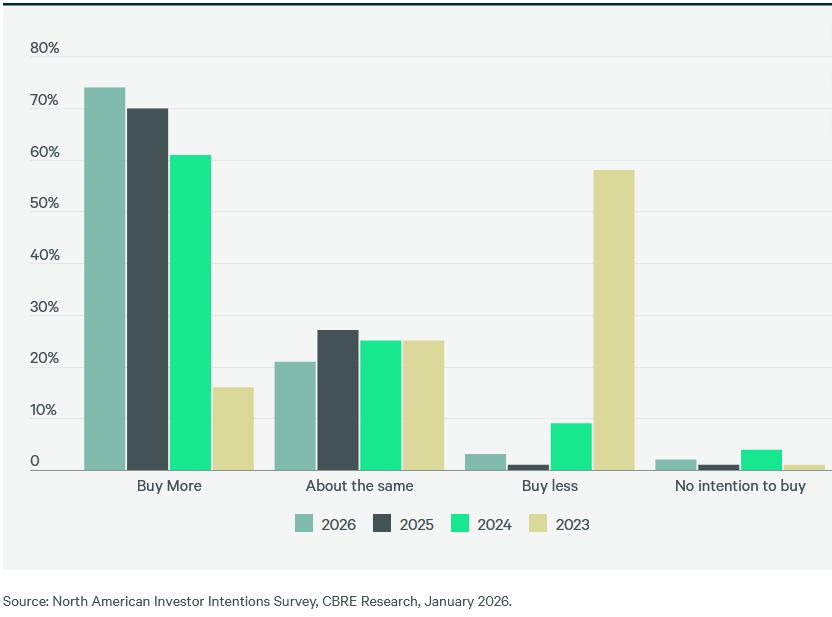
But investors are also looking ahead with some trepidation, since the survey found that an uncertain economic outlook and a weakening labor market are the biggest challenges for investors.
So while investors are looking to buy, their target assets are shifting somewhat. More of them are looking for core-plus, while fewer say they will be investing in opportunistic assets. About the same number are looking for value-add plays.
All together, CBRE surveyed 204 commercial real estate investment executives for its North American Investor Intentions Survey, completed in January, including developers, real estate and private equity fund managers, REIT decision-makers and others. A little less than half (46 percent) had less than $5 billion in assets under management, while at the other end of the spectrum, 14 percent had more than $50 billion in AUM.
CRE headwinds and tailwinds
CBRE found that 61 percent of U.S. investors are concerned about broad economic and labor uncertainty in 2026. But other headwinds are on their minds as well: long-term rates remaining elevated or volatile (47 percent named that situation), weakening commercial real estate fundamentals (40 percent) and higher operating costs (29 percent).
READ ALSO: Look For Easier Money—But Not Too Easy
Regarding interest rates this year, the survey noted that macroeconomic pressures are expected to keep long-term rates elevated. Nevertheless, CBRE expects the Fed to make two rate cuts of 25 basis points each in 2026 and shift its focus to supporting the labor market. “These cuts, combined with sustained economic growth, should result in long-term yields of around 4 percent, sufficient to support investment in commercial real estate,” the report forecasts.
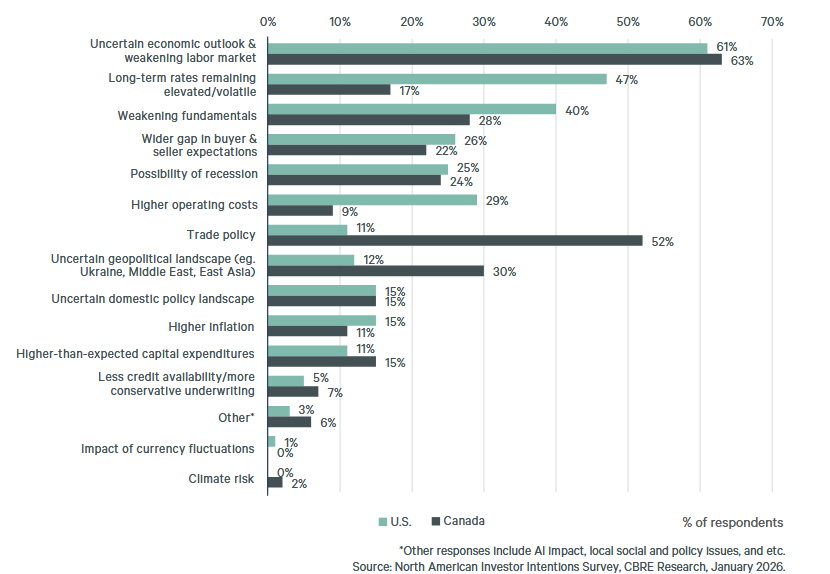
Other concerns include the possibility of a wider gap in buyer-seller expectations and the possibility of a recession, with about a quarter of respondents citing those worries. Many fewer are concerned about geopolitics, or even domestic politics. Very few (5 percent) are worried about credit availability or more conservative underwriting.
Most investors said they will tolerate short-term negative leverage, the report found. That reflects improving market fundamentals, including stronger rents and cheaper financing. CBRE expects that although the 10-year U.S. Treasury yield will remain around 4 percent in 2026, overall commercial real estate investment volume will increase by 16 percent.
As for tailwinds, the four out of five respondents said that a reduced supply pipeline is going to be good for the overall health of commercial real estate investment, while another large majority (68 percent) cited lower debt costs. With most lenders now back in the game, and especially banks ramping up their lending, capital will be there for investors.
Other tailwinds cited in the survey—by a quarter or more of respondents each—include attractive price entry points, an improving rental outlook, greater alignment between buyers and sellers and stronger occupier demand.
Investment preferences
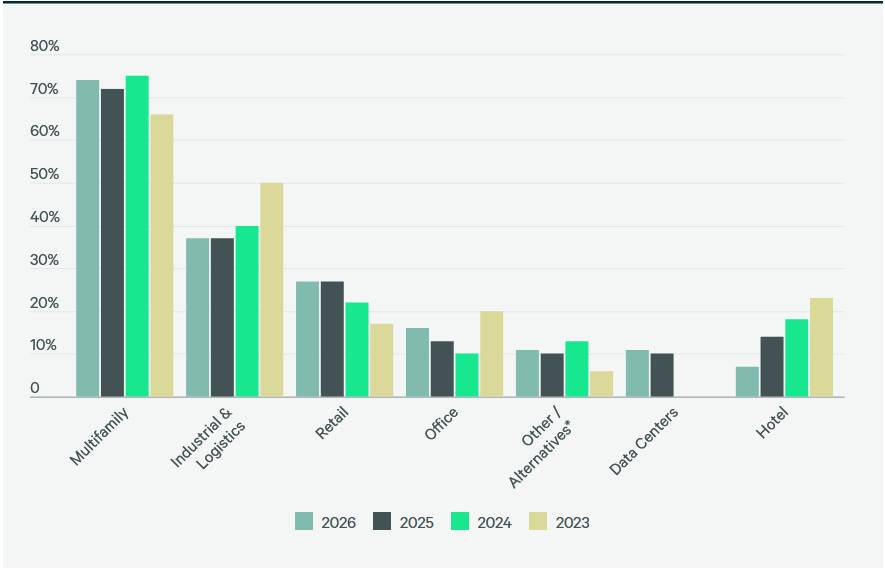
Multifamily remained the most-preferred sector among investors, with industrial second, and retail and office gaining some ground compared with previous surveys, CBRE found. Nearly three-quarters of investors (74 percent) said multifamily is their top choice, roughly the same as in 2025 and 2024.
Some 37 percent cited industrial as a top choice, also roughly the same as the last two years. Retail, at 27 percent, didn’t change from 2025, but is up from 22 percent in 2024.
Office assets aren’t particularly popular, but at 16 percent, that is up from last year (13 percent) and the year before (10 percent), reflecting cautious improvement in office space trends. Hospitality properties, by contrast, have slumped in the estimation of investors. In 2024, 18 percent cited the sector as a top investment choice. This year, only 7 percent do.
Geographically, all U.S. gateway markets were among the top 20 for investment, with Dallas still the top choice, followed by Atlanta and San Francisco, CBRE found. Boston and Washington, D.C., with their muted demand among tenants, are less favored than they used to be. New York City and Seattle are still among the top 10 destinations for investors, who like those markets’ solid fundamentals.
“Investor preference for Sun Belt markets is expected to persist in 2026, despite supply-side challenges, particularly in multifamily and industrial,” the survey noted. “Charlotte, N.C., and Nashville, Tenn., are notable examples, benefiting from solid job markets, population growth and balanced supply-and-demand dynamics.”

You must be logged in to post a comment.