


If AI Becomes the Shopper, What’s Next for Industrial?
AI shopping agents are forcing retailers to prioritize speed to consumer even more.
This article first appeared in the CPE Sneak Peek Newsletter. Subscribe now for early access to exclusive content, in-depth analysis and key trends!
As AI agents increasingly optimize purchases, retailers will likely face greater pressure to strengthen their fulfillment capabilities.
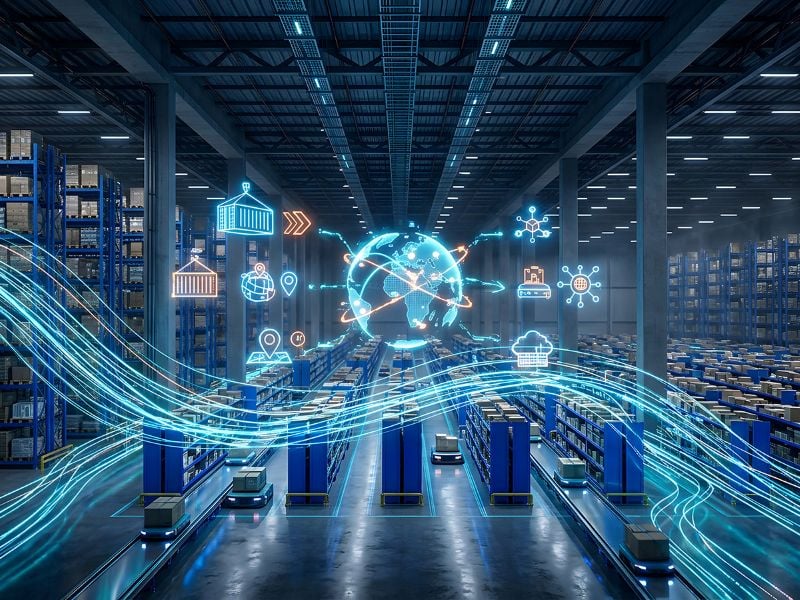
In such a scenario, AI shopping agents could strengthen the role of industrial assets in the customer experience, a recent JLL study predicts.
AI-powered shopping is in fact expected to heighten, rather than redefine, consumer expectations already shaped by e-commerce, making fulfillment infrastructure an increasingly important part of the sales process.
“Consumers have been pushed by the Amazon effect,” John Kirkman, CBRE’s supply chain advisory leader, told Commercial Property Executive. “A-commerce is going to accelerate the expectation of quality, price and speed.”
Kirkman went on to explain that brands used to hire marketers to find consumers, but today consumers can “hire” AI agents to find products. The challenge now is determining how retailers can get these agents to select their products.
Fulfillment gains an edge
Price has traditionally been a major factor in consumers’ purchasing decisions, and while it remains influential, the rise of e-commerce has brought availability and delivery speed further into the mix. A-commerce changes who is doing the evaluating, with AI agents potentially weighing those factors when deciding which retailer best meets the consumer’s needs.
Richard Thompson, JLL’s international director of supply chain & logistics solutions for the Americas, gave an example of how this trend works. He explained that a consumer could find a cheaper pair of pants that are out of stock, while another pair could cost $3 more but arrive the next day.
LISTEN TO: Why Small-Bay Demands Discipline
“That fulfillment promise is going to be the key thing,” Thompson said.
Even though the agent may not evaluate the warehouse itself, it could consider the availability for faster delivery that the specific facility is able to provide. Location and operations can allow the retailer to keep that delivery promise, which could help it win the sale. Thompson sees this trend reinforcing the need for more automated facilities closer to the consumer.
In making delivery an even more significant competitive factor, A-commerce would be accelerating a shift that began with the e-commerce boom, Kirkman observed.
Thompson added that fulfillment could in fact become more important than marketing. If a retailer can market a product successfully, he explained, the effort loses its value when that product isn’t available when a customer goes to purchase it. He believes that fulfillment, and therefore industrial real estate, is a critical part of the “customer marketing promise.”
If delivery plays a greater role in customer acquisition, the distinction between traditional marketing investment and spending on fulfillment infrastructure could begin to blur.
Investment shifts toward AI visibility
Retailers are already taking steps to adapt to AI’s growing role in the shopping process. According to Colliers, nearly 40 percent of major U.S. retailers have implemented AI shopping assistants. Anjee Solanki, national director of retail services & practice groups at Colliers, said retailers are investing in the infrastructure to make their products more visible to AI systems. Retail media networks, geolocation data, computer vision and updated POS systems all generate clean, real-time product and inventory data, she said.
“An AI agent can’t recommend or select a product it can’t accurately see,” she said.
If AI agents consider inventory availability and delivery speed along with price, Solanki sees fulfillment becoming not just an operational consideration but a competitive input.
“Fulfillment infrastructure can begin to function less like a cost center and more like a customer-acquisition channel because it may directly influence which retailer an agent recommends,” Solanki said.

What tenants will value most
For industrial owners and developers, proximity to consumers could increasingly shape acquisition, development and property-improvement decisions.
Prologis already prioritizes infill and near-consumer locations when it comes to its business strategy. William O’Donnell, global head of corporate development and growth, views the rise of A-commerce as aligning with the company’s existing approach.
“I don’t think that it would dramatically change our strategy. I think it would help and accelerate our strategy,” O’Donnell said.
The idea of AI-powered shopping may not drastically change how much industrial space retailers need, but it may affect how tenants use that space and what they prioritize when looking for facilities.
“It’s not necessarily less warehouse space, but right-fitted warehouse space,” Kirkman said.
With this emerging trend, Kirkman identified several facility characteristics tenants could search for, including higher clear heights, higher power requirements, greater SKU density, automation-ready facilities and the ability to move inventory at a faster rate. These features support the shipping capabilities that could become increasingly important as AI agents take on a greater role in purchasing decisions.
Aside from evaluating location, Prologis is considering what happens inside warehouses. Prologis is looking beyond the “four walls and the roof” of a warehouse and working with its customers on the total cost of operations—this includes transportation, infrastructure, network planning and labor, O’Donnell said.
READ ALSO: Finding the Exit Ramp in a Stalled Market
O’Donnell is seeing companies invest more heavily in warehouse automation, which could become increasingly significant as fulfillment expectations accelerate. These investments can help companies increase throughput and move products through facilities more efficiently, while newer forms of automation and robotics can also provide greater flexibility within warehouse operations.
AI raises the bar for warehouses
An expanded role for industrial facilities in the sales funnel would build on years of rising fulfillment expectations that have already pushed warehouses and distribution networks closer to the point of purchase.
Thompson described how 20 years ago shoppers’ expectations were around seven to 10 business days. Today, that time frame has shortened to around two days, and he expects the demand for faster shipping to continue and delivery windows to become even shorter.
“Customer service expectations become more and more demanding. That’s a fact, and so that changes the game of network strategy,” he said.
Owners and developers are also under increasing pressure to evolve their facilities. “AI agents, like e-commerce, don’t remove the physical layer of commerce,” Kirkman said. “We’re still moving boxes at the end of the day. They raise the bar on the expectations of what the warehouses do.”


You must be logged in to post a comment.