

Does Your Building Design Respond to the New Mixed-Use Reality?
Four case studies revealing how unique places call for unique solutions.
Mixed-use development is no longer about stacking uses on a single site. It’s about creating a community where people want to be. Today, architects and developers are considering site conditions—including climate, history, proximity to public transit as well as demographics—more than ever to find the right composition and configuration of each mixed-use project.
As these case studies show, serious assessment of surrounding conditions in the design process can lead to ambitious outcomes like reworking street grids, creating new communities around transit hubs and reactivating obsolete buildings. Highest and best use, however, depends on the characteristics of the site rather than application of pre-packaged solutions.
Truly Transit-Oriented
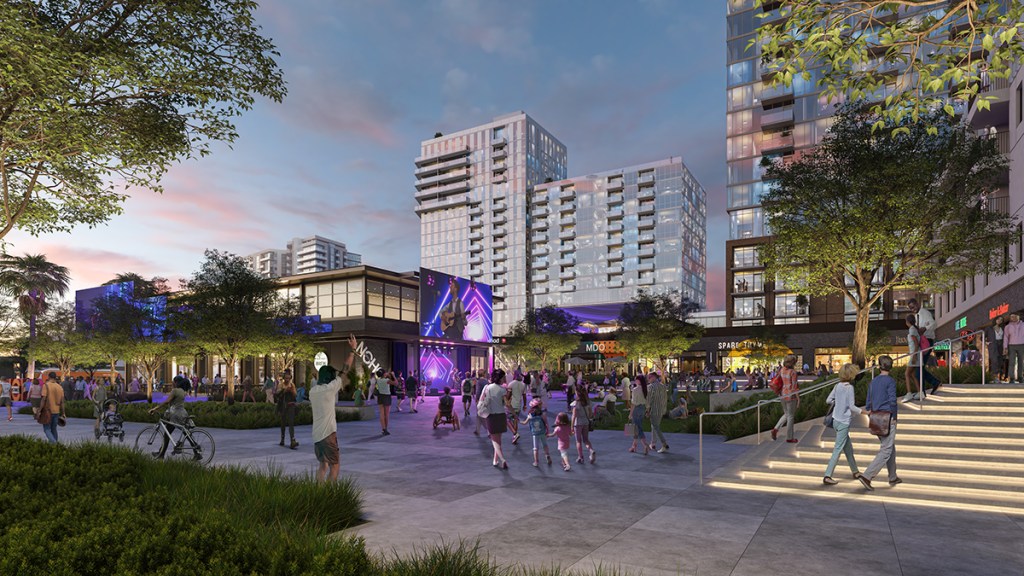
District NoHo (Los Angeles)
District NoHo is a mixed-use development that Trammell Crow Co. and High Street Residential, TCC’s multifamily arm, are bringing to life in Los Angeles. MetLife Investment Management is also part of the venture.
Taking shape in the North Hollywood Arts District in the San Fernando Valley, District NoHo is set to span 2 million square feet, encompassing market-rate and affordable apartments, as well as office and retail space. The project is anchored by its connectivity to the area’s transit system through the North Hollywood metro station.
Many TOD projects sit beside transit hubs. At District NoHo, the station shapes the development. However, there won’t be any disruptions to transit service during construction, mentioned Gabe Hungerford, principal at Trammell Crow Co. Each phase is designed to protect bus and rail operations as well as pedestrian pathways.
At 1.8 million square feet across 16 acres, this is one of the largest redevelopment sites in the city.
—Gabe Hungerford, Principal, Trammell Crow Co.
“The whole reason why this is such a wonderful development site is really because it’s a strong multimodal transit hub,” Hungerford said. “That’s what attracted us to it when we started this project some time ago.”
Plans call for a multiphase delivery over the next decade, beginning with an affordable housing component. Each stage is being designed to work on its own, so the project doesn’t need the final buildout to feel complete.
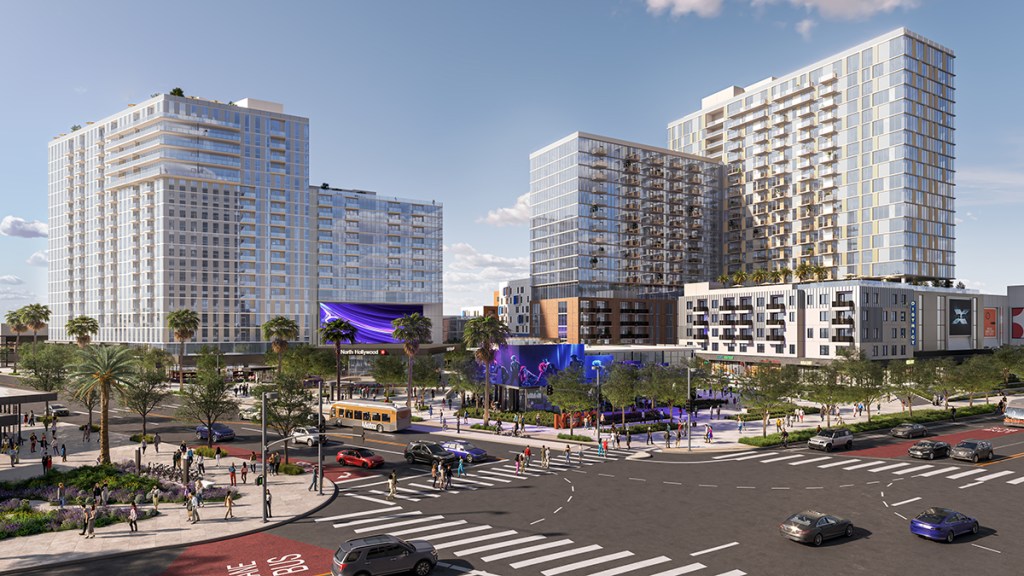
The team also wanted to avoid the feel of a typical master-planned community. “We didn’t want it to feel homogenous in terms of architecture,” Hungerford shared. “We didn’t want it to feel like it was the same building multiple times over.”
That’s why TCC and High Street tapped multiple architects to handle different components. HKS is the master and principal multifamily architect, Gensler is facilitating office and retail design, and KFA is leading design of the affordable residential component.
“If we had multiple voices on this, we would turn out something that could become more authentic to the location,” said Greg Verabian, regional practice director for commercial and mixed-use & partner at HKS.
Hungerford pointed to the pedestrian walkways and green space within the development as the connective tissue. RELM Landscape is managing the streetscape across the project, which also includes a public plaza.
From Mall to Main Street
One West End (Atlanta)
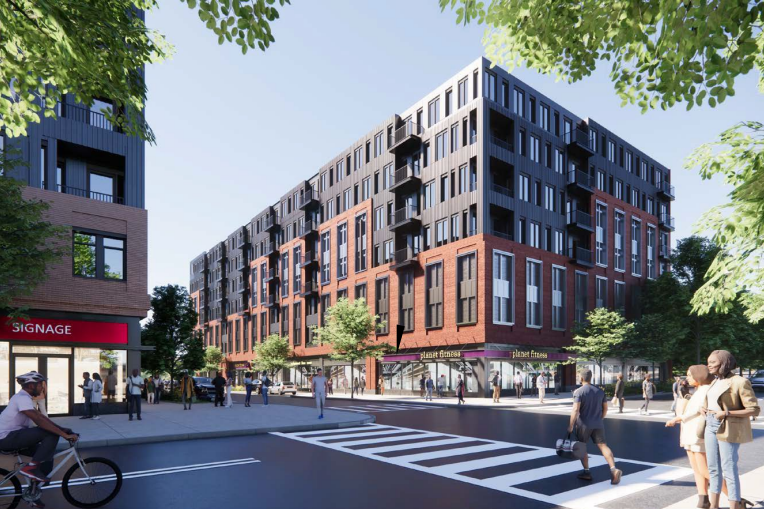
Taking an obsolete mall and reimagining it into a mixed-use district is what developers The Prusik Group and BRP Cos. are doing with One West End, a future mixed-use development at the former Mall West End in Atlanta.
The joint venture is transforming the 1970s-completed structure with a $450 million investment across a 12-acre site. Plans include 125,000 square feet of retail, including a grocery store, a fitness center, diverse dining options and local boutiques, as well as approximately 900 mixed-income residences, including affordable and student housing, a 150-key hotel and 12,000 square feet of medical office.
Malls are typically car-oriented, insular structures. Transforming them requires reintroducing a street grid, improving pedestrian connectivity and upgrading infrastructure to support multiple uses.
—Meredith Marshall, Co-Founder & Managing Partner, BRP Cos. and Andrew Katz, Principal, The Prusik Group
The redevelopment introduces a new street grid that breaks up the mall’s inward-facing form to prioritize pedestrian circulation. John Clifford, founding principal at S9 Architecture, said the design team approached the site by splitting the block into smaller sections. “We broke down the superblock into a network of smaller, walkable streets to create a human-scaled urban village.”
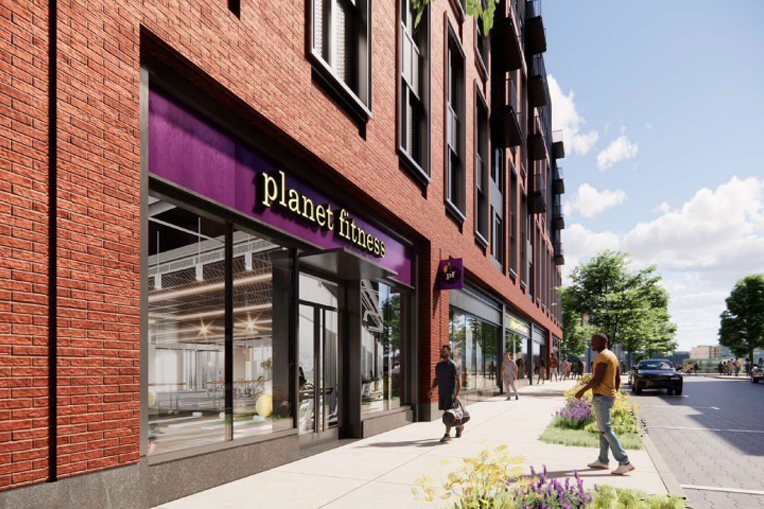
The developers used community input to inform their design, phasing and implementation strategies. Utilities, stormwater systems and internal circulation are being modernized so the site functions as a neighborhood. Legacy tenants such as American Deli, Dendera Cosmetics and The Burning Sands are being temporarily relocated but will be part of the final project. The developers are anticipating the first phase opening between late 2028 and early 2029 when local businesses are set to move into their new locations.
Although the mall’s structure is being fully demolished, elements of its commercial and cultural history are being retained. The team said the redevelopment will utilize historical and cultural aspects into both the site’s physical design and community programming. One feature is the creation of a digital time capsule documenting the former mall’s role in West End.
Future activations, including the groundbreaking ceremony and planned community programs, will continue to highlight the mall’s legacy, according to Meredith Marshall, co-founder & managing partner of BRP Cos. and Andrew Katz, principal at The Prusik Group.
An Epic Experience
EpicCentral (Grand Prairie, Texas)
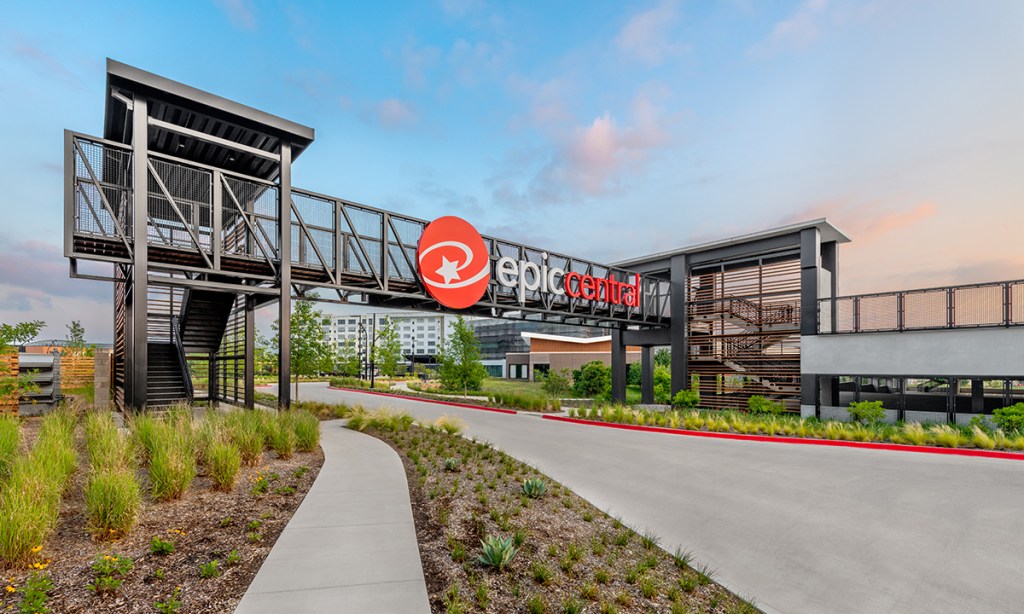
Opened in 2023, EpicCentral is an entertainment-focused mixed-use district in Grand Prairie, Texas. Merriman Anderson Architects led the master planning, architecture and interior design services for the town, shaping the project around a core principle: moving people comfortably, with climate considerations driving many of the design decisions.
The broader development spans 170 acres, with Merriman Anderson’s work concentrated on 18.7 acres that include six retail buildings totaling 37,000 square feet; structured parking; a 15,000-square-foot lawn with a covered stage and outdoor seating areas; and a 200,000-square-foot hotel and convention center.
As an established community was already present, with destinations such as the Epic Waters indoor water park and a police station, MAA picked the visual design based on what was already there to make the overall space feel unified. “We didn’t want to be a twin,” said John Carruth, principal & design director of MAA. “We wanted to be a cousin of the development.”
A lot of our placemaking really comes from alleviating distance. … It doesn’t feel like it’s 3 miles to get somewhere—everything is very walkable.
—John Carruth, Principal & Design Director, Merriman Anderson Architects
Carruth said the firm approached the project with what he described as an “alleviating distance” strategy, designed for Texas heat by shortening the perceived walk between destinations. In planning terms, the team also focused on removing “pressure points” that can hinder the experience. What Carruth described as “three strikes and you’re out,” from struggling to find parking and long walks to a destination to difficulty finding entrances and front doors can affect the perception of the district.
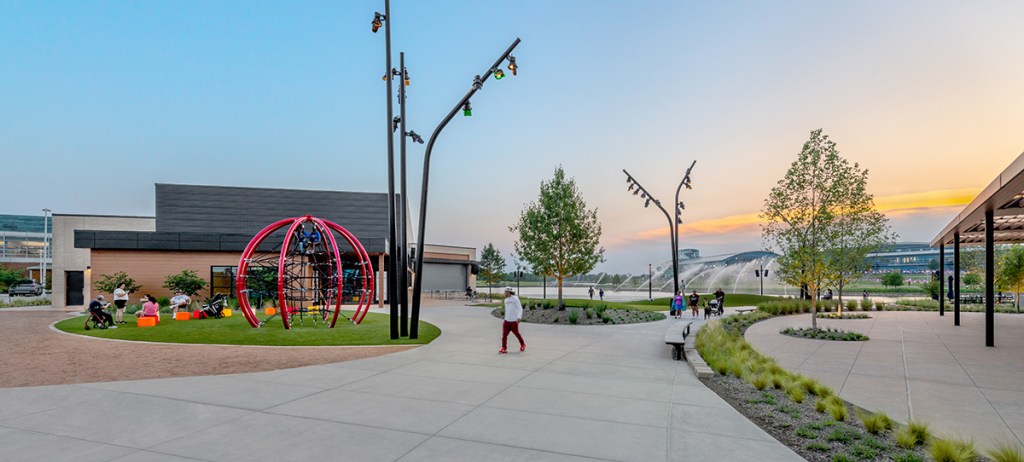
To break up the distance, interest points throughout the development include the pedestrian bridge and water show, as well as outdoor areas that aren’t over-programmed and offer multiple uses throughout the seasons.
Climate-responsive architecture also played a role in this project. Structural overhangs, fabric awnings over patio areas and retractable doors introduce shade and seasonal flexibility, allowing visitors to comfortably use outdoor spaces throughout much of the year.
“The spacing of the buildings from each other, the amount of space, the widths of the sidewalks and green spaces, the areas that are a little bit more nonprogrammed,” noted Carruth, are what allow the district to evolve over time. Viewed as a lifestyle district rather than a strict master-planned community, EpicCentral has in-between spaces that leave room for future additions—or for elements to be removed if they aren’t being used.
Preservation Before Reinvention
Navy Yard (Charleston, S.C.)
Adaptive reuse projects and redevelopments such as One West End have gained popularity, as the tectonic plates of CRE demand shift. Jamestown, along with joint venture partners Weaver Capital Partners and WECCO Development, is taking a particular route with Navy Yard Charleston.
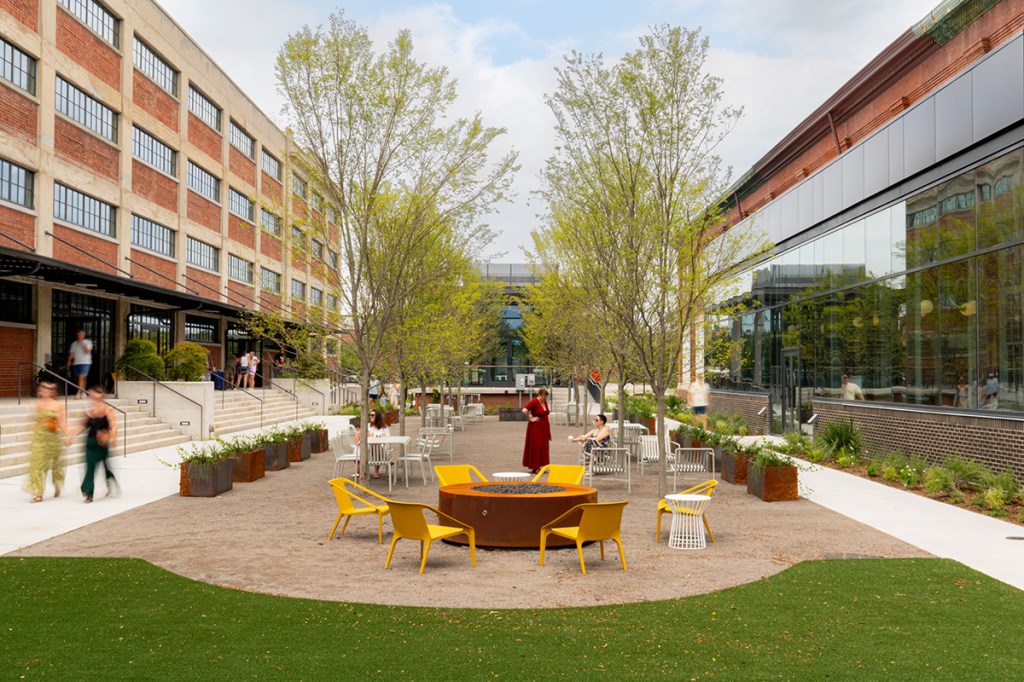
The former industrial naval base is being reimagined as a 3 million-square-foot mixed-use district with retail, residential and office uses. In the early 1900s, a cluster of storehouses at the heart of the yard functioned as administrative offices and storage facilities for the U.S. Navy, positioned along the Cooper River.
“The historic Charleston Naval Yard has long held a legacy of international influence from decades of visitors and workers cycling through the campus, bringing culture to the area and establishing the base as a regional economic force,” said Ned Miller, head of development at Jamestown.
Navy Yard Charleston represents a new model of industrial adaptive reuse at a district scale—one of few former U.S. military installations to be transformed into a mixed-use development.
—Ned Miller, Head of Development, Jamestown
Redevelopment began in the early 2020s, with the first major renovations starting in 2021. Early work included the renovation of Storehouses 8 and 9. Rather than replace the historic structures, Jamestown preserved exterior brick and interior plaster walls while restoring original elements such as the cornice and slate roofing.
Miller said that the project is taking a phased approach to unify the district in the neighborhood while preserving the history.
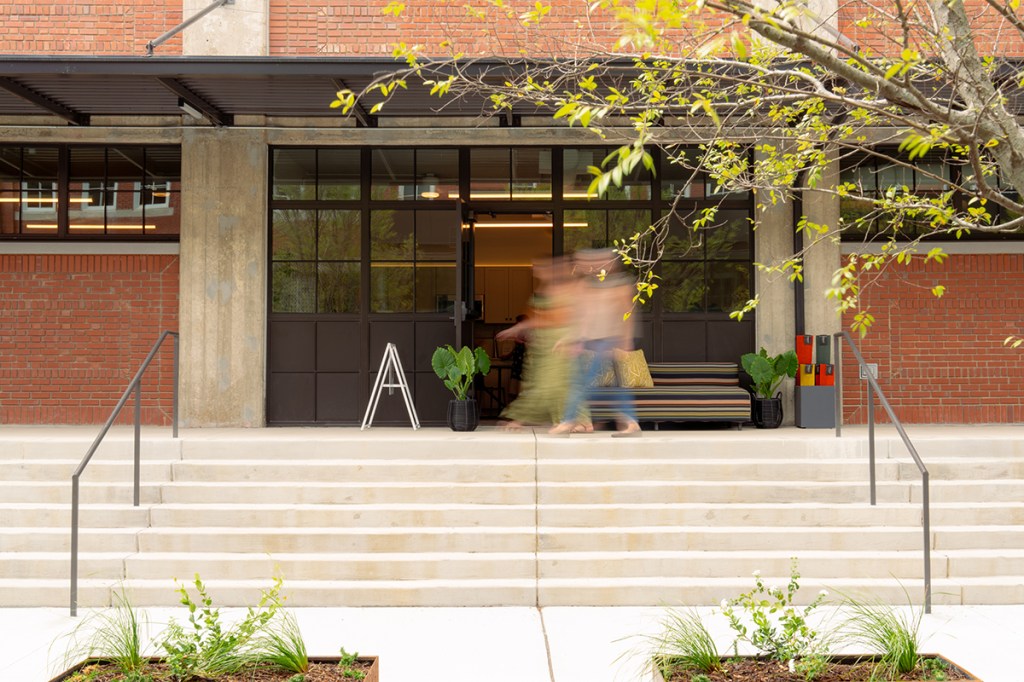
“Preserving industrial heritage often requires creative structural interventions and collaboration with preservation partners while ensuring spaces are functional for contemporary uses,” Miller added.
The Cooper River is integral to Navy Yard’s identity and planning, Miller noted. The waterfront acted as the spatial spine for the neighborhood and prioritized public access. Planning is still evolving, but the masterplan includes improving public access to the river and connecting to Riverfront Park. As sea levels rise and flooding pressure continues to affect coastal communities, the development incorporates green infrastructure to strengthen stormwater resilience and ecological function.
The next phase will introduce a residential component through a partnership with DRB Homes, which will construct Marine Row at Navy Yard, a 55-townhome community. In each phase of the plan, Jamestown utilized adaptive floorplates in the mixed-use buildings, allowing the district to evolve based on community needs and market conditions.
“Input from neighbors, local leaders and organizations helped shape priorities around public access, inclusionary economic opportunities, preservation of character and enhanced connectivity to neighboring districts like Park Circle,” Miller also pointed out.



You must be logged in to post a comment.