


Prime Breaks Ground on $3B Phoenix Data Center Campus
The first phase features three of five buildings planned for the 240-megawatt project.
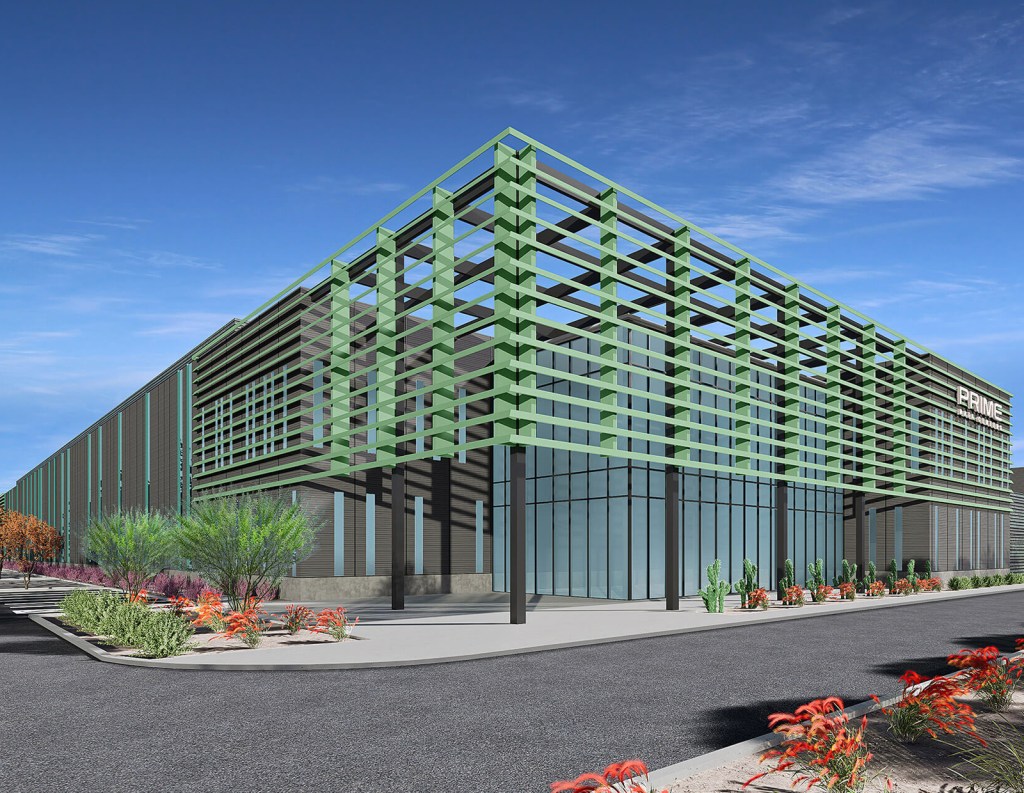
Prime Data Centers has broken ground on three data centers in the first phase of its $3 billion, 1.3 million-square-foot, hyperscale campus in Avondale, Ariz., near Phoenix. Five buildings are planned for the 66.5-acre, 240-megawatt campus called PHX01.
Buildings 1 through 3 have been secured by a leading hyperscaler, which was not identified by Prime. The remaining two buildings, 4 and 5, remain available to meet additional demand. Each building is a 267,000-square-foot facility that will have 48 megawatts of critical IT load capacity.
In all, there will be 20 data halls with infrastructure galleries for data hall privacy, concurrently maintainable mechanical and electrical systems, multiple carriers and layered security.
READ ALSO: In a Topsy-Turvy World, Capital Flows to CRE
The campus, designed for artificial intelligence and high-performance computing workloads, will be powered by an on-site 250-megawatt dedicated substation. Phase 1 of the substation construction will deliver 144 megawatts of critical IT capacity.
Prime declined to release construction timelines for the project, which was first announced in May 2023. At that time, the proposal was for a 210-megawatt campus with each of the five buildings delivering 42 megawatts of critical IT power. The project’s price tag was also smaller–pegged at about $2 billion.
Greater Phoenix is just one market where Prime, an international developer and owner of hyperscale and purpose-built data centers, is active. The company currently has a 4-gigawatt power capacity across top-tier markets in the U.S. and Europe, including Chicago, Los Angeles, Silicon Valley and Austin, Texas.
European locations include Frankfurt, Berlin, Madrid and Helsinki. The firm has six data center locations in operation across the U.S., such as Dallas, Los Angeles and Sacramento, Calif., and numerous others in its construction pipeline. The firm’s expansion got a financial boost in August 2025, when a joint venture of Nuveen and Snowhawk became an equity investor to support its expansion.
Focus on water consumption
In Avondale, Prime and local officials stress the project is being designed with sustainability, particularly regarding water consumption, in mind. Prime also notes the campus is 100 percent committed to 100 percent renewal energy on the campus but did not provide details.
The facility will use a closed-loop cooling system designed for zero process water use during operations and eliminating the need for ongoing water consumption during the cooling process. Prime said it procures Water Restoration Certificates equal to 120 percent of its annual operating water consumption across its portfolio and is committed to maintaining that annual coverage.
Fears about data center water use are among the concerns increasingly being raised by residents and local officials across the U.S., where pushback is growing against large-scale, AI-ready, hyperscale data center development proposals. The backlash has resulted in municipalities proposing and enacting building moratoriums and policy changes, where officials say they need more time to evaluate potential impacts of data centers.
In addition to fears of water shortages, other issues raised include potential electricity rate increases, noise and air pollution problems, and expensive tax breaks. The City Council in Chandler, Ariz., about 43 miles from Avondale, unanimously rejected a $2.5 billion, 400,000-square-foot, 150-megawatt data center proposal in December.
Last year, Phoenix updated its zoning regulations requiring data centers to get special permits so that health and safety issues would be addressed for new proposals. Tucson, Ariz., is also working on a new regulatory framework for data centers.
One of the top data center markets in the U.S., Arizona has 98 operating facilities and 86 planned data center developments, according to the Pew Research Center. Even though the state currently ranks 7th among top 10 markets, Gov. Katie Hobbs and other Arizona lawmakers are considering repealing sales tax exemptions and other tax incentives for developers and operators. Legislators are also looking at new rules to protect residential ratepayers from rising grid connection costs.





You must be logged in to post a comment.