


Data Center Expansions Push the Sector Into New Territory
One region is on track to overtake Virginia as the world’s largest data center market.
As AI demand, hyperscaler expansion and electrical grid limitations shape the explosive recent growth of data centers, these forces are relocating the front lines of the industry’s expansion, according to JLL’s North American data center report for the year-end 2025, released today.
“Texas is positioned to overtake Virginia as the world’s largest data center market by 2030,” JLL reported. “Markets like Texas, Tennessee, Wisconsin and Ohio are experiencing explosive growth as companies seek abundant energy and business-friendly environments.”
The report found that 64 percent of new data center construction is taking place in “frontier markets,” outside traditional hubs like Northern Virginia and Silicon Valley. In Texas, for example, 6.5 GW of capacity is under construction.
Across North America, more than 35 GW of data center capacity is under construction, which JLL calls “an extraordinary volume by historical standards.” At the same time, individual projects are getting sharply larger; JLL is tracking more than 10 projects of 1 GW or larger, currently under construction.
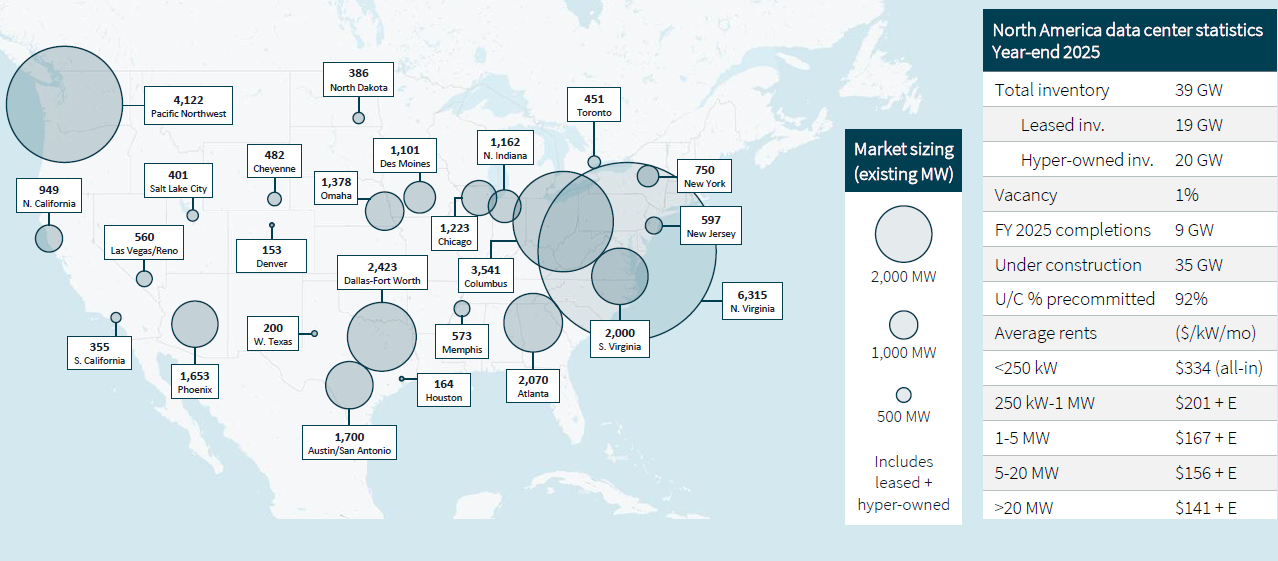
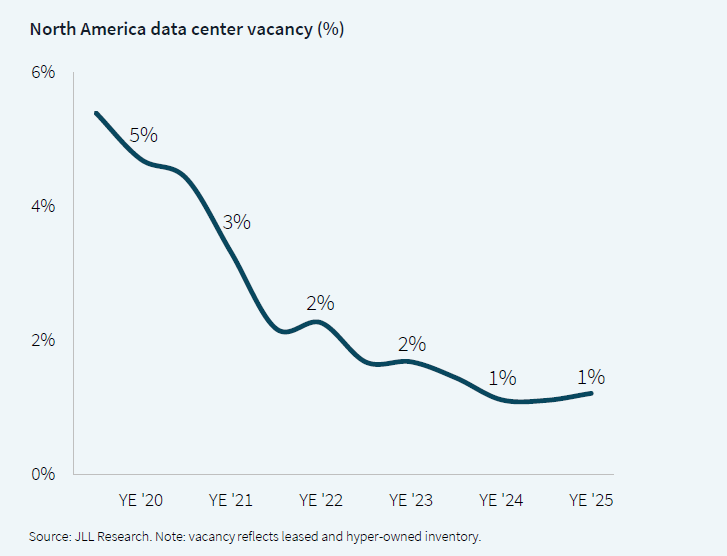
Meanwhile, vacancy has remained at a record-low 1 percent for two straight years, and 92 percent of that 35 GW construction pipeline is already preleased or committed.
Currently, JLL is tracking 39 GW of active capacity across North America, roughly half of which is leased and the other half owned by hyperscalers.
READ ALSO: Top 10 Data Center Developers
The data center sector has officially entered hyperdrive, Andy Cvengros, executive managing director & co-lead of U.S. Data Center Markets at JLL, said in a prepared statement. He added that record-low vacancy sustained over two consecutive years provides compelling evidence against bubble concerns, especially when nearly all the construction pipeline JLL tracks is already preleased by investment-grade tenants.
That supply scarcity is pushing rents higher, by an average of 9 percent in 2025, illustrating ongoing data center industry trends. “Rent growth was broad-based across all deal sizes, with listings greater than 1 MW commanding premium increases of 13 percent,” JLL stated.
As construction grows, so too does demand for power, such that hyperscalers and other major data center tenants have to secure capacity years in advance and/or expand into those frontier markets with more available power resources.
Developers who work closely with utilities on creative approaches—like flexible load profiles, phased power demand or backup generation—can often speed up the grid connection process, stated Matt Landek, global division president of data centers and critical environments at JLL. He added that major hyperscalers and leading operators have reached carbon-neutral data center operations through large-scale renewable energy procurement, demonstrating how sustainability requirements increasingly drive site selection, facility design and operational strategies.
Environmental pushback intensifies
Growing public and political pushback over data centers’ environmental costs has followed the recent development boom, so Commercial Property Executive asked for JLL’s thoughts on this.

“The industry has undergone a significant redesign of cooling systems to reduce water consumption and will continue advancing these technologies, driven by companies meeting their own environmental goals and cutting operational costs,” Curt Holcomb, vice chairman of data center solutions, told CPE. “Innovation includes closed-loop liquid cooling systems that recycle water for years and direct-to-chip cooling advances, while nuclear energy moves from planning to implementation.”
He noted that the industry’s latest “zero-water data centers” use only about 8,000 gallons daily. That’s roughly the equivalent of fewer than 30 average U.S. households.
As to the electric side, Holcomb said, the U.S. electrical grid has seen minimal investment over the last 20-plus years and needs new investment.
READ ALSO: The Hyperscaler Effect on NoVa’s Industrial Market
“This investment,” he continued, “will be funded by the data center industry through upfront payments for transmission upgrades and power purchase agreements for new generation from clean sources including solar, wind, nuclear and natural gas.” He added that the industry expects to transition from 40 percent clean energy today to 60 percent by 2035, creating more sustainable and community-integrated facilities that support rather than hinder the overall data center expansion.

With respect to AI specifically, Ram Srinivasan, JLL’s managing director of consulting, future of work, AI transformation & data center advisory, added that every transformational technology goes through a maturation phase moving from infrastructure buildout to real enterprise value creation.
“Today’s tech leaders have lessons from history at hand and recognize the need to be more disciplined than the dot-com era,” he continued. “The dot-com era investments laid millions of miles of fiber that built the digital economy. Similarly, today’s AI investment is creating durable infrastructure and capability. We’re transitioning from experimentation to execution, and that’s exactly where lasting value emerges.”




You must be logged in to post a comment.