


MBA–CREF Special Report: Surveying the Lending Landscape
Which lenders and capital structures are coming out on top in this investment cycle?
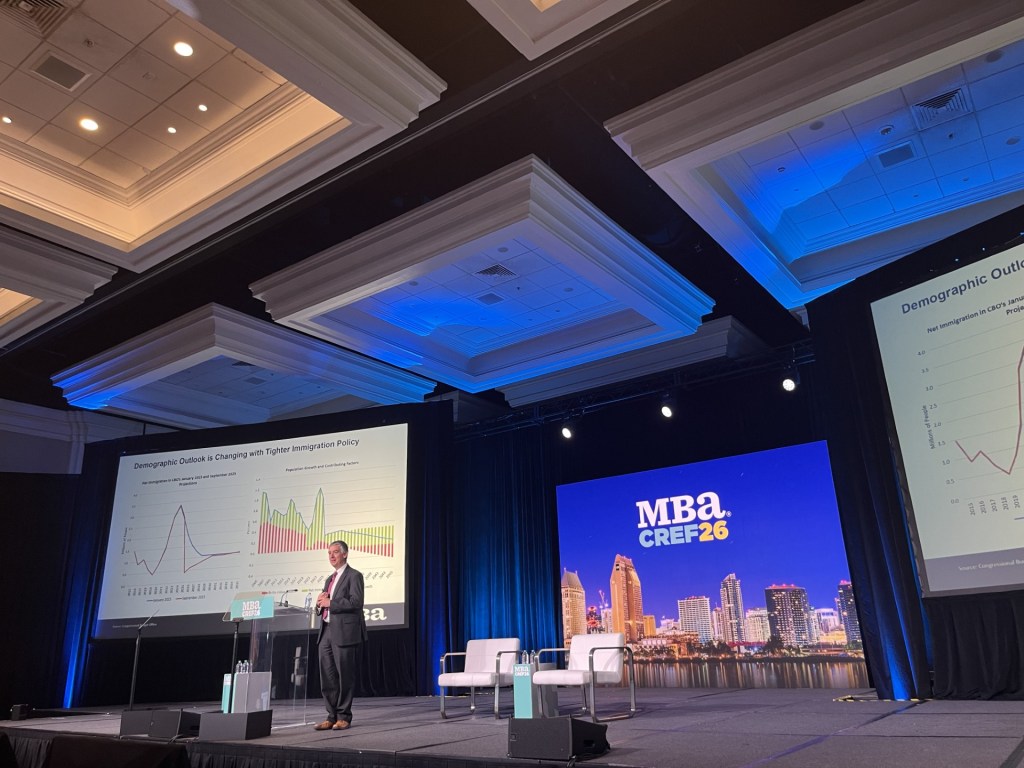
If you’re expecting any drama in the commercial real estate finance world beyond predicted loan maturity and origination volumes, you might be a little disappointed.
This ‘more of the same’ mindset prevailed on the first day of the Mortgage Bankers Association’s 2026 Commercial Real Estate Finance conference, hosted in San Diego.
Consequently, commercial real estate lenders, originators and investors of all sizes showcased a series of more refined strategies, ones that favor distinct asset classes and capital structures in this new financing world.
CRE lending’s strong year
Much of the certainty was set by the MBA’s economic and commercial real estate finance outlook, led by Chief Economist & Senior Vice President of Research and Business Development Mike Fratantoni.
Fratantoni’s team projected one interest rate cut this year by the Federal Reserve, at the lower end of most forecasts. “We don’t see them moving very much, with little movement in the 10-year Treasury (yields) as well,” Fratantoni said while presenting the data. That latter figure sits at 4.18 percent, roughly level with that of September of last year. “The Fed’s probably done, or close to done,” Fratantoni added.
Slowing demographics brought on by an aging population and tough immigration policy, a sluggish labor market, rapid advancements in artificial intelligence and a gradual devaluation of the U.S. dollar dovetail into what Fratantoni referred to as an “inconsistent, K-shaped” economy.
Still, the mortgage market remains “strong,” according to Fratantoni, with $634 billion in new commercial real estate loan originations taking place in 2025, according to the MBA’s originations index. That number is expected to increase to $805 billion this year, a 27.2 percent delta. A further $875 billion, or 17 percent of $4.7 trillion in outstanding commercial mortgages, are set to mature in 2026 as well. “That’s quite a lot that needs refinancing this year,” Fratantoni reflected.
READ ALSO: Investors Plan to Buy More CRE in 2026
The biggest debt holders include depositories, Government Sponsored Enterprises and commercial mortgage-backed securities, totaling 37 percent, 21 percent and 16 percent of debt, respectively.
Banks, private investors and GSEs all saw the biggest jumps in their origination volumes in the 2024 through 2025 period, with their lending increasing by 74 percent, 59 percent and 27 percent, respectively. “It’s a massive growth in capital sources, especially during this recent period,” said Judith Ricks, the organization’s associate vice president of commercial real estate research. “Even if we size the market and scope it out from a mortgage debt outstanding perspective, we see a long trend over time.”
A potential alarm bell for the MBA are loan delinquency rates, which saw a bump to 3.9 percent in the third quarter of 2025. “It’s still sitting at a relatively low level,” Ricks noted. “We’re keeping an eye on it but, are not necessarily all that worried about it.”
Capital adapts

Today’s most favored lending terms are starkly different from those of even half a decade ago, according to panelists speaking at a breakout session titled Shorter Terms, Smarter Deals.
The ever-more steep yield curve and tightening credit spreads have led to lenders and investors favoring shorter-term loans, with the five-year duration becoming a favorite for both groups. “If you look at loan volumes since 2021, 75 percent of them have been five years or less, and if you look at the previous five years it was 55 percent,” detailed Jason Hernandez, Nuveen’s head of commercial mortgage investments.
Institutional investors have enjoyed these structures the most, with the flexibility brought on by shorter-term financing serving as a hedge against the inherent uncertainty of the market. “It feels like home prices before the Global Financial Crisis,” said Nate Barnson, managing director of production at Northmarq’s Salt Lake City office. “Nobody wants to lock in a 10-year bet right now,” agreed Julie Thick, market manager of the central region for the Real Estate Banking Group at JPMorgan.
As for which investment types and asset classes are piquing investors’ interests, there’s a return to form for office investments and value-add funds, the first of which saw a 20.2 percent increase in sales activity, according to Yardi Matrix information. “It’s okay to do an office loan now, which is great,” said Wally Reid, senior managing director & debt platform leader at JLL Capital Markets. “Our sales pipeline is up 77 percent compared to last year, and 80 percent over that,” Reid added.
For their part, equity investors have taken a liking to the value-add space. Despite its higher risk, the investment type yields some of the strongest returns relative to the capex going into acquired assets. “It’s much less about borrowers’ views on rates, because capital flows will always trump fundamentals,” Hernandez noted. “Hope is not a strategy, but the capital flows drive it more than anything else.”






You must be logged in to post a comment.