


What Amazon’s Store Closures Signal for Retail CRE
Experts discuss the challenges and risks property owners face.
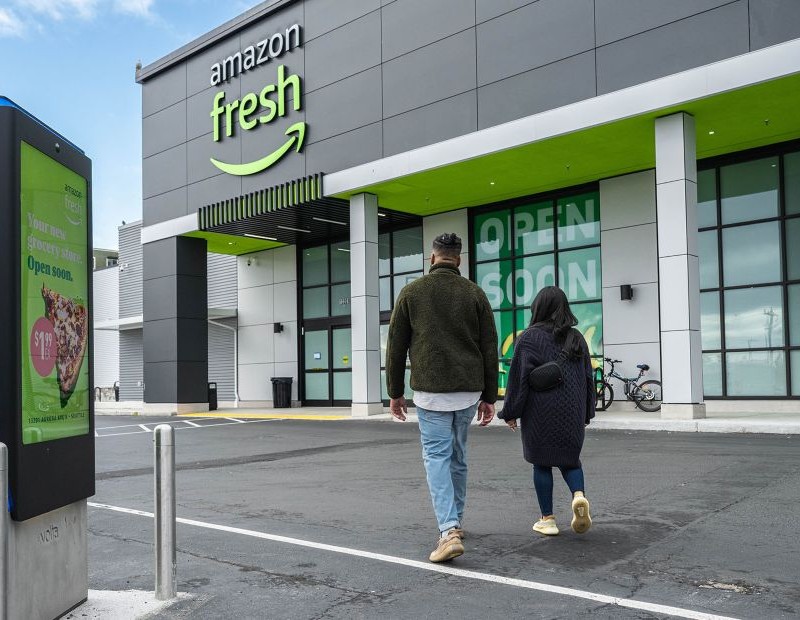
Amazon’s decision to close all 57 Amazon Fresh and 15 Amazon Go physical locations around the U.S.—a total of more than 2 million square feet of retail space nationwide—comes as the e-commerce giant plans to shift investments to its online grocery delivery and an expansion of its Whole Foods Market brand.
Retail experts tell Commercial Property Executive backfilling those locations will be easier in some areas than others, amid uneven retail market trends across major U.S. metros. In fact, Amazon may repurpose some of the properties themselves with other branded physical stores, including Whole Foods Market and Whole Foods Daily Shop, a smaller store format ranging from 7,000 to 14,000 square feet designed for quick shopping trips with a selection of grab-and-go meals, fresh produce, coffee and everyday essentials. Amazon is operating five Whole Foods Daily Shops and plans to add five more by the end of 2026.
“Some of the largest Go stores could become a Whole Foods Daily Shop, and many of the Fresh stores could become Whole Foods Markets, since Amazon said it plans to add more than 100” in the next few years, said John Harmon, managing director of technology research at Coresight Research.
READ ALSO: Saks Global Bankruptcy Part of Retail Real Estate Evolution
The company did not disclose which of the Amazon Fresh and Amazon Go locations might be transitioned into those or other concepts but stressed in an announcement Tuesday that it is still investing in physical stores and had seen encouraging signals despite deciding to pull the plug on those formats. For example, Amazon said the Amazon Go locations served as innovation hubs where the company developed its Just Walk Out technology. The checkout-free solution is now used in more than 360 third-party locations across five countries, cutting down waiting times significantly.
One day after Amazon announced it was closing the Amazon Fresh and Amazon Go stores, it said it was cutting about 16,000 corporate employees, the second round of cuts since October, when it laid off about 14,000 white-collar workers. While some of those jobs will come from the store closings, the majority of jobs lost will be part of ongoing efforts to streamline the company after several years of post-pandemic hiring.
Challenges for property owners
John Chang, chief intelligence & analytics officer at Marcus & Millichap, said the greater impact will come from Amazon Fresh closures, which are concentrated in Philadelphia, Chicago, Los Angeles, Washington, D.C., and the Inland Empire and Orange County in California.
Coresight Research notes there were 22 Amazon Fresh locations in California, the most of any region across the country.
According to Chang, the properties average nearly 40,000 square feet, meaning the company will vacate more than 200,000 square feet of space in each metro.
“Fortunately, supermarket vacancy across these markets ranges from 2 percent to mid-4 percent, with grocery store-related construction activity limited to select build-to-suit projects,” Chang told CPE. “These dynamics, and many of these stores’ presence in well-located suburban shopping centers, may improve prospects for property owners seeking to backfill these spaces.”
Chang said the closures may provide opportunities for regional supermarket chains to expand their footprints.
“Meijer and Giant represent several grocers eyeing Philadelphia, while specialty grocery chains, including T&T Supermarket, are growing their market share in Southern California. Amazon may also consider some of these locations for future Whole Foods Market stores,” he added.
Chang also noted off-price stores like Burlington, Goodwill, Ollie’s Bargain Outlet and Ross have been among the most active backfillers of larger-format space. He said Wayfair is also establishing a physical presence in large-scale immersive stores. Fitness facilities are actively leasing in community and neighborhood centers, primarily seeking 20,000- to 50,000-square-foot spaces.
Brandon Isner, head of U.S. retail research at Newmark, said it could be a challenge to fill the large spaces in urban areas.
“The larger the space, the smaller the pool of retail occupiers who are looking for that size of space,” he mentioned.
Peter Braus, president of Lee & Associates, NYC, said the retail cost structure in places like New York City is unforgiving because of high rents, high labor costs, complex logistics and expensive buildouts.
He noted that the impact on New York City’s retail market would be minimal since there were only a limited number of Amazon Go in the city and a very small Amazon Fresh presence in the region.
“This isn’t a mass vacancy event, but it is symbolically important,” Braus continued. “If a company like Amazon can’t make certain physical formats scale here, it reinforced that brand strength alone doesn’t guarantee retail viability. The economics still have to work at the unit level,” he mentioned.
While some spaces may be taken over by local grocery operators or companies like H Mart, which is aggressively expanding in New York City, Braus said that won’t be universal and he does expect many landlords will still face repositioning and re-tenanting challenges.
Different types of risk
Braus also added the Amazon-branded closures highlight a strategic risk rather than a credit risk.
“Amazon isn’t exiting because of financial distress. It’s reallocating capital to higher-performing channels. That’s a growing reality in retail real estate,” he noted. “It puts renewed focus on lease durability. Owners need to underwrite not just the tenant’s balance sheet, but the durability of the business model itself. Is the concept proven, repeatable and scalable—or experimental? Those are two very different risk profiles.”
Braus mentioned innovation-driven tenants bring visibility, foot traffic and modernization to retail corridors, but they may not be permanent anchors.
“The landlords who perform best long-term are the ones who structure leases and asset strategies to treat innovative concepts as flexible components of the tenant mix—not irreplaceable cornerstones,” he said.
Isner noted that despite the risk, retail remains “remarkably tight given the wild rise the market has experienced over the past several years, including rebounding from the pandemic, navigating the new tariff policy and the overall lack of prime space for retailers to expand into.”



You must be logged in to post a comment.