
Uncategorized
The Lineup: New York
To be administered by New York State Energy and Research Development Authority (NYSERDA), New York’s soon-to-launch $1 billion green bank will look to enhance private credit and round out capital stacks when lenders are unwilling to cover entire project costs. In September, NYSERDA formally requested the bank’s first round of capitalization funds, amounting to about $165 million in previously uncommitted tax revenues, from the Public Service Commission. The state bank will aim to help facilitate markets for credit-enhanced bonds backed by pooled clean-energy loans. Warehousing such loans before securitization will help standardize loan terms – and will also help get…
The Lineup: Connecticut
Billed as the nation’s first state green bank, Connecticut’s Clean Energy Finance and Investment Authority (CEFIA) consolidates existing energy-related funding activities. To minimize any new taxes funding CEFIA’s activities, the state imposed an electricity ratepayer surcharge (amounting to less than one cent per kilowatt-hour) that is expected to generate $30 million for CEFIA programs annually. The state also rolled $18 million into CEFIA’s capitalization from the existing Connecticut Green Loan Guaranty Fund. And CEFIA has the authority to issue as much as $50 million in bonds that would be backed by the state’s special capital reserve fund. With respect to…
Insurance Strategies: Top Tips from the Experts
Navigating insurance policies can be a challenging exercise for commercial real estate executives. Following is a short list of best practices offered by a variety of underwriters, carriers and real estate professionals.
Cutting Storm Losses
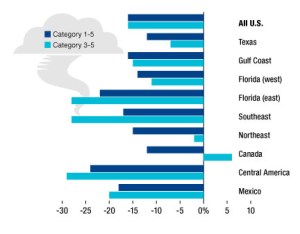
Insurance carriers are closely watching the effects of global climate change as they assess risk for commercial real estate properties. According to a widely circulated new projection by Risk Management Solutions, a risk modeling and consulting firm, the next several years may present a paradox. Storms on the North Atlantic are expected to increase in frequency; however, RMS expects fewer of them to make landfall. As a result, insured losses related to Atlantic storms are expected to decrease significantly during the next five years.


Be Aware of ‘CAM’ Expenses
By Randolph T. Mason, CCIM, SIOR, Partner, Commercial Realty Specialists: Occasionally, a landlord may attempt to use the common area maintenance expenses as a profit center. It’s not uncommon to have the tenant reserve the right to audit the landlord’s expenses.

Shades of ’06-’07 Emerge for U.S. Equity REITs of ’13, But Much Has Changed
By Steven Marks, Head of U.S. REITs, Fitch Ratings: Recent bond yield spreads are signaling familiar territory, though Fitch Ratings is observing that U.S. equity REITs have a decidedly different plan of action during this credit cycle.
Politics & CRE Sales (Déjà Vu)
By Kenneth P. Riggs Jr., Chairman & President, Real Estate Research Corp.: The failure of Congress and the administration to reach a budget agreement before Oct. 1, the possibility that the debt ceiling will not be raised before the nation is unable to pay its obligations, and the huge swings in the stock and bond markets are all too familiar.

Somebody Turn the Lights Back On
By Marcelo Bermúdez, President, Figueroa Capital Group, subsidiary of Charles Dunn Co.: As of Oct. 15, a deal is within striking distance to give the Fed authority to borrow through mid-February 2014.