

The Growing Appetite for NNN-Leased Restaurants
Single-tenant retail deals are up 20 percent year-over-year.

Private real estate investors are increasingly reshaping their portfolios based on market shifts, their own risk tolerance and management preferences and tax considerations. One notable trend is the growing volume of capital flowing into single-tenant, triple-net-lease retail properties, particularly those leased to nationally recognized brands that serve everyday needs—like fast-casual and quick-service restaurants.
Transaction activity in the sector reflects that demand, with single-tenant net-lease retail deals increasing 18 percent year-over-year through the first three quarters of 2025, according to research from Marcus & Millichap.
For many investors, the appeal lies in a combination operational simplicity and tax efficiency. Properties leased under long-term, absolute triple-net agreements typically shift property taxes, insurance and maintenance obligations to the tenant, leaving the owner with minimal day-to-day responsibilities while providing reliable income.
Why restaurant net-lease assets stand out
Within the net-lease market, restaurant properties have emerged as a particularly attractive investment opportunity. These tenants, especially those operating quick-service or fast-casual concepts, have driven some of the highest demand in the sector in recent years.
Real estate investors have the opportunity to benefit from the success and expansion of these brands. In some cases, these locations are developed by the corporate operators themselves or by preferred development partners before the real estate is then sold to private investors and leased back under long-term agreements. The result is a purpose-built asset with a credit tenant already in place, allowing investors to acquire stabilized properties that generate income from day one.

For example, we recently worked with a private investor who owned a 24-unit multifamily property in Redwood City, Calif., and sold the asset for approximately $9.3 million. The proceeds were redeployed through a 1031 exchange into two newly constructed triple-net retail properties in Texas and Florida.
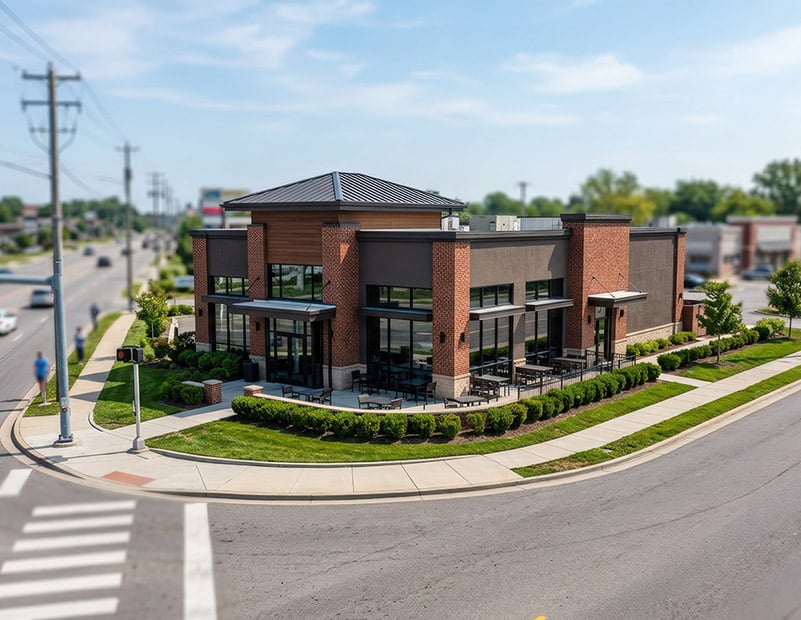
The acquired assets include a Chipotle Mexican Grill location in the Tampa Bay area and a Chick-fil-A in Austin. Both properties were purpose-built restaurant locations leased to nationally recognized brands under long-term agreements.
For the investor, the exchange allowed for a transition from an actively managed apartment property to assets with long-term leases and limited landlord responsibilities. It also provided geographic diversification, shifting a portion of their portfolio from California into two high-growth Sun Belt markets.
Tax considerations shaping portfolio decisions
For many private investors, tax strategy is also an increasingly important factor shaping where capital flows. Investors who have accumulated significant gains are often looking for ways to offset tax exposure while preserving capital for reinvestment. Net-lease real estate offers several advantages in this regard, including depreciation and cost segregation strategies that can help offset income or capital gains.
Recent tax policy changes are also helping drive new and reallocated capital into net-lease real estate. The restoration of 100% bonus depreciation, combined with the continued availability of 1031 exchanges, allows investors to preserve capital that would otherwise be lost to taxes and redeploy it into assets that better align with their evolving investment strategies.

Even long-time property owners may not fully realize the range of tax tools available. For instance, we’ve seen that families who inherited apartment buildings or smaller commercial properties decades ago often discover that exchanging into newer net-lease assets can simplify ownership while maintaining tax advantages.
Geography also plays a role in these decisions. Many investors are increasingly directing capital toward Sun Belt markets such as those within Texas and Florida, where population growth, business migration, and favorable tax environments support long-term fundamentals.
Shifting investor priorities
More broadly, we are seeing a shift among private investors who are reevaluating how their real estate holdings fit into long-term financial and estate planning strategies.
Investors who accumulated wealth through hands-on ownership of apartment buildings or smaller commercial properties are increasingly seeking assets that require less active management. At the same time, migration trends and tax policy differences between states are encouraging many investors to diversify beyond traditional coastal markets like California.
Purpose-built, triple-net-leased assets, particularly those leased to established national restaurant tenants, can provide an efficient way to balance risk, stabilize income and simplify ownership structures.
Adam Levin is executive managing director of Levin Johnston of Marcus & Millichap. Robert Johnston is executive managing director of Levin Johnston of Marcus & Millichap.
Please note: To become a Viewpoint writer, reach out to Therese Fitzgerald at therese.fitzgerald@cpe-mhn.com. All Viewpoints are copyright of Commercial Property Executive 2026. We do not accept AI-written content.





You must be logged in to post a comment.