


RETCON Special Report: How CRE Is Seizing the AI Revolution
For this new wave of tech, the industry is ahead of the curve.
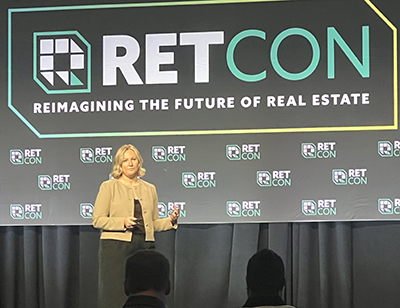
Technology today is a fast-moving train, and commercial real estate professionals are along for the ride as they seek efficiencies, faster decision-making and a better tenant journey. But they’re not looking to buy vendors’ prepackaged tools. They want technologies that are configured for their businesses and that can be adjusted as their organizations change and grow. And they want solutions that can integrate with their other platforms—no more siloes. In some cases, they’re building the tools themselves.
“We can’t just have a black box,” said Justin Segal, president of Boxer Properties, during Day 2 of the RETCON conference and expo in Las Vegas. “We need to see what’s going on in there.”
Managing your own technologies in partnership with outside vendors was a recurring theme throughout the conference, which drew 2,000 CRE and technology professionals to discuss new innovations and how best to implement them. Here are some of the other important topics discussed on the second day.
Change is a permanent condition
In a presentation inspired by the music of the late David Bowie, CBRE’s Spencer Levy told attendees to be like Bowie. “He kept changing,” said Levy, global client strategist & senior economic advisor for CBRE. “He kept innovating.”
AI is going to change everything we do, and we need to adapt to it, Levy said. He also identified other changes or megatrends offering opportunity today, including REIT M&A, data centers and other infrastructure, manufacturing space and industrial outdoor storage.
Agentic AI and CRE are well-matched
AI is thought to be more impactful than electricity or the Internet and it is growing at a rate much faster than those advancements, said Taylor Blades, industry principal for Yardi, during a session on how agentic AI is reshaping multifamily. And, as AI moves rapidly into its second phase with agentic AI, the real estate industry will benefit tremendously.
“The last wave was really focused on data and forecasting,” Blades said. “This next wave is focused on operationally complex tasks, and so we’re poised to take advantage of the wave.”
READ ALSO: How AI Is Reshaping CRE One Agent at a Time
How fast is agentic AI growing? Blades displayed a chart by Metric that showed how in 2019, large language models could complete a 30-second long task. In 2022, it could handle a six-minute task. In 2025, AI could complete a task requiring one to six hours. “We closed 2025 at six hours,” Blades said, “and today three months into 2026, we are at 12 hours. In three months, the length of tasks that AI could handle doubled.”
Speed is the differentiator
As AI moves from “automation to agency,” as Blades put it, it’s not just property managers taking advantage. Investors are also using AI tools for underwriting, entitlements, zoning and more, leading to much faster decision-making and making speed a key differentiator.
“I think the expectations from our brokerage partners who are marketing deals, especially marketed deals, is they are looking for answers within days, not weeks,” said Martin Pupil, executive managing director & partner for Stream Realty Partners speaking on a panel titled “Process & Progress: Creating a Frictionless Future for CRE.”
AI is also helping investors see more opportunities and to sort through them faster. “Where I see our team saving the most amount of time is responding to opportunities “yes” or “no” fairly quickly, keeping everybody happy during the process,” said Chad Porat, chief investment officer for Faropoint.
Standardization is essential
Standardization of technology and cybersecurity protocols across portfolios has become increasingly important to prevent the increasing threats of fraud and cyberattacks. And, if there is an attack, standardized systems will make it easier to find the problem. Seems like common sense today, but it can be a challenge for third-party managers to get all of the clients to install the right infrastructure, especially when the owner does not plan on owning the property for long.
“We’ll set up a meeting,” said Jackie Ware, CEO of Pegasus Residential, during a panel titled “Reliable, Secure and Scalable IT: Two out of Three Ain’t Bad.”
“We’ll show them what’s at risk and give them the worst case scenarios because it’s just about mitigating your risk. ‘What are you willing to risk if you don’t set things up correctly.'”
AI for the science and humans are for the art
Throughout the conference, the question was raised: As AI becomes more agentic, what are the professional skills that will thrive and survive? What attributes should you be looking for in your new hires?
“The relationship is going to be the part of real estate that’s going to be unique to humans, and that’s what we emphasize when we build our new, call it human capital,” said Porat, noting that new hires must also be AI natives.
Justin Segal, president of Boxer Properties, suggested companies should be hiring for aptitude and personality first, while experience and skills come second.
That’s because AI can perform many of the required skills, and a person’s experience may conflict with new ideas and new ways of doing things. “There is no framework for that,” Segal said, but his company has developed one that includes personality tests.





You must be logged in to post a comment.