

Manhattan Office Market Strengthens Its National Lead
Declining vacancy and a significant construction pipeline reinforced the borough’s standing across key metrics.
Manhattan’s office market fundamentals improved significantly through September, with several key metrics pointing to stronger performance despite the broader sector’s lingering challenges, according to Yardi Matrix data.
The borough recorded the lowest office vacancy rate in the country, overtaking Miami. Its construction pipeline also surpassed Boston’s, becoming the nation’s largest in both overall and competitive office space under construction.
Manhattan maintained its lead in office investment volume and average sale prices, although pricing moderated since our previous coverage. Meanwhile, the borough continued to command the highest asking rents in the U.S. and retained its position as the country’s largest coworking market.
Manhattan office construction activity leads nationwide
As of September, the Big Apple had 5.6 million square feet of office space underway across 11 projects, representing 1.2 percent of its existing stock. The metro led nationwide, followed by Boston (3.3 million square feet) and Miami (2.9 million square feet).
As for competitive space, Manhattan had 3.4 million square feet of space under construction, accounting for 0.8 percent of its total stock—above the 0.5 percent national average.
Four gateway cities had pipelines below 1 million square feet, including Chicago (251,930 square feet) and Seattle (15,910 square feet), highlighting ongoing challenges for new development.
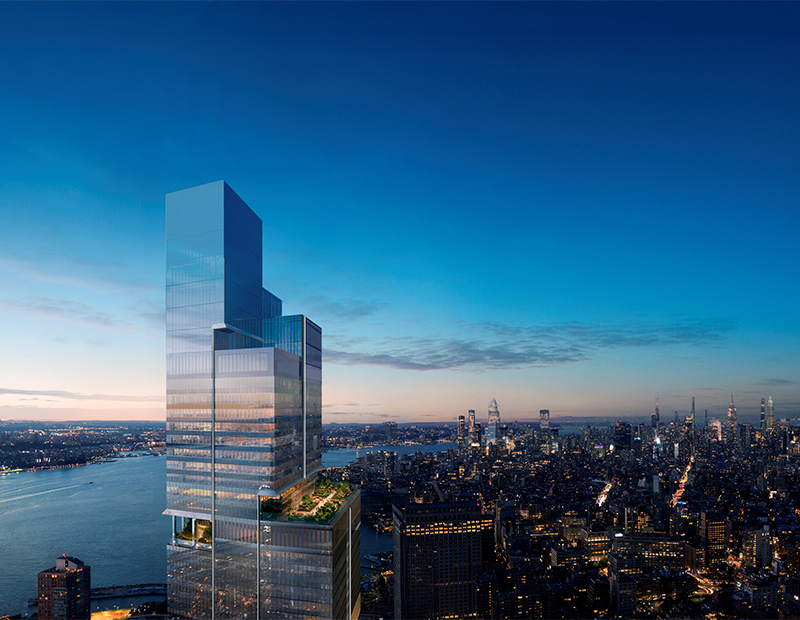
The largest office project currently under construction is Two World Trade Center. Silverstein Properties broke ground on the 2 million-square-foot property that will serve as American Express’ new global headquarters, in July this year. The office component of the 55-story tower will total 1.6 million square feet. The high-rise is expected to come online in 2031 as the final component of the World Trade Center redevelopment.
Only one office project totaling 210,882 square feet came online in Manhattan year-to-date through September, marking a 75 percent year-over-year decline in deliveries. In June, Rabina Properties completed 520 Fifth Ave., an 88-story mixed-use tower in the Plaza District featuring 25 floors of office space and 100 condominiums.
Lowest vacancy and highest rents in the U.S.
Manhattan’s office vacancy rate fell to 10.2 percent as of September—below the 17.8 percent national average and the lowest among the top 25 U.S. office markets. The rate also declined 260 basis points year-over-year. Among markets with notable recoveries, the Big Apple recorded the third-highest year-over-year vacancy improvement.
Gateway markets that followed included Miami (11.6 percent) and Los Angeles (14.5 percent). San Francisco recorded the highest vacancy nationwide, at 26.7 percent.
Manhattan’s average asking rents reached a nation-leading $72.03 per square foot in September—more than double the $33.18 per square foot national average. San Francisco ($64.92 per square foot) and Miami ($61.26 per square foot) followed. In contrast, Chicago ($27.99 per square foot) and Seattle ($35.17 per square foot) were the gateway cities with some of the most affordable rents.
Nationwide, office visits reached new post-pandemic attendance highs in June, according to Placer.ai. In New York City, visits were only 4 percent below 2019 levels.
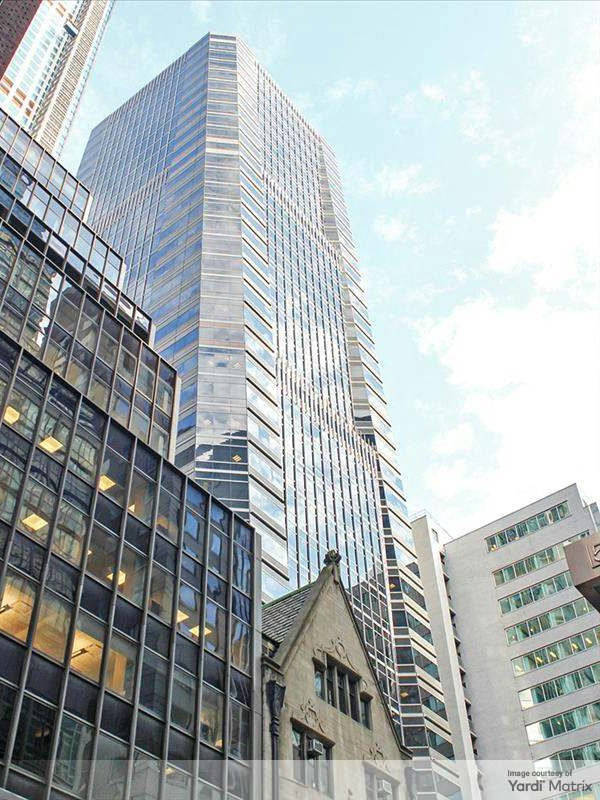
Among Manhattan’s recorded notable third-quarter leases this year was General Atlantic’s 150,000-square-foot commitment at Related Cos.’ 625 Madison Ave., an office project in the Plaza District. The anchor tenant will take five floors and will establish its global headquarters at the 53-story tower.
In August, Capital Group signed a 10-year lease for the entire 70,400-square-foot fourth floor at Rudin’s 345 Park Ave., bringing the tower to full occupancy.
Manhattan dominates office investment rankings
Manhattan’s office investment volume reached $5.7 billion year-to-date through September, maintaining its position as the national leader. The Bay Area ($4.6 billion) and Dallas ($3.7 billion) followed, while San Francisco ($3.2 billion) and Washington, D.C. ($2.9 billion) ranked fourth and fifth, respectively. At the other end of the spectrum, Seattle recorded the lowest investment volume among gateway markets, with $574 million in sales.
During the same period, Manhattan office space traded at an average of $585 per square foot, nearly three times the $197 per square foot national average and the highest pricing in the country.
San Francisco ($470 per square foot) and Miami ($405 per square foot) followed, while Washington, D.C. had the most affordable office pricing among gateway markets, at nearly $177 per square foot.
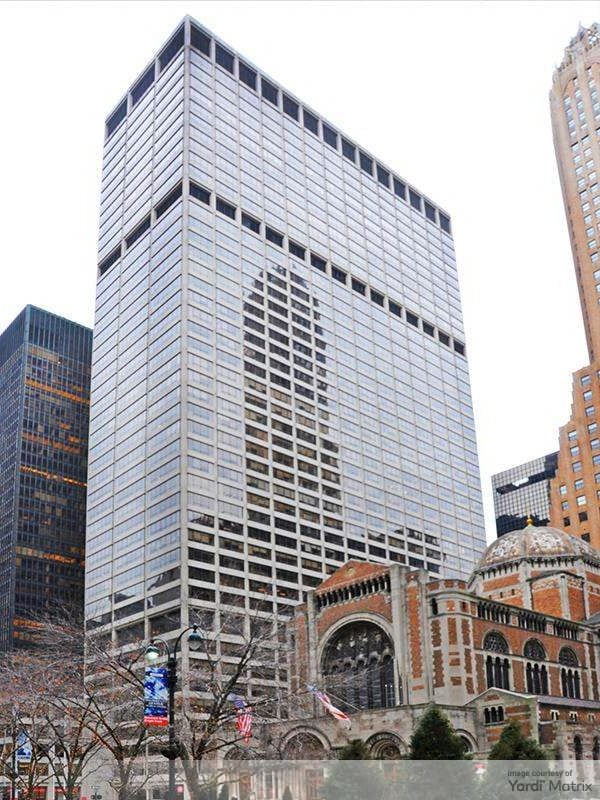
The largest office sale recorded during the first three quarters of 2026 remains SL Green’s $730 million purchase of Park Avenue Tower. The company completed the acquisition of the 35-story Plaza District tower after going under contract in October 2025. The building was added into a $480 million, five-year CMBS pool held by Wells Fargo, with participation from JP Morgan and Bank of America.
Manhattan’s coworking sector maintains national lead
Manhattan’s coworking sector totaled 12.3 million square feet across 307 locations as of September, according to CoworkingCafe, marking the largest inventory in the country. Flex office space accounted for 2.7 percent of the borough’s total leasable office inventory, above the 2.5 percent national average and on par with Los Angeles. Among gateway markets, Miami recorded the highest share at 5 percent, followed by Chicago at 2.9 percent.
he ranking of Manhattan’s five largest flex office providers by footprint has shifted since our previous coverage. WeWork retained its leading position, with 2.2 million square feet of coworking space. Industrious followed with 1.7 million square feet, while Grand Central Offices (848,640 square feet), Studio by Tishman Speyer (828,685 square feet) and Regus (669,604 square feet) rounded out the top five.



You must be logged in to post a comment.