

Industrial Outdoor Storage Surges Into Stardom
These properties may seem plain vanilla, but their strong performance is earning them an aura of glamour.
For properties that might look to the uninitiated like glorified vacant lots, industrial outdoor storage assets are rapidly evolving into star performers in the industrial sector, according to a new report from CBRE.
The company’s fourth-quarter 2025 report on U.S. industrial outdoor storage documents the niche’s unexpected acceleration, which has made IOS one of the best-performing segments in industrial and logistics real estate.
CBRE explains that “IOS facilities serve construction, utility, trucking, equipment and public-sector users by offering proximity to job sites and corridors while requiring only basic infrastructure, resulting in lower costs and more durable cash flow.”
The data underlying the report were filtered to include only properties with floor to area coverage less than 20 percent, 50,000 square feet or less of building space, and total parcel size less than 40 acres. In addition, only single-tenant, net-leased properties were tallied.
READ ALSO: Busy Ports Support Industrial Market Recovery
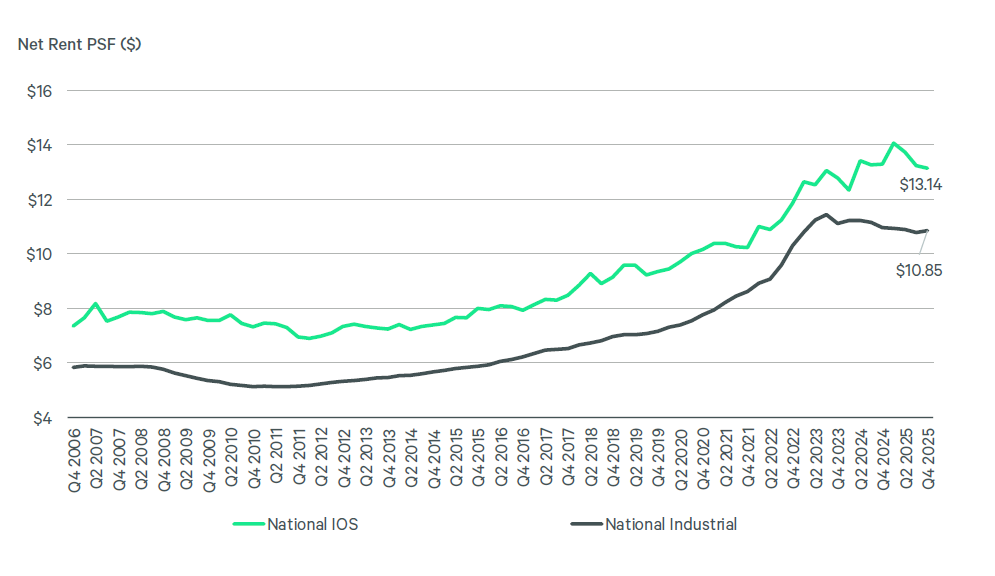
Based on those criteria, CBRE found that the national IOS rent premium climbed 17.9 percent over traditional industrial rents in the fourth quarter of 2025, widening year-over-year. Rents averaged $13.14 per square foot, outpacing traditional industrial at $10.85 per square foot in the fourth quarter of 2025.
In brief, IOS has become “one of the most constrained, and most competitive, asset classes in industrial commercial real estate.”
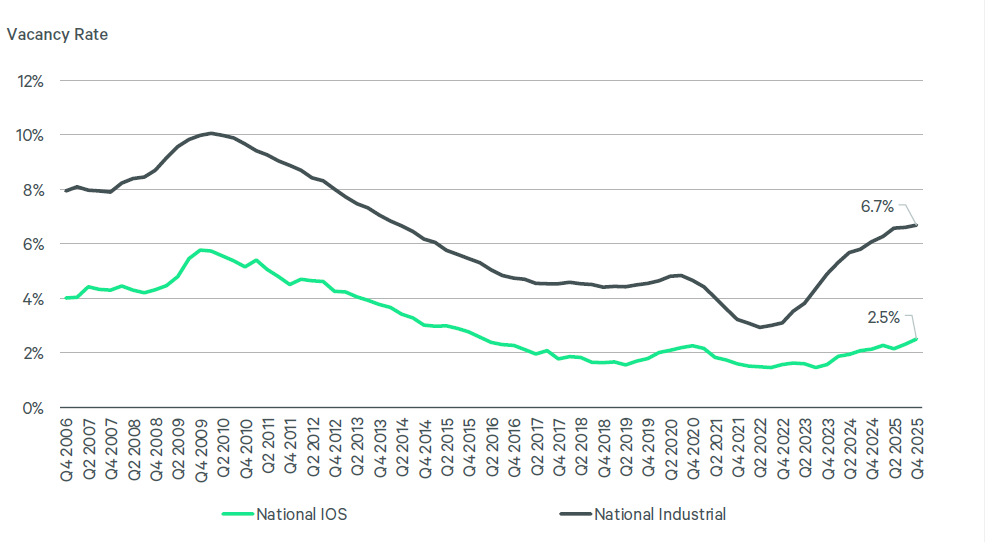
How constrained? In the fourth quarter, IOS vacancy averaged 2.5 percent, versus 6.7 percent for traditional industrial. Restrictive zoning and increasing local opposition have made development challenging, which has driven stronger tenant retention and consistent pricing power.
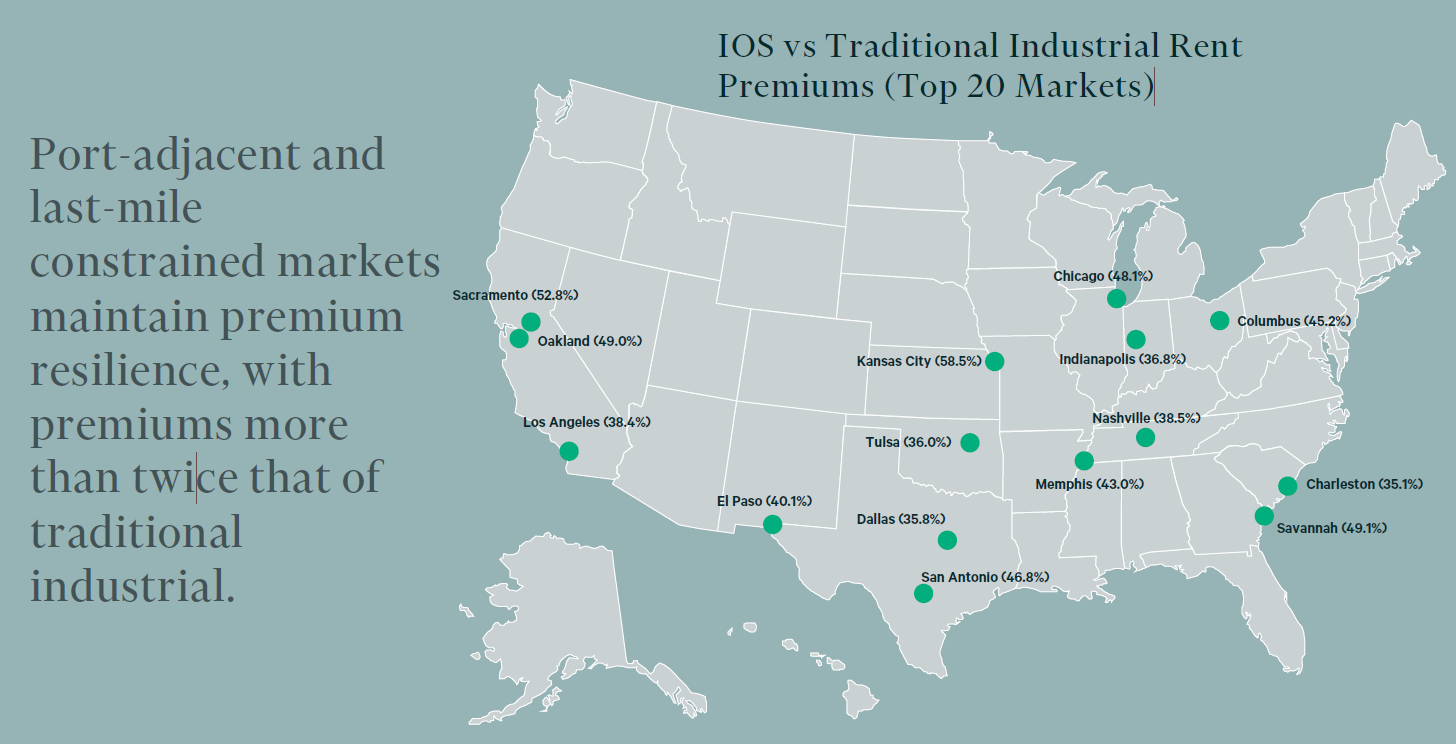
Some of the top metros for IOS rent premiums are secondary markets between major logistics hubs, such as Kansas City, Kan., Indianapolis, Charlotte, N.C., and Cincinnati.
CBRE tags Kansas City, Los Angeles, Savannah, Ga., Columbus, Ohio, and El Paso, Texas, as top emerging IOS markets.
A few deeper dives
James Breeze, CBRE’s vice president & global head of industrial research, Americas, gave Commercial Property Executive a close look at some of the report’s key points.
For example, one of the barriers constraining IOS supply growth, he said, is that “IOS sites tend to be in urban settings near logistics hubs (air, rail, truck or sea). These areas lack available land for additional IOS conversions or development.”

The rising demand noted by the report, Breeze said, arises from several sources including the growth in manufacturing, domestic energy production and increased infrastructure spending. “It makes more sense to store raw materials used in all these categories in outside storage yards rather than lease a warehouse at a much higher cost. They also tend to be logistics hubs, which give the items quick access to multiple transportation modes, lowering transportation costs.”
As to why net leases are prevalent in the IOS world, Breeze explained that this is because there is little building infrastructure to maintain. “As a result, it makes sense for tenants to pay for items like property taxes, insurance and maintenance of paving, fencing, lighting and drainage. This allows the tenants to control their own costs based on their needs and type of business,” he told CPE.
Finally, he noted that “there are few alternatives to IOS. The primary option is leasing a Class B or C warehouse with an available yard for outdoor storage.”



You must be logged in to post a comment.