


How Much Office Space Does a Chatbot Need?
Stakeholders need to get ahead of generational changes to where, when and how people work.
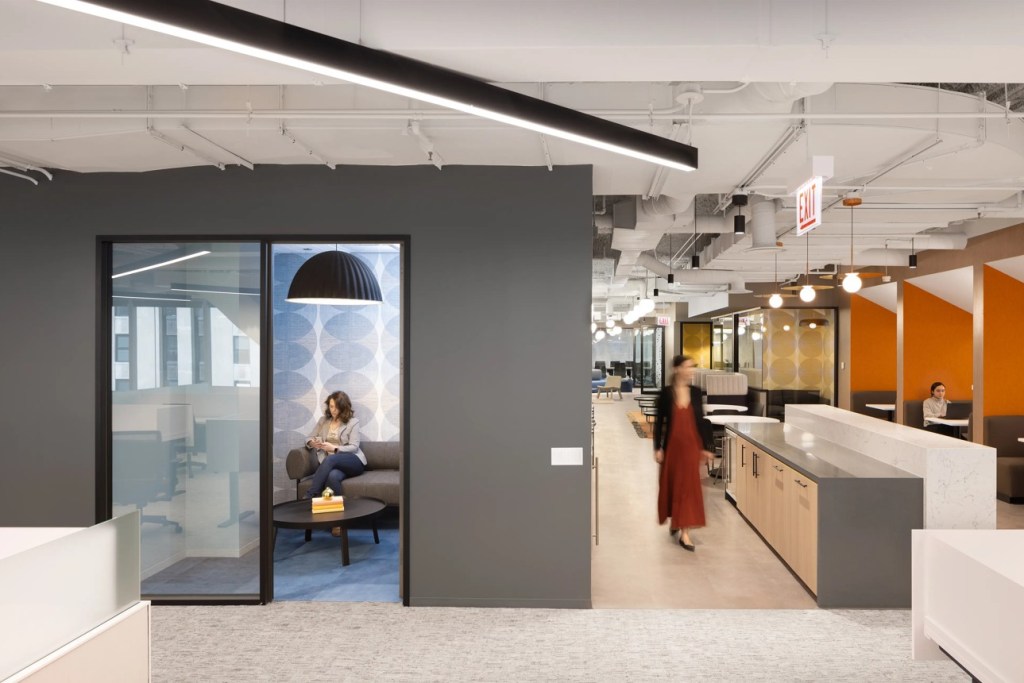
The widespread adoption of artificial intelligence by many white-collar industries has the potential to cause widespread disruption of the office market. But it may not be what you think.
A previously feared mass replacement of entry-level analytical jobs remains unlikely in the near term, but what’s more likely to persist is a recalibration of leasing strategies, property management techniques and space layouts to adapt to a more flexible, partially automated workforce.
While predictions around the specific impacts of automation adoptions may vary, experts agree that the sector may experience a more pronounced flight to high quality, with technology-centric spaces that operate more as dynamic business than static investments. In other words, it’s not so much a robot takeover as it is an accommodation.
“You think about roles that, to start, have more repetitive types of activities, such as call center staff, analysts, data entry, but it’s going to move up the value stream over time,” said Josh Herrenkohl, a senior managing director in FTI Consulting’s Real Estate Solutions practice. “It’s more likely to impact every industry and perhaps all levels of industry.”
Present, meet future

Despite rapid advancements in AI since ChatGPT’s launch three years ago, the actual threat of near-term mass unemployment and sky-high vacancy rates is small. An October 2025 report from Brookings Institution found minimal changes to the proportion of workers in the industries most exposed to AI from January 2023 through July of this year. Highly exposed, high-usage industries include sales, office administration, health care, tech and finance.
Over the next three to five years, however, the story begins to change more dramatically as AI becomes more agentic and better equipped to handle more repetitive jobs, while assisting, if not replacing, more complex tasks.
According to Indeed’s 2025 AI at Work Report, more than a quarter of jobs posted on the site last year were listed as being likely to be “highly” transformed by generative AI, while 54 percent will probably experience a “moderate” transformation.

What’s most at risk are entry-level, apprentice-style white-collar jobs such as customer service representatives, paralegals and analysts. And from the perspectives of some workplace strategy experts, this is already a reality.
“Most of our client organizations are focused on elements like drafting, summarizing research, code generation, report creation and email triage and drafting,” noted Ram Srinivasan, a managing director of consulting and workforce optimization expert at JLL.
Srinivasan sees agentic models as the next logical step. “Autonomous agents that are able to create and execute workflows for you and cognitive tasks could get completely modified through these models,” he said.
On the ground, the implementation remains at the surface level, but even most owners and operators anticipate a sudden, dramatic change. “We’re seeing implementation by law, accounting and financial services firms,” observed Ran Eliasaf, founder & managing partner at Northwind Group. “And currently, we aren’t seeing any immediate effects on leasing volumes, but two years from now, it’ll probably minimize (some) entry-level positions.”

Eliasaf’s firm has invested in Manhattan office properties, which are generally faring much better than their counterparts in other CBDs. “We think it’ll impact the leasing market, even if volumes are quite healthy right now.”
Nowhere is this idea more pronounced than the tech sector, which has seen more than 107,000 job cuts this year. Employment consultancy firm Challenger, Gray & Christmas tracked 7,000 job cuts due to AI specifically. On the agentic front, Salesforce CEO Marc Benioff announced in August that his company cut its customer service headcount nearly in half due in part to its implementation of AI agents that interact with customers directly.
As for the impacts on office leasing, look no further than life science, perhaps the most exposed industry of all. Challenger, Gray & Christmas’ 2025 life science market update found that the share of biotech-related venture capital investments skyrocketed in the period from 2022 through 2024. But companies are leasing one-third less space than comparable industries.
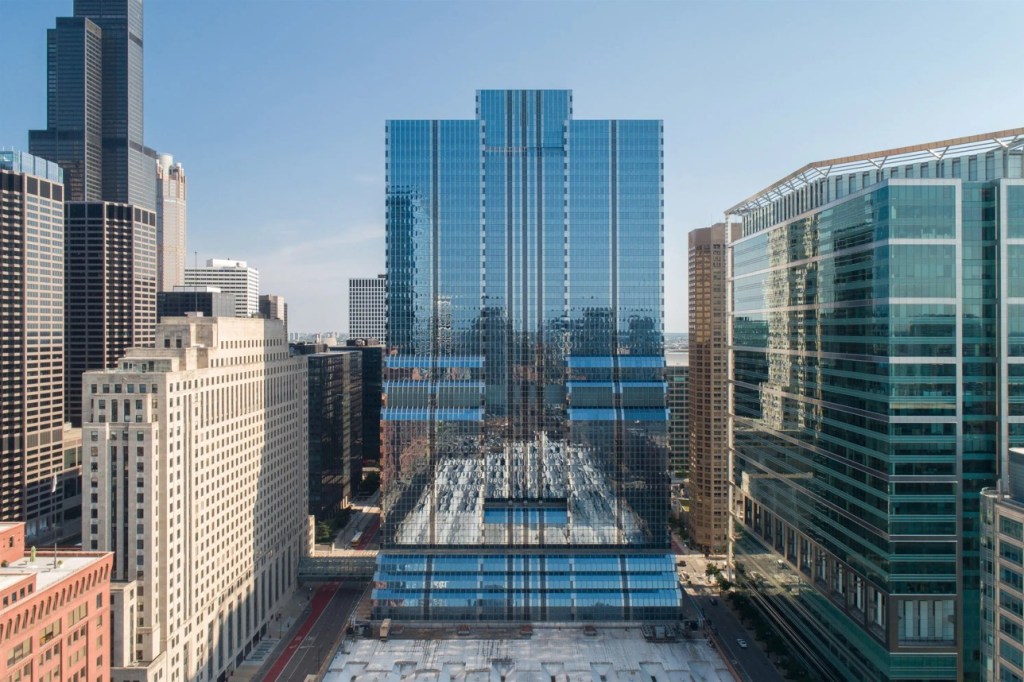
What’ll happen to office spaces?
Increasingly advanced uses of AI introduce a degree of uncertainty to commercial real estate that hasn’t been seen since the pandemic. In fact, the sheer pace at which the technology is evolving could completely warp lease durations as well as space needs.
“Even companies that don’t have AI to replace people specifically are much more worried about expanding, hiring or keeping people and signing long-term leases because they have no idea what their needs will be 18 months out,” said author & technology consultant Dror Poleg. Consequently, “the notion of a company being able to sign a 10- to 20-year lease is unimaginable at this point,” he added.

On a smaller scale, these trends are already playing out, with both new office leases and renewals falling below historical means, according to data from Avison Young.
“You’ll see a smaller footprint in core urban markets, on the order of 30,000 square feet or more,” Eliasaf predicted. “(They’re) not being cut in half, but that’s a possible 20 percent impact on office leasing. I’m not saying that that’s going to lead to 20 percent unemployment, but people will have to both upscale and rescale their spaces.”
If that sounds familiar to you, it probably is. Herrenkohl predicts that the sector could experience a bifurcation akin to the one that’s occurred in the years since the pandemic—but more pronounced. In other words, the urban, Class A amenity-driven buildings will fare well, while the B and C assets will suffer.
When ChatGPT was still in its infancy, a 2023 report from Cushman & Wakefield found that 25 percent of the nation’s office stock—roughly 1.5 billion square feet—could be functionally obsolete by 2030.
“When demand shrinks, tenants look for smaller footprints with better amenities —even if they’re paying more on a price per square foot basis,” noted Herrenkohl.
Paradoxically, this could very well lead to competition among high-dollar tenants for the most exclusive office spaces, often located in top-tier markets such as New York City, Boston, Miami and the San Francisco Bay Area, home to the largest chunk of the nation’s AI-related office leasing.
On the other hand, Poleg predicts an intensification of trends governing coworking and suburban office spaces, where employees favor space closer to where they live in exchange for coming to the office more frequently.
“It’s similar to the remote and hybrid work story, where people want to move closer to residential areas and near mixed-use spaces,” he said.
Learning curves

Even if the dreaded layoffs never happen, office operators need to anticipate how these trends will end up manifesting themselves, particularly regarding employee habits and workflows. “In the long term, the most enduring effects of AI on office real estate are likely to be structural rather than temporary,” noted Marc DeLuca, CEO & Eastern regional president for KBS.
And real estate is expected to be a much higher-touch business than it is now. “There will be fewer customers, who are giving you less than you give them, while they expect you to do more than they ever did,” Poleg added.
In order to get AI models to act on their own, they first need to be trained around their specific workflows. “We very well may be in a situation where digital employees will be working alongside human employees,” Herrenkohl predicted. “It will be important to have areas that are conducive to that.” For Herrenkohl, this includes large, open meeting spaces and areas for training and collaborating.
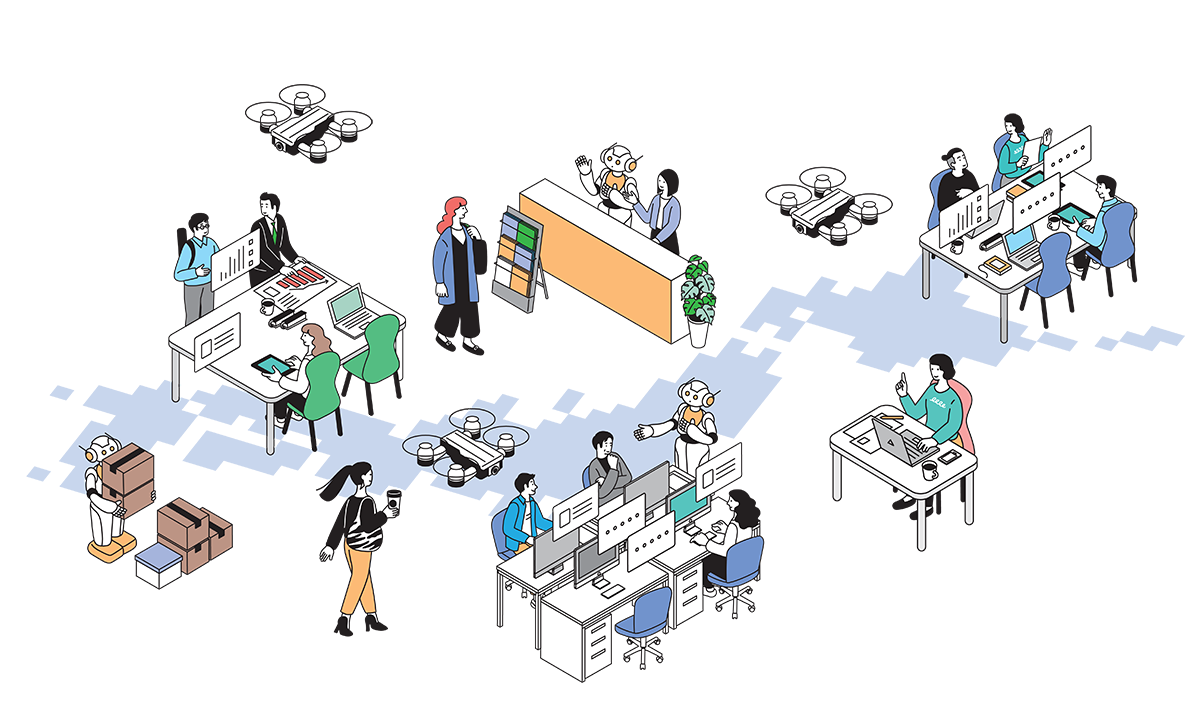
But meeting these needs can’t happen in a vacuum. AI-friendly offices need to have the infrastructure necessary to support these changes. While strong amenity offerings, proximity to transportation and optimized foot traffic are table stakes, high-bandwidth data-transfer capabilities, sufficient power, cooling and security are musts not only due to AI’s energy consumption but also in the increasingly uncertain leasing environment that tenants will likely find themselves in. “(They) increasingly expect flexible infrastructure—from adaptable floorplans to plug-and-play power and cooling systems—allowing them to scale and reconfigure as their needs evolve,” said DeLuca.

Buildings that offer lab areas, high-power redundant fiber, secure rooms and high-quality, commute-worthy experiences will become valuable from a landlord’s perspective, Srinivasan advised.
What’s equally important to a shift in hard assets and operational capabilities is a change in mindset. According to Poleg, the office sector’s most important shift will be changing from a static investment to a more dynamic business like a restaurant or hotel.
“It’s not just a matter of squeezing margins but it also changes the whole nature of what the asset is,” Poleg said. “Becoming an operating business isn’t a bad business, but it needs to be managed and funded differently, with different responsibilities.”



You must be logged in to post a comment.