
Confidence in the Economy, CRE Edges Higher: RCLCO
The company’s end-of-year sentiment report foretells stability and renewed growth in 2026.
The 2025 year-end sentiment survey from RCLCO points to confidence, steadying conditions and positive expectations.
RCLCO wrote that although the overall economy and the real estate sector still face a challenging environment with substantial stress, expectations are indeed starting to improve. “While risks remain evident, sentiment suggests a shift toward stabilization and growth in the year ahead.”
RCLCO’s proprietary Real Estate Market Index (RMI) remained relatively stable over the second half of the year, rising four points to 41, which is “toward the top of a range historically linked to economic and real estate market stress.”
In contrast, the Future RMI, which reflects sentiment regarding the next 12 months, rebounded by almost 15 points, to 63, showing considerable optimism for moderately or significantly improved market conditions.
Looking at the macroeconomic side first, the survey found that expectations of a recession within 12 months are down significantly, from 44 percent of respondents at mid-year, to just 29 percent now.
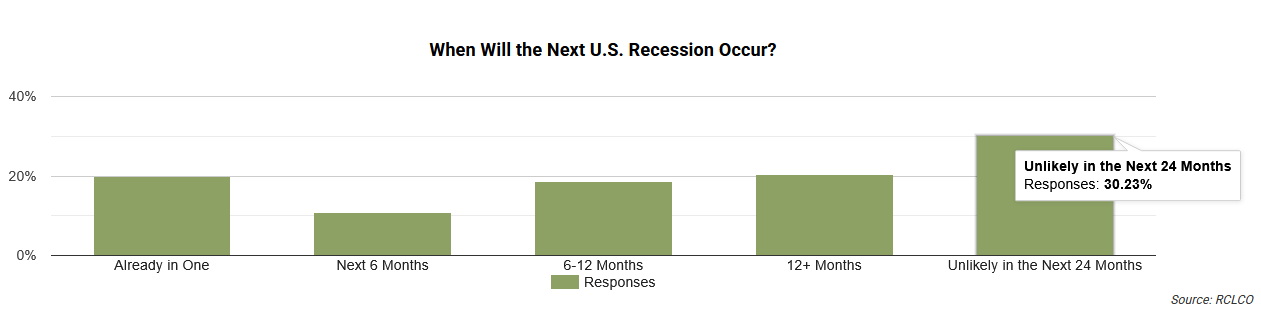
As to when the next recession might appear, opinions are diverse. Roughly one-third of respondents see a recession as likely in the next year, while an equal share sees it as unlikely within the next two years.
Expectations about interest rates and inflation are turning toward the positive.
A moderate decrease in interest rates is seen as the likely outcome over the next six to 12 months by 77 percent of respondents. This is in contrast to the mid-year 2025 sentiment survey, in which expectations were evenly balanced (at nearly 40 percent each) regarding whether interest rates would remain stable or decline.
READ ALSO: What’s Ahead for CMBS, CLOs in 2026
As to inflation, RCLCO reported, “Equal shares of respondents expect inflation to remain unchanged (39 percent) or increase moderately (39 percent), with a smaller but notable group (16.04 percent) anticipating a moderate decrease.”
Closer looks
While most respondents are bearish on the for-sale and rental housing sectors, the industrial, self storage, senior housing and lifestyle and necessity retail are seen as experiencing at least some growth currently, with nearly every real estate product type expected back in growth mode over the next year.
“The exceptions to this,” RCLCO said, “are Class B/C office and regional malls, which are expected to continue to experience stress.”
A timely question for survey respondents was about whether data center demand and development constitute a bubble, amid evolving data center market trends. Nearly two-thirds said that there is a bubble in this sector, and many cited power availability as a possible limiting factor in future data center development.
Still, RCLCO described the majority sentiment as “measured concern rather than alarm.” Overall, the responses indicate that while many participants recognize signs of potentially unsustainable demand and development, most do not view the risk as severe at this stage.
RCLCO’s Real Estate Market Sentiment Survey is based on the opinions of a pool of experienced real estate professionals from across the industry and the nation. A large majority (75 percent) of these respondents have worked in real estate for 20 years or more, with an average tenure of about 25 years. Further, 87 percent of respondents are C-suite or senior executives in their organizations.




You must be logged in to post a comment.