


Will Construction Costs Continue to Rise in 2027?
A new JLL report examines how tariffs, energy prices and labor shortages could shape construction costs next year.
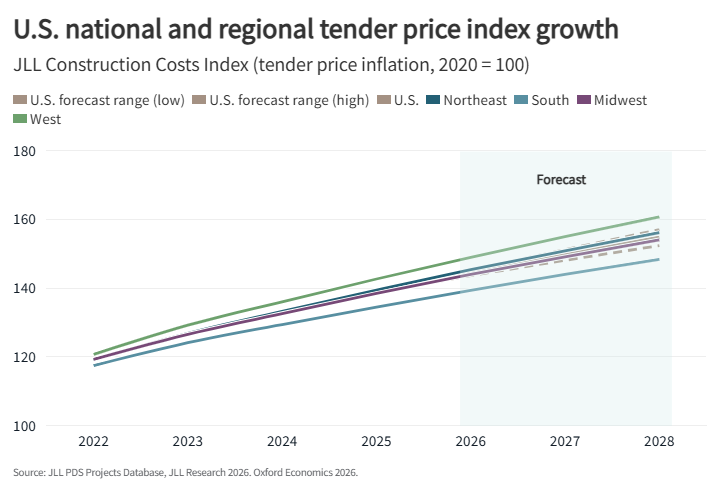
U.S. construction costs are expected to increase next year anywhere from 3.1 percent to 4.2 percent across the nation as the question for commercial real estate investors and developers is no longer when costs will fall, but how fast will they continue to rise and where.
As for where, construction costs are expected to rise across all four U.S. regions, with the upper end of each region’s projected range exceeding the pre-2020 annual norm of 2 percent to 3 percent, according to JLL’s 2027 U.S. Construction Perspective report.
The report forecasts tender prices, the prices contractors bid for projects, which combine input costs, demand and contractor margins and risk pricing into a single number. JLL’s Construction Costs Index measures tender-price inflation, while its Construction Costs Monitor tracks the underlying material, labor and other input costs that typically rise before contractors adjust their bids.
The 2027 tender-price forecast is lower than 2026’s 3.5 percent to 4.6 percent but still above pre-pandemic norms. The report also notes that each year’s increase compounds on a cost base that jumped in 2021 and 2022 and hasn’t come back down again.
Real construction spending is expected to fall for the second straight year in 2026, with increases through 2028 but staying below the 2024 level. Data centers are the only sector that is adding real spending this year, but growth is expected to broaden to power, civil and other building in 2027.
Energy and tariffs add cost pressures
Material and labor costs keep pushing tender prices up, with energy prices and pending tariff decisions that will continue to drive growth in materials pricing. Trade policy impacts metals and equipment, while higher energy costs linked to the Middle East conflict raise the costs of imported materials. According to JLL, tender prices lagged input costs by approximately three quarters during the previous cycle, meaning material price increases in late 2026 could affect bids in 2027.
Contractors are pricing that uncertainty into their bids as a permanent risk premium, particularly since material prices have risen faster than tender prices since mid-2025. For owners, that could mean higher project costs, larger contingencies or contract terms that shift the risks associated with price increases, long lead times and labor shortages back to them.
Andrew Volz, manager, Americas projects & development services research at JLL, said in prepared remarks that contractors now view geopolitical and policy uncertainty as a standing risk premium and bids reflect that shared risk as much as the work costs. He said the programs that hold up best treat cost as a live input and revisit it at various stages.
The report suggests updating costs at each decision point, tying them to building packages and markets where there is exposure and setting triggers that reopen a decision should conditions change. For volatile packages like mechanical, electrical and plumbing materials, JLL recommends setting pricing and procurement strategy early.
Data center, power projects strain labor supply
Owners and contractors can expect labor shortages to continue in 2027, with some local markets impacted more deeply. Some areas such as the South where large data center projects are concentrated are experiencing a lack of skilled labor, particularly electricians, mechanical contractors and pipefitters. The report notes MEP systems account for 50 percent to 58 percent of total costs on a data center, compared with 28 percent to 32 percent for commercial buildings.
The South is set to lead U.S. construction growth in 2027 due to data center developments along with other power and public civic projects. JLL notes the Northeast will also see some gains, though more modest, led by power and public civil work. On the other hand, in the West and Midwest regions, some of those categories are expected to pull back in the year ahead, the report states.
Labor shortages in high-demand markets could extend construction timelines, increase upfront costs and expose owners and contractors to further price escalation. JLL notes a project’s labor risk will depend on the trades it needs and location, so assessments before a project starts are important.


You must be logged in to post a comment.