


Inside CRE’s Softening Insurance Market
The realities behind lower prices and some recommendations for policyholders.

The property insurance market continues to improve for commercial property executives. Rates have dropped nationally, providing owners with the opportunity to increase coverage at new rates or invest in hardening their properties. But prices are still elevated in high-risk markets like California and Florida, and more rigorous underwriting could make it difficult for some owners in lower-risk markets to get favorable terms.
Price points
According to Marsh, property insurance rates fell by 10 percent in Q1 2026 compared with an 8 percent drop in the previous quarter. Renewal rates for non-catastrophe-exposed properties have declined about 7 percent year-over-year. Properties with catastrophe exposure saw declines of about 16 percent.
“These accounts experienced the most significant premium increases between 2022 and 2024, so had more room to fall,” noted Xander Snyder, economist for First American Financial Corp.
Rates vary by sector, with office, retail and hospitality generally benefiting from the same broader market conditions, while hospitality and manufacturing have always been underwritten with their specific exposures in mind, noted Joffre Mishall, who heads Large Property for U.S. National Accounts at Zurich Insurance Group.
After several years of corrective pricing, the cost of reinsurance treaties also dropped beginning with renewals in January 2026, pointed out Marc Gordon, principal, co-president & CFO at Investors Management Group.
His firm’s reinsurance renewal quotes of roughly 15 percent below expiring premiums were reflected in broker data, with multifamily rates down 5 to 15 percent. Gordon said that property rates overall are projected to decline about 4 percent on average through the rest of the year.
Additionally, deductibles are generally maintaining or decreasing slightly, while available limits are increasing due to an oversupply of insurance capacity in the market, said Mishall.
During the hard market, storm deductibles increased by 5 percent, with some carriers pushing them up to 15 percent, said Michael Brodie, managing director at Howden U.S. & co-leader of the firm’s real estate practice. Those deductibles have returned to 5 percent or less.

Why premiums are falling
The primary driver behind declining premiums is an increase in insurance capacity that now exceeds demand. As such, insureds are seeing a second round of rate reductions, many of which represent a 30 percent or more reduction in premiums, according to Brodie.
Lower rates also reflect an influx of insurance capital following several years of strong returns combined with relatively limited catastrophic losses in many regions. As more capacity has entered the market, competition has increased, noted Brodie: “We expect rates to continue softening, although likely at a slower pace, provided there are no major catastrophes during the remainder of hurricane season.
This also provides property owners the option of seeking greater certainty through multi-year rate locks, when available.
Some insurers that left high-risk markets or stopped writing new business there, however, are now returning due to regulatory reforms that allow carriers to use forward-looking catastrophe models and include net reinsurance costs in their rates in exchange for commitments to write business in wildfire-exposed areas.
“Rumors of a softer market are real, but it has yet to reach the properties that need it most,” remarked Jason Adams, partner at Cox, Castle & Nicholson, where he serves as a litigator and leads the firm’s Insurance Recovery & Risk Management Practice.
Nine carriers have publicly committed to writing new policies in high-risk areas under California’s Sustainable Insurance Strategy. They include Farmers, Travelers, Mercury, CSAA, USAA and AAA, according to Gordon. Additionally, Farmers removed its cap on new policies in late 2025, and Travelers announced expansion of its California book in April 2026.
Additionally, losses in 2025 were well below projections. The 2025 Los Angeles wildfires, for example, resulted in an estimated $40 billion in losses, an amount roughly 40 percent lower than in 2024, according to the Swiss Re Institute.
Florida’s reforms, which eliminated one-way attorney fees and curbed assignment-of-benefits abuse, resulted in 17 new carriers entering the market, Gordon noted. Citizens, the state-backed insurer of last resort, has shrunk from a peak of about 1.4 million policies in late 2023 to roughly 336,000, and carriers are now filing rate decreases, including a statewide 10 percent reduction by State Farm, he said.
This affects homeowners insurance more than commercial properties, as it is more highly regulated, pointed out Snyder, noting that insurers that withdrew from California, such as State Farm, specifically cited regulatory challenges, at least in part, for their decision.
The evolution of underwriting
Insurers are protecting their bottom lines by increasing some deductibles, according to Gordon, who noted that a few years ago, his firm’s typical all-other-perils deductible was $25,000 with wind and hail included at most locations. Today the standard starts at $100,000, and wind and hail carry a separate percentage deductible that ranges between 1 to 5 percent of total insured value.
Carriers have also added sublimits, tightened exclusions and held firm on higher attachment points on reinsurance renewals.
Adams said that carriers are transitioning to more forward-looking wildfire risk and reinsurance models, which aid in more accurately assessing risk and expanding coverage.
Underwriting has also become much more granular, and the coverage that is available is often met with higher deductibles, lower limits, and less favorable terms.
Rather than relying on broad market assumptions, for example, carriers are using aerial imagery, roof-age data and claims analytics to evaluate individual buildings , Gordon said. Therefore, two similar properties can receive very different quotes based on documentation alone.
“Rather than broadly labeling an entire area at the same degree of risk, using technologies like drone flyovers to examine roofs to find tree branches hanging over them and refuse to renew unless removed,” Mishall said.
The other big change for underwriting is reinsurance levels. Reinsurance rates are down, and there are some concessions on terms now, but in general, reinsurance is attaching at a higher level than prior to 2023, said Blake Giannisis, executive vice president & property practice leader at insurance brokerage Hub International.
“Now underwriters have less reinsurance to fall back on, especially at the lower levels of the programs, so they’re retaining losses in-house and need to be extra vigilant about the types of risks they underwrite.”
Another major change is underwriter focus on climate-related perils that historically may have been viewed as secondary, including hail, tornado, lightning and what is known as pluvial flooding as well as wildfire risk, noted Mishall. “These events have become more material to commercial property underwriting, and they are modeled and monitored much more closely than several years ago.
Pricing and valuations

While no assets are uninsurable, insurance can still be priced beyond what makes sense. Over the last few years, insurers had re-evaluated property values, causing premiums to escalate, especially for single-family homes, which have experienced significant increases in value due to short supply. This helped to make insurance markets more profitable for insurers, which was a factor in rate reductions.
For commercial properties, however, insurance pricing generally tracks replacement cost rather than fair market value, which doesn’t always correspond with market value, noted Adams. An older office building worth 40 percent less, for example, costs the same to rebuild as a new project.
And market value and replacement cost are going in different directions, noted Gordon: “An older building may have lost 20 percent of its market value, but the cost to rebuild it has gone up roughly 40 percent since 2020.”
Underwriters still look at valuations, but for the most part, they have been corrected over the last few years. “Valuation pressure has eased as the insurance market softened,” said Brodie. “Carriers competing for business are broadening coverage and are placing less emphasis on re-evaluating values than they did one or two years ago.”
But valuation is only one piece of the puzzle: competition, location and other factors also can greatly affect premiums.
Insurers, for example, are applying greater scrutiny to a property’s physical condition, claims history, deferred maintenance, and exposure to natural hazards, said Brian Connolly, founder & CEO of Feasibly. Assets viewed as higher risk may face increased deductibles, reduced coverage limits, or exclusions that shift more potential loss to the owner.
Insurance is now making or breaking sales deals
Insurance premiums, which previously were an afterthought in real estate deals, now are a priority in due diligence around asset sales and financing. “Lenders are taking a much more active role in evaluating coverage and pricing, and availability of insurance can make or break the viability of a deal,” Adams said.
This is because high premiums reduce net operating income and debt-service coverage, which can lower loan proceeds, increase required equity and cause buyers to reprice or walk away from deals, contended Connolly. In some high-risk markets, the challenge is not only the cost of insurance, but also whether sufficient coverage is available to meet lender requirements, he said.
When a property’s coverage limits have lagged rebuild costs, the credit team substitutes what adequate coverage should cost, Connolly noted. On a mid-size asset that adjustment can be significant—enough to push a deal below the lender’s debt service coverage floor. Deals that penciled at 1.25x on the sponsor’s numbers, for example, can fall to 1.10x or 1.12x after the insurance adjustment, and that kills loan proceeds or the deal itself.
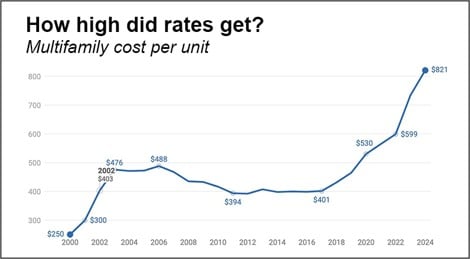
Insurance rates, however, do not just affect sales but also rent growth. For example, rent growth for multifamily assets is typically lower in cities with the highest rate increases, according to the National Apartment Association.
Multifamily presents biggest insurance challenges
Multifamily remains one of the industry’s most closely scrutinized asset classes because of combustible construction, aging plumbing systems and recurring water losses.
Brodie noted that underwriters weigh heavily in COPE (construction, occupancy, protection, exposure). Life-safety and building systems upgrades (fire suppression, sprinkler coverage, backup power, roof condition) typically move the needle on both risk and premium far more than aesthetic renovations, he contended.
“Hardening assets is becoming the price of admission for coverage in high-risk areas,” Adams noted. This is especially true for multifamily assets, with carriers in fire zones wanting to see Class A roofs, ember-resistant vents and noncombustible vegetation zones around the structure.
But water damage has now surpassed fire as the leading cause of property loss in multifamily real estate, according to Gordon, who said it is rarely caused by one catastrophic event but the accumulation of recurring claims.
He suggested installing water-detection, monitoring and automatic shutoff systems to provide an early warning and limit damage as well as upgrading plumbing and replacing water heaters. Additionally, electrical upgrades that modernize outdated panels and wiring can prevent fires.
Words to the wise
As the market softens, experts say owners should resist treating lower premiums as simple savings. Instead, they recommend using the opportunity to strengthen both their insurance programs and their properties.
That may mean restoring coverage or lowering deductibles that were reduced during the hard market, while also investing in improvements that reduce future losses, such as roof replacements, plumbing and electrical upgrades, water-leak detection systems, wildfire mitigation or flood protection.
“Now is the time to address the issues insurers have been raising over the past several years,” said Giannisis. “You’re likely to get much better pricing on additional coverage or improved terms today than you would have during the hard market.”
Property owners also should begin evaluating insurance early in any acquisition, refinancing or development process, rather than waiting until closing, Connolly advised. Understanding lender requirements, obtaining preliminary pricing and documenting risk-reduction improvements can help avoid surprises later in the transaction.
“One-size-fits-all placements are giving way to granular underwriting,” Adams said. “Owners who invest in mitigation and other safeguards are putting themselves in a much stronger position.”



You must be logged in to post a comment.