


What the Quantum Computing Boom Means for CRE
Private owners are expected to have a growing role in quantum real estate over the next decade, according to JLL.

If quantum computing as a real estate story isn’t on your radar, you might be behind the curve, according to a new report from JLL, which is tracking more than 240 quantum facilities across the world.
More than $4 billion in quantum real estate projects are planned or under construction globally. In some cases, companies like IBM own their facilities outright, while others partner with private CRE players to develop and lease space.
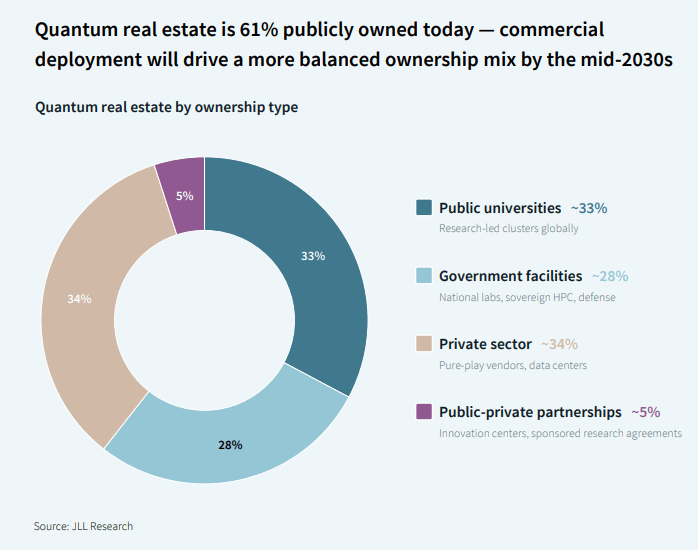
The report categorizes facilities into nine distinct types, under three typical ownership models. Four are typically privately owned: corporate research laboratories, quantum fabrication sites, enterprise on-premises deployments and commercial hybrid data centers.
Four more fall under public-sector ownership: academic research facilities, supercomputing/high-performance computer centers, government research laboratories and military/defense installations. The last type consists of public-private innovation centers under hybrid ownership.
READ ALSO: CRE Trends at Mid-Year
Quantum won’t displace classical computing, nor will it disrupt data center investment, Matt Landek, JLL’s global president of data centers and critical environments, told Commercial Property Executive.
“Quantum computing is creating a new category within digital infrastructure real estate,” Landek explained, “not because it replaces traditional data centers, but because it introduces a highly specialized layer of compute that must sit alongside them.”
Landek said that the markets attracting the most momentum are places where research universities, public funding, advanced manufacturing and high-performance computing capacity are already intersecting. Those factors are even more important than just power or land availability.
The technology can be dizzying, and so too are the numbers behind quantum investments. For example, four quantum IPOs in the first half of this year raised more than $2.7 billion.
For those wanting a summary of the current technology, the report offers that, including estimates of the remaining technical milestones before full deployment of quantum computing. Even as universities and national laboratories are the nuclei of quantum computing, a major shortfall of qualified physicists, engineers and others is a sizable obstacle, despite investors’ interest in quantum.
“The pace of capital entering the sector has accelerated dramatically over the last two years,” Landek said, “while the workforce required to scale the industry remains exceptionally limited. That imbalance is pushing development toward tightly connected innovation clusters where talent pipelines already exist.”
He added that the industry will likely start to see deployment of hybrid facilities built for both classical and quantum workloads. Over time, ownership structures will likely shift from public institutions toward private capital.
From brownfield to quantum
One major quantum center provides a case study. The Illinois Quantum and Microelectronics Park began development in September 2025 on a 128-acre site on Chicago’s South Side lakefront, formerly home to a steel mill. Related Midwest is the primary developer.
The University of Illinois, University of Chicago, Argonne National Laboratory and Fermilab are among the key sponsors, and the federal government has its hand in the site too, in the form of two Department of Energy quantum research centers, each funded at $125 million over five years. Key tenants are PsiQuantum, IBM, Diraq and Infleqtion, along with the DARPA-Illinois Quantum Proving Ground.
The size of IQMP admittedly is an outlier, however. JLL noted that most quantum facilities are modest in size—often under 150,000 square feet—and affiliated with universities or government agencies.
A closer look
On the inside, JLL reported, “a quantum installation looks less like a server rack and more like a room within a room—dilution refrigerators, vibration isolation and electromagnetic shielding sit beside standard air-cooled racks, linked by low-latency fiber to classical systems.”
Strategically, JLL predicts that quantum infrastructure is likely to evolve similarly to life science space, shifting from “a predominantly public ownership profile toward greater private participation through the mid-2030s.”
The report emphasizes that the key for private investors isn’t ownership of public infrastructure, but rather proximity to it.
“Quantum companies cluster tightly around university anchors and those markets are already densely valued,” the report reads. “Investors who understand quantum’s facility requirements today will have a structural advantage when deployment accelerates.”






You must be logged in to post a comment.