


Chicago Life Science Shows Surprising Strong Points
The area is becoming a preferred alternative to established markets, according to Cushman & Wakefield.
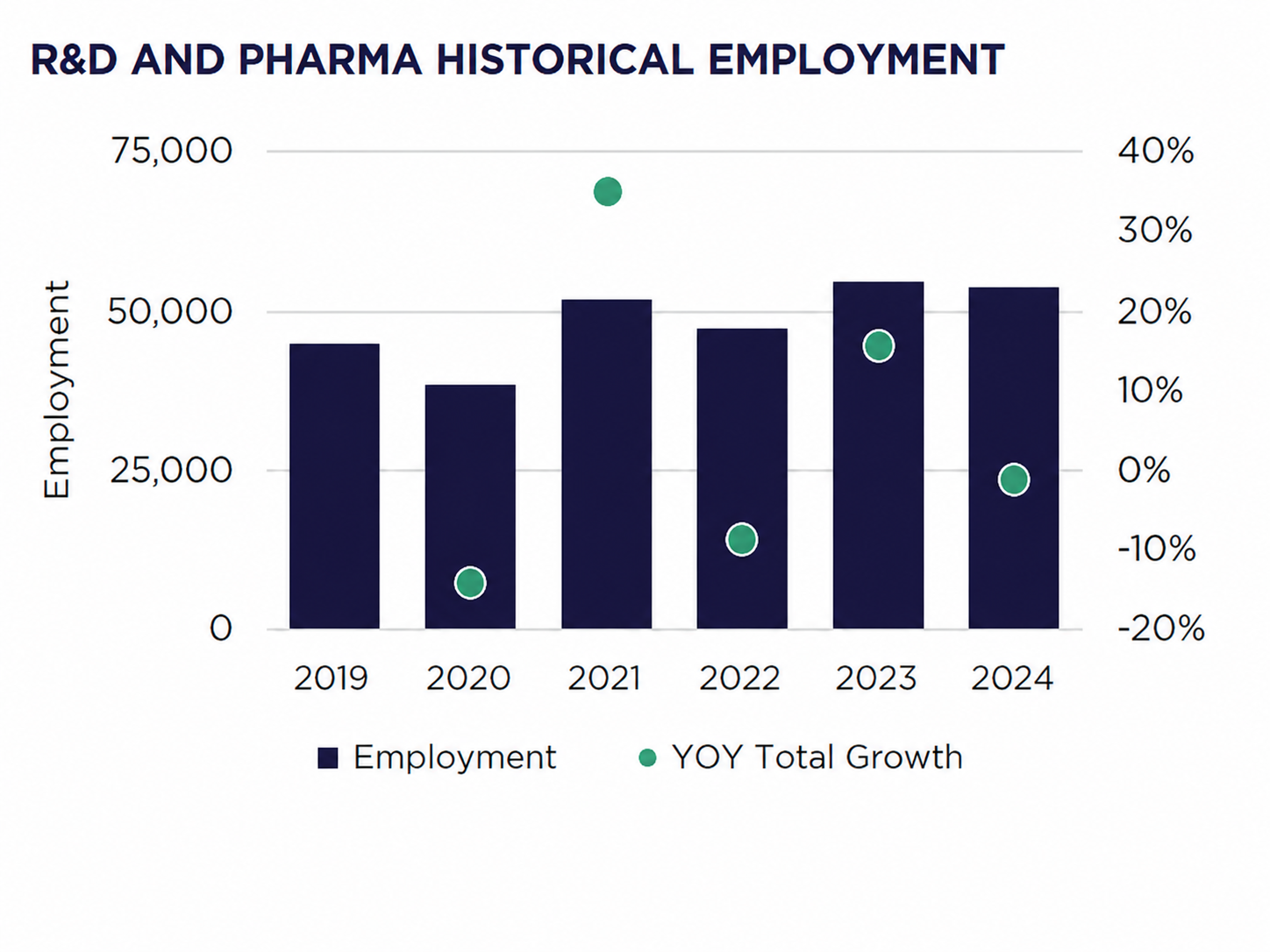
While life science at large is going through a slowdown, Chicago is broadening beyond manufacturing, even as production remains the metro’s biggest competitive advantage. The area is still the Midwest’s leading life science hub, with pharmaceutical manufacturing accounting for 54 percent of local sector employment, according to a recent Cushman & Wakefield report.
The market’s growth story is slowly shifting: R&D employment rose 16 percent year-over-year in 2024, to 24,042 workers, and pharma manufacturing employment fell 12 percent, to 29,938.
This recent split suggests Chicago is not moving away from its manufacturing base so much as building a broader life science platform around it, one that is also slated to benefit CRE. These recent developments pair with wider advantages for the area, including rising research activity, a deep university pipeline and more manageable labor costs compared to larger coastal hubs.
READ ALSO: Life Science Sector Faces Vacancy Glut After Construction Boom
The shift lands at a moment when life science companies are reevaluating where to grow. Boston-Cambridge, the San Francisco Bay Area, San Diego and Raleigh-Durham still hold the deepest life sciences labor ecosystems, with mature clusters anchored by major employers, research institutions and specialized talent. However, these high-cost markets require higher wages to attract talent, while midwestern and southeastern areas offer more cost-efficient labor environments.

Building a more balanced ecosystem
Chicago and Denver-Boulder stand out among secondary life science markets because they combine competitive wages, established education pipelines and improving labor demand, according to Cushman & Wakefield.
Chicago’s case is not that it can out-research Boston or the Bay Area, but that it offers more breadth. The metro’s employment breakdown for the sector gives it a larger and more balanced profile than many other secondary markets.
The city’s education base strengthens the argument. The University of Chicago, Northwestern University, University of Illinois Chicago, Illinois Institute of Technology and Loyola University Chicago anchor the region’s talent pipeline. Additionally, Chicago accounts for one of the largest volumes of life sciences degree completions in the U.S., which should support longer-term expansion in the sector, the Cushman & Wakefield analysis also noted.
READ ALSO: AbbVie Eyes $380M Chicagoland Expansion
Recent investment is giving Chicago’s research profile more visibility. The city’s selection as the site of the second Chan Zuckerberg Biohub is expected to accelerate development and job creation, while adding momentum for biotech lab space. It also adds a research-focused catalyst to a market already anchored by employers such as Novartis, AbbVie and Argonne National Laboratory.
Chicago’s wage profile could also help it stand out. The metro’s median annual R&D salary was $98,250 in 2024, below Boston-Cambridge ($128,550), the Bay Area ($136,717) and San Diego ($123,313). Manufacturing wages were higher, at $135,714 annually, but remained below several high-cost hubs, including the Bay Area, San Diego, Seattle and suburban Maryland.
That does not make Chicago a low-cost market across the board, but it does give the metro a more competitive profile in research roles, especially for companies looking to scale without fully absorbing the wage pressures of the largest coastal clusters.




You must be logged in to post a comment.