
Data Centers Are Creating Spillover Industrial Demand. Will It Last?
Link Logistics’ Glenn Wylie breaks down where demand is coming from and what industrial owners should know.

As data center development continues to dominate real estate headlines, a quieter industrial footprint is sprawling across the country.
The scale and complexity of these projects require far more than land, power and fiber. Electrical equipment, cooling systems, precision hardware and other specialized components need to be procured, stored, staged and serviced, creating demand for industrial space well beyond the data center itself.
According to Link Logistics research, every gigawatt of data center construction can generate roughly 2 million square feet of spillover industrial demand, with much of that activity tied to long-term operations rather than construction staging.
Commercial Property Executive spoke with Glenn Wylie, executive vice president & head of asset management at Link Logistics, about the warehouse demand forming around the data center boom, how it differs from traditional logistics demand and what owners should consider when underwriting the trend.
READ ALSO: CRE Trends at Midyear
Walk us through the roughly 2 million square feet per gigawatt estimate. How should we interpret it?
Wylie: The estimate comes from analyzing the industrial demand generated across the data center vendor ecosystem. For every gigawatt of data center construction, we estimate approximately 2 million square feet of spillover industrial demand and, importantly, roughly 80 percent of that demand is long-term in nature. With approximately 100 gigawatts of data center construction in the pipeline nationally, the aggregate implication is around 200 million square feet of industrial demand over the next five years or roughly 0.2 percent of total stock per year.
What’s usually overlooked about the warehouse demand created around data center projects?
Wylie: The conversation about data centers generally centers on megawatts, transmission infrastructure and land entitlements. What is underappreciated is the industrial real estate footprint that activates around those projects or ‘spillover’ space. Data centers are among the most materials-intensive built environment projects per square foot. The density of electrical equipment, cooling systems, steel, fiber and precision hardware creates a need for space geared toward procurement and staging. The demand operates through two distinct channels: construction staging, and the vendor and supplier network that forms around any major data center presence. Each generates its own industrial demand footprint.
What does spillover industrial demand look like on the ground? Who’s actually taking the space?
Wylie: It’s a fairly distinct tenant mix from what we typically see in logistics-driven demand. During construction, you’re looking at contractors and subcontractors storing equipment and materials before they go into the ground, and specialty suppliers managing hardware and components moving through the supply chain. Beyond construction, which represents roughly 15 to 20 percent of total spillover industrial demand, you see vendors supporting ongoing data center operations.
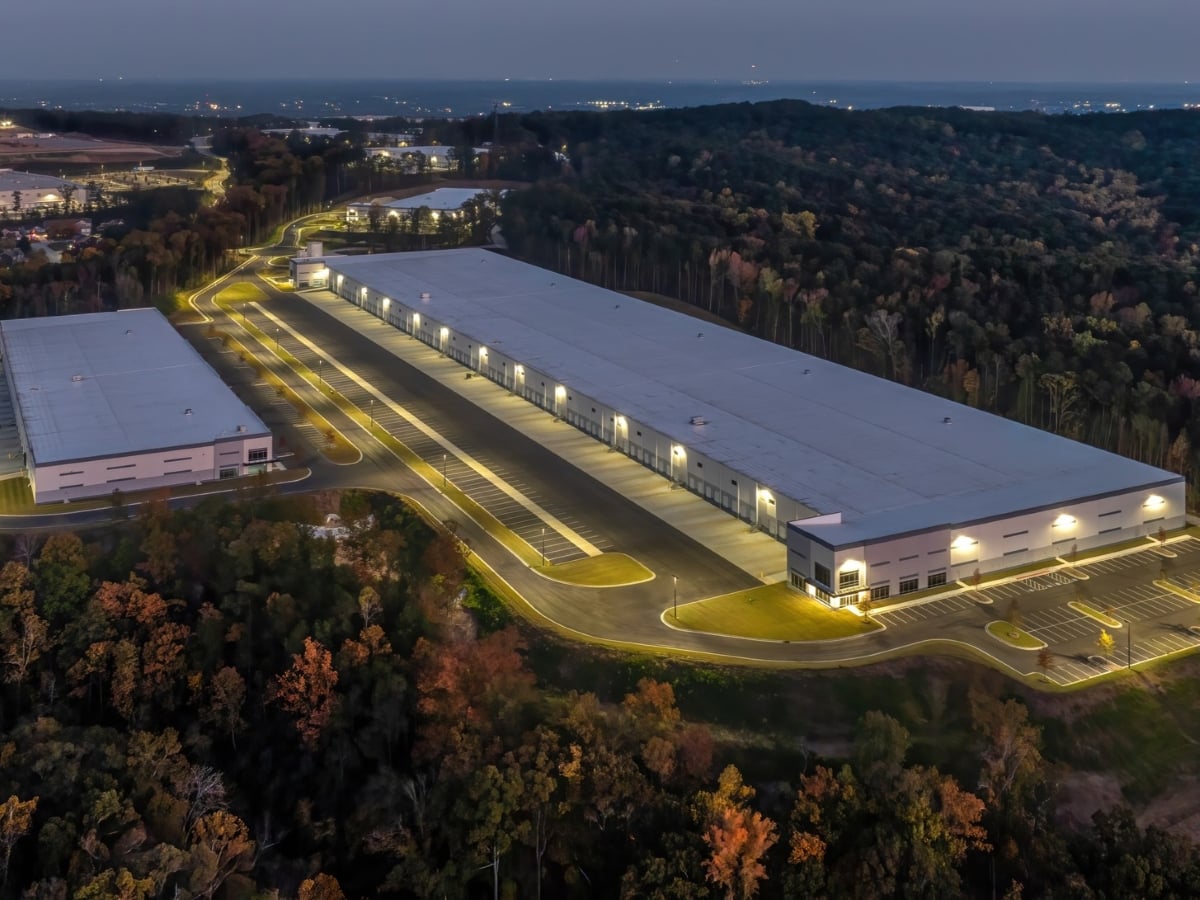
A third category is specialty third-party logistics providers. In Columbus, Ohio, for example, we recently leased a 740,000-square-foot building to a major third-party logistics company whose end customer is an AI hyperscaler, storing data center components and equipment. Additionally, at our Douglas Hills property in Lithia Springs, Ga., 88 percent of the space is now leased to data center infrastructure suppliers.
How does this type of demand differ from traditional logistics or 3PL demand?
Wylie: There are a few key differences. First, on building requirements, data center supply chain tenants often need higher clear heights, heavy floor loads and robust power. Dock configuration matters less than floor load capacity and power access.
Second, lease structures tend to be shorter in duration than traditional logistics tenants, especially for construction-phase tenants. A staging contractor may need 18 to 36 months, not five to 10 years.
Third, location priority is driven by proximity to the development site rather than end consumers. Access to the skilled labor supporting construction and ongoing operations is a related consideration.
Is this demand mostly a construction-phase story or does it extend into operations?
Wylie: Both, but in different proportions, with a majority of the demand being operational, not construction driven. Construction-phase demand generates a near-term spike. Contractors and specialty vendors tend to sign one-to-three-year leases tied to the build-out. The larger, more durable piece of spillover industrial demand comes from vendors supporting ongoing operations: maintenance contractors, cooling and power infrastructure vendors, server testing and reverse logistics providers. Once a data center is operational, that demand is long-lasting.
How close do warehouses typically need to be to a data center site?
Wylie: Construction services and specialty contractors represent the near-term boost. These tenants typically sign one-to-three-year leases tied to the build-out phase and are often in close proximity to the site. The larger and more durable share of demand comes from vendors supporting ongoing data center operations once facilities come online: cooling systems, power infrastructure, engineering services and third-party logistics providers managing component storage and distribution.
These tenants serve multiple industries and can locate within a few hours from the sites they serve, which gives them more flexibility in where they take space. A smaller but highly sticky category is server maintenance and reverse logistics—vendors who need to be extremely close to or even onsite. Server downtime is costly enough that some operators require vendors to maintain a facility within the immediate vicinity.
READ ALSO: What Amazon’s Supply-Chain Push Means for Industrial
Which markets are best positioned to benefit from this demand and what do they have in common?
Wylie: Markets that combine active data center development pipelines with available, well-located industrial product. Atlanta and Dallas are two of the clearest examples. Both are experiencing major data center infrastructure growth, significant related power and utility expansion, and substantial data center-related leasing activity, and both have the industrial infrastructure to support it. Phoenix and Columbus have likewise seen significant data center investment and have the industrial infrastructure to match.
The geographic breadth of this trend is worth emphasizing. It is showing up well beyond the established tech markets. Memphis, Tenn., is a compelling example: A hyperscaler’s decision to locate there, drawn by available power and competitive costs, drove approximately 4 million square feet of net absorption and is beginning to generate a supplier and partner ecosystem. Milwaukee is another, where an announcement of a $20 billion, 15-data-center campus for a hyperscaler has produced increases in demand from electrical suppliers and contractors. Reno, Nev., has emerged as a data center destination in its own right, with power availability, fiber infrastructure and favorable tax incentives drawing investment and the supplier network that follows.
What all of these markets share is access to power, developable land and existing logistics infrastructure that can flex to accommodate project-specific tenants.
With the industrial construction pipeline mostly muted, could data center demand tighten availability faster than the market expects?
Wylie: The industrial supply pipeline nationally has pulled back considerably, and what’s being built is more often preleased or build-to-suit. If you layer significant incremental demand from data center activity into a market already running lean on inventory—particularly for heavier-power, higher-clear-height product—you can see availability tighten quickly. That dynamic is worth watching in markets like Phoenix, Atlanta and Columbus, where construction activity is most concentrated right now.
What should owners and investors be careful about when underwriting this trend?
Wylie: The strongest outcomes will come from owners who understand which tenants are tied to the construction cycle and which represent long-term occupancy—and structure their underwriting accordingly. Construction-phase staging tenants tend to sign one-to-three-year leases tied to the buildout. The more durable piece is the operations and maintenance layer that follows.
It’s also worth being precise about causality. Markets like Atlanta and Dallas have deep, diversified logistics demand independent of any single catalyst, and the data center effect is one driver among several. The key is underwriting the demand with the same discipline an owner or investor would apply to any occupier mix.




You must be logged in to post a comment.