


Trepp Connect Special Report: Uncertainty Is Certain
Commercial real estate's selective recovery continues despite a greater chance for risk.

Commercial real estate seems to be maintaining the positive momentum that started in 2025 despite the war in Iran and the spiking oil prices and supply chain logjams that have come along with it. Uncertainty has definitely risen since February, but many pockets of CRE have proven their resilience post-COVID.
“The underlying economy and the real estate have been performing very well, and there are statistics to back that up,” said Trimont CEO Bill Sexton during this week’s Trepp Connect (in NYC) 2026 conference. “And so, yes, I feel pretty optimistic about where we are.”
But there are definitely headwinds to watch, Sexton said, including the potential for “embedded” inflation should the Middle East conflict be an extended one.
Recovery amid rising geopolitical tensions was a recurring theme of the conference, which featured a deep lineup of expert panels and keynote speakers spanning the investment and finance world. Here are few other key takeaways.

Higher for longer
Central banks, including the US Federal Reserve, were expected to cut their rates multiple times this year. Those predictions have now been dampened by rising energy prices and concerns about jobs due to the war. There is even talk of several rate hikes in 2026 in Australia, Canada and Japan, noted Victor Calanog, managing director & global co-head of real estate research and strategy for Manulife Investment Management.
Calanog thinks the talk of rate hikes is an “overshoot”, however, with most central banks taking a wait-and-see approach about the war. The Fed has kept rates steady since Dec. 2025 following three rate cuts last year. “If it suddenly ends, we’re OK.,” he said. “We can reverse all this. We don’t need inflation to rise.”
Never a wall of maturities
The pending distress in CRE due to a massive amount of loans maturing and not being able to refinance has not materialized, speakers said. The wall of maturities that the industry was supposed to hit has been more like “a sliding glass door” with the better loans being able to get through by way of extensions and modifications, said Kyle Stevenson, senior managing director of Berkadia. Improving economic conditions and a competitive refinance market have also helped.
The bifurcated recovery
The industry’s recovery has been selective in many property types, particularly office, speakers said. Prices are firming and occupancies are rising for well-located Class A office properties, for example, while many older properties are struggling or facing obsolescence. Conversion opportunities are economically compelling but require the right building and the right operator.
Keynote speaker Scott Rechler, chairman & CEO of RXR. said his company recognized the bifurcation in office back in 2022 in a study it called “Project Kodak.”
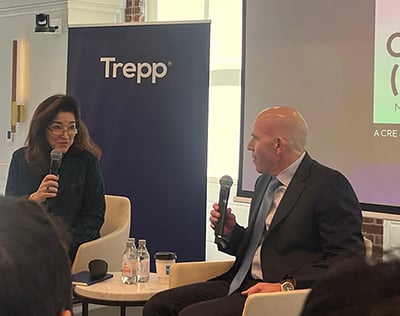
“We said, just like film, there’s going to be a point where some buildings are going to be digital and they’re going to have a future, and some are going to be film and not have a future,” Rechler said. “And we can’t be like Kodak and ignore the fact that (they are) not going to have a future.”
Multifamily is also a divided market. Demand is high but older properties and those in overbuilt markets are still facing challenges, according to Sam Tenenbaum, head of multifamily insights for Cushman & Wakefield. Institutional invests are vying for the better value-add opportunities. Rent stabilized properties in New York City have suffered significant losses in value due to previous and anticipated policy changes.
“In terms of investors’ interest, it’s a flight to quality story,” Tenenbaum said. “Everyone wants the best of the best. The newer the asset, the more interest, the better the fundamentals.”
Hotels also present an inconsistent picture. Luxury hotels are benefiting for the strength of high net worth spending. Suburban full-service properties are aging and out of step with the way people travel.
Capital competition
Many CRE loans have been paid off, so debt funds, private capital, insurance companies and banks are all jockeying to originate new business. Spreads are tight, and multifamily spreads are the tightest.
John Barkidjija, executive vice president & head of commercial real estate and specialty finance for Byline Bank, said his bank is competing on spreads while “trying not to give on structure.”
With all lenders competing on price, relationships are often the differentiator, noted Daniella Marca, executive director of real estate debt for BlackRock, which expanded its footprint in CRE lending when banks were less active.
“We were able to move up the capital stack, and now most of our book is senior debt” she said.
Today, banks are back, often in the form of providing back leverage to other lenders. A proposed change to the Risk-Weighted Asset rules would encourage banks to make more whole loans by lowering the capital reserve requirements.
But its intended results remain to be seen. Back leverage is highly efficient for banks and already gives them a more favorable risk-based capital treatment. And, banks may not be looking to significantly increase their CRE lending, noted Catherine Sierakowski, managing director & group head for Corporate Banking North American Real Estate at BMO Capital Markets.
“You have to remember every bank has a certain amount they want of real estate,” Sierakowski said. “A lot of us are looking to grow it, but we are not looking to double it.”
Luxury hotels are benefitting from the strength in high-net-worth spending. Suburban full-service hotels are struggling and candidates for conversion.




You must be logged in to post a comment.