


Where Office Use Is Heading: The NYC Bellwether
A recent survey sheds light on future office demand, both traditional and flexible.
As the return-to-office trend continues its slow and steady march, with hybridization efforts in lockstep, many investors, landlords and tenants find themselves at a crossroads regarding leasing strategies.
A recent Hubble survey picked the brains of top New York City business leaders, including founders, C-level executives and decision makers, gauging their present office utilization philosophy and future workplace arrangement plans.
The questionnaire reached small- and mid-sized businesses, as well as startups, with more than 125 participants. This workplace ecosystem is highly relevant for New York City office space, including coworking, as such companies fill in gaps in a market with high barriers to entry for long commitments. However, it can also be seen as a bellwether for less dense markets, considering the expansion of such models beyond coastal CBDs.

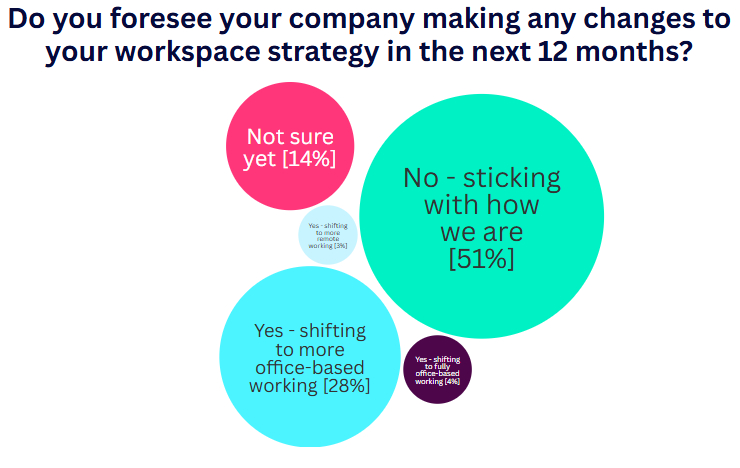
Findings reveal that approximately half of respondents are content with the status quo; however, nearly one-third intend to align with a more office-based approach in the future. What’s more, just 3 percent consider ramping their remote-working capabilities.
Return-to-office has room to grow
While there’s a measurable push toward more office utilization, fully remote work approaches remain a close second, just a few percentage points behind hybrid. Fully office-based plans make up a very slim, single-digit share.
Hybrid work models enjoy widespread popularity across New York City, with most arrangements observing employee-driven choices when it comes to physical attendance. Yet, mandates for certain days or a set number of days aren’t far behind.
READ ALSO: 2026 Office Vacancy Update
Participants consider hybrid work structures as the best of both worlds, providing a cheaper alternative for growing firms, using flexible or shared offices. Respondents also believe that employees might be more susceptible to office collaboration when presented with flexible options.
Expanding and enforcing attendance policies
There still are hurdles when it comes to stronger return-to-office pushes, as employee leverage still seems to endure on this front. Worker retention weighs heavily on the minds of respondents, with 40 percent concerned about pushback and even resignations.
While expanding mandatory office days can be laborious, enforcing a mandate for the current work environment appears more facile. Yet, the share of companies applying disciplinary measures for breaking attendance rules is in the low single digits.
A potential solution could stem by example, with leadership boosting office visit frequency. Indeed, top brass is more likely to work from the office when compared to the baselines of their companies.
Respondents value in-person work environments on account of relationship building, collaboration and mentorship, productivity and company culture. In fact, leadership satisfaction peaked in fully office-based arrangements, followed by hybrid and fully remote.
Even if sentiments weren’t as high for remote work, participants still recognized some of the practice’s merits, namely redirecting capital to other growth-focused areas and access to a wider talent pool, allowing for more robust scale-ups.






You must be logged in to post a comment.