

2026 Office Vacancy Update
The latest data shows a significant year-over-year improvement, according to Yardi Matrix.
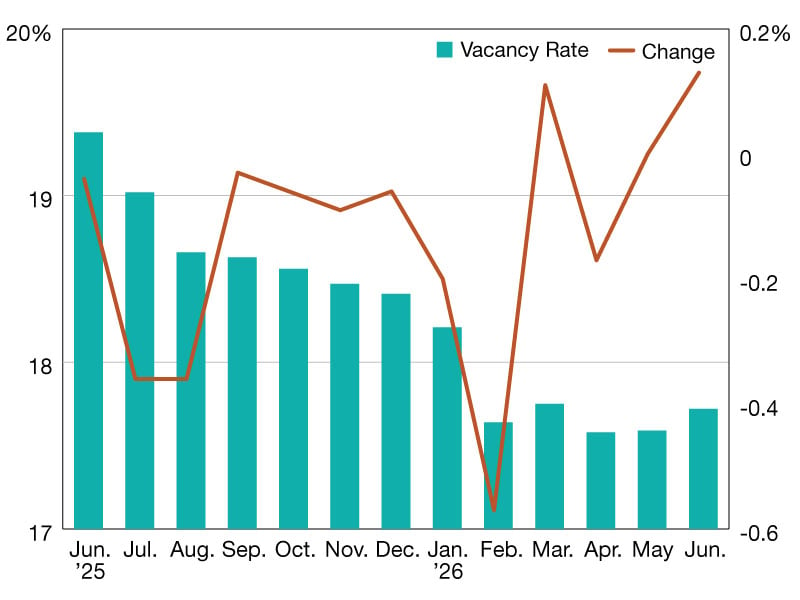
The national office market continued to show stable fundamentals through the second quarter of 2026, with overall vacancy ending June at 17.7 percent, according to Yardi Matrix data. Although this represents a 13-basis-point increase from May, vacancy remains well below the levels recorded throughout most of 2025 and reflects a market that has largely maintained the gains achieved over the past year.
After reaching 17.6 percent in February—the lowest point in the current recovery cycle—vacancy fluctuated within a narrow range during the second quarter. March saw a modest 11-basis-point increase before vacancy slipped back to 17.6 percent in April and May.
June’s slight uptick marks the second monthly increase in the past four months but is not enough to alter the broader trend of improving occupancy.
Recovery remains evident on an annual basis
The longer-term picture remains encouraging. National vacancy has declined by 166 basis points year-over-year, falling from 19.4 percent in June 2025 to 17.7 percent this June. Much of that improvement occurred during the second half of 2025, when vacancy steadily compressed from above 19 percent to 18.4 percent by December, before posting another significant decline early this year.
February delivered the sharpest monthly improvement in the period analyzed, with vacancy dropping 57 basis points from January.
While the pace of compression has moderated since the first quarter, the recent data point to a market entering a more stable phase rather than reversing course. Monthly movements since March have remained relatively limited, ranging from a 17-basis-point decline in April to a 13-basis-point increase in June, suggesting that supply and demand are becoming more balanced.
Overall, national office fundamentals continue to compare favorably with a year ago. Vacancy remains below the 18 percent threshold for the fifth consecutive month, indicating that the sector has held onto its recovery despite modest month-to-month fluctuations and a slower pace of improvement entering the summer.
—Posted on July 27, 2026
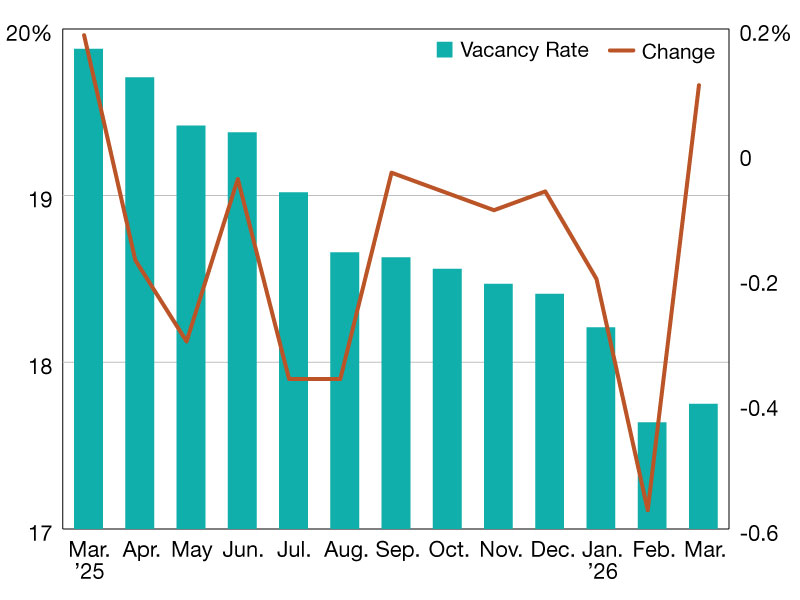
National office fundamentals continued to strengthen in the first quarter of 2026, reflecting a steady, data-supported recovery. According to Yardi Matrix, national vacancy ended March at 17.7 percent, down from 18.2 percent in January, representing a 46-basis-point decline over the quarter.
February marked the most pronounced improvement, with vacancy falling 57 basis points month-over-month to 17.6 percent before inching up slightly by 11 basis points in March. Despite the modest uptick at quarter-end, vacancy remained firmly below the 18 percent threshold—an important historical benchmark for the sector.
The broader context underscores the significance of these first-quarter gains. Vacancy declined for 11 consecutive months between April 2025 and February 2026, highlighting a sustained improvement rather than episodic movement. January’s decline and February’s sharper compression point to stronger absorption early in the year, while March’s stabilization suggests the market is beginning to find balance rather than losing momentum.
Year-over-year compression signals firmer market conditions
Year-over-year, national office vacancy fell 2.1 percent, from 19.9 percent in March 2025. This represents one of the most meaningful annual improvements seen since vacancy peaked near 20 percent in early 2025. Throughout last year, vacancy consistently trended lower—from 19.7 percent in April to 18.4 percent by December—setting the stage for further compression in early 2026.
Importantly, this improvement occurred with limited volatility. Monthly changes throughout 2025 were generally modest, ranging from 3 to 36 basis points, reinforcing the view that the recovery has been driven by underlying fundamentals rather than short-term shifts.
Overall, the first quarter of 2026 marks a clear transition into a lower vacancy range. With vacancy holding in the mid- to high-17 percent range and year-over-year compression exceeding 200 basis points, office fundamentals appear increasingly stable, supported by restrained new supply and gradually improving occupier demand.
—Posted on April 27, 2026


You must be logged in to post a comment.