

Timber Takes Root in Fort Lauderdale: Inside the City’s 1st Mass Timber Office Building
Hines and Urban Street Development execs discuss this innovative project and its significance within a larger master plan.

Food, art and technology—that’s FAT Village’s plea to the Fort Lauderdale, Fla., community. Located in the city’s downtown and spanning four blocks, FAT Village is an 835,000-square-foot master-planned redevelopment project by Hines and Urban Street Development, set to include apartments, retail and dining areas, as well as art, cultural and entertainment centers.
At the heart of the $500 million megadevelopment is T3 FAT Village, Fort Lauderdale’s first mass timber office building, part of Hines’ T3 product line. The six-story, 180,000-square-foot structure recently topped out and is slated for completion next year, serving as a future anchor for the neighborhood. The broader redevelopment is progressing as well: Phase I, which broke ground in 2023, will deliver 600 multifamily units across two towers and 73,000 square feet of food, retail and entertainment space. Full build-out of FAT Village is expected by 2027.
In a conversation with Commercial Property Executive, Urban Street Development Co-Founder Alan Hooper and Hines Managing Director Alan Kennedy discuss the progress of T3 FAT Village and detail how the building will shape and support the larger redevelopment.
READ ALSO: Green Building Trends
In what ways does T3 FAT Village bring food, art and technology together, and how does that mix shape the identity of the broader district?
Hooper: The overarching mission of the FAT Village project is to recreate a place where culture, creativity and innovation coexist in an authentic way. This was the spirit of FAT Village that evolved over the past 30 years. We are elevating that objective with added emphasis on food, art and technology. These elements are fundamental to the district’s identity, and the individual designs of each building embrace the individual nature of art.
From a food and beverage perspective, we’re curating culinary concepts that reflect originality and provide a sense of discovery that has always made the district a draw. Artistically, we’ve worked to honor the district’s roots with walkable streets, outdoor rooms, gathering spaces and moments of visual storytelling highlighting local creators and celebrating the cultural fabric that has shaped FAT Village for more than three decades.
As the office component of FAT Village, T3 FAT Village is the first major mass timber office expression in Florida. With its structure of timber beams and columns, its physical stature is an architectural work of art. The building’s infrastructure is designed to support Fort Lauderdale’s growing innovation sector with technology-friendly infrastructure and flexible environments that support the creative entrepreneur who has always been part of the district. It creates an environment that feels authentic. It’s a place where people come not just to work, but to connect, explore and participate in a creative environment.

T3 FAT Village will rise six stories. All renderings courtesy of Binyan Studios 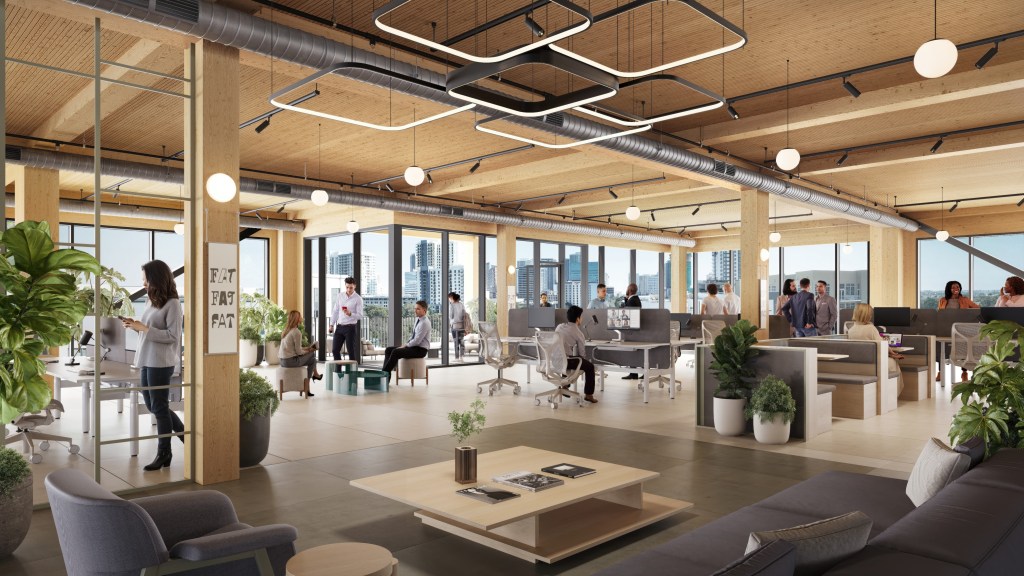
The mass timber project is set to include a mix of communal spaces and collaboration zones. 
FAT Village has been in the works in downtown Fort Lauderdale since 1999. 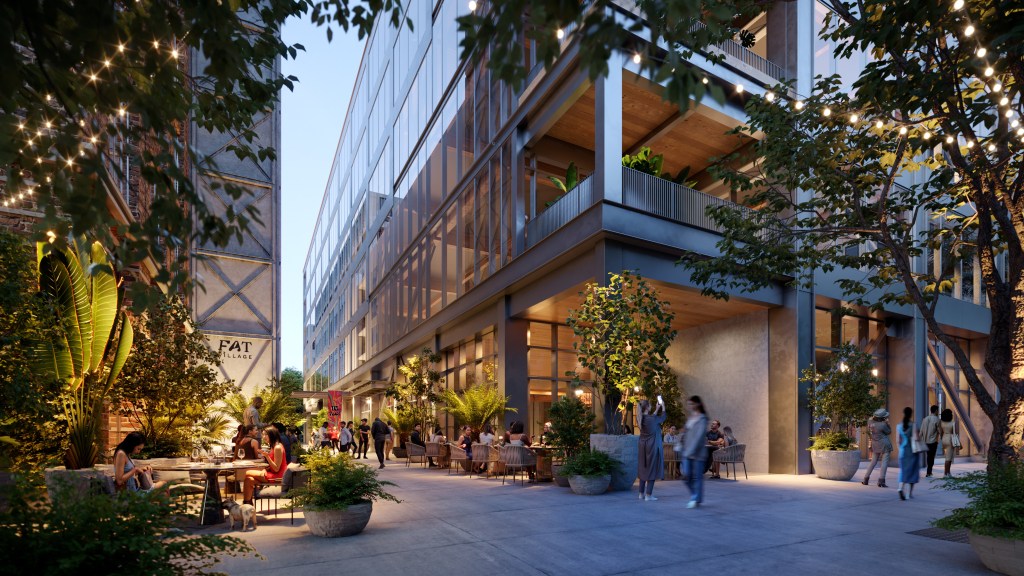
The master-planned, mixed-use redevelopment transforming a portion of downtown Fort Lauderdale’s Flagler Village will feature residential, retail, dining and office buildings across a 5.6-acre site. 
FAT Village is scheduled for completion in 2027.
Beyond mass timber, what will set T3 FAT Village apart?
Kennedy: T3 stands for timber, transit and technology. It defines the architectural language, the level of detail, the quality of development and the connection to the broader South Florida region that will guide the evolution of the reimagined FAT Village.
With mass timber as its structure rather than typical steel and concrete, the building becomes a statement about sustainability, innovation and a more purposeful offering in the office market. Its design also maximizes natural light and fresh air, with open floorplates that encourage flexibility and collaboration.
Strategically located, T3 serves as a gateway into FAT Village, marking the first impression for people arriving from downtown Fort Lauderdale. Its proximity to future mass transit options strengthens its connectivity, linking the district to surrounding neighborhoods and supporting a walkable, integrated urban environment. By combining thoughtful design, differentiated architecture and an engaging tenant experience, T3 not only anchors FAT Village physically but also culturally, signaling the district’s next chapter and establishing expectations for the broader masterplan ahead.
What design elements are you prioritizing to attract modern companies?
Kennedy: Modern companies prioritize sustainability as proof of their commitment toward environmental stewardship and corporate responsibility, and demand flexibility, wellness, authenticity and a sense of place for employees. These are all values that shaped T3’s design from the beginning.
The exposed mass timber creates a warm, inviting atmosphere that helps connect people to the built environment. Combined with high-performance systems, the building delivers a top-tier Class A experience through thoughtful, human-centered design. Access to the outdoors via private balconies and natural light from massive windows are major priorities.
Each floor is also designed to accommodate diverse workstyles, with a mix of communal spaces and collaboration zones. Amenities follow a hospitality-driven approach from the social lobby to the fitness center and bike facilities, creating a seamless lifestyle experience rather than a traditional office environment.
Ultimately, the goal is simple: If companies want people to come into the office, the space must inspire them. T3 was created with that expectation in mind.
What aspect of the redeveloped district are you most excited for people to experience?
Hooper: We have been developing in Flagler Village since 1999. For the most part, the development community has focused on the residential sector. Since then, Flagler Village has grown by more than 15,000 residents, but the area has lacked the lifestyle opportunities that make a neighborhood great.
The T3 component of FAT Village, along with substantial retail on both sides of a two-city-block street, is a game-changer for so many residents who have been waiting for curated eateries within walking distance. This is the final piece that creates an 18-hour experience and provides a complete lifestyle for the residents of downtown’s Flagler Village.
T3 will introduce office users, our food and beverage options along the street will act as a community dining room, the art will provide that sense of discovery, and thousands of residents of downtown Fort Lauderdale will provide the curious and the creative at heart to explore the new, but not forgotten, FAT Village. Seeing that spirit evolve while still honoring its roots is what we’re looking forward to the most.
How have potential tenants responded to mass timber, especially since it’s new to South Florida?
Kennedy: The response has been extremely positive. When tenants walk into the building, the timber immediately communicates that this is a modern, forward-looking workplace, one that aligns with contemporary values around sustainability, material quality and employee experience.
Interest comes from a broad range of companies, including tech firms, creative studios, professional services, law firms and more. Many are seeking a workspace that feels different from the typical buildings in the market. Some groups are expanding from Miami, while others are entering Fort Lauderdale for the first time. Across all sectors, they’re looking for environments that help attract and retain their talent and the uniqueness of T3, especially combined with the offerings of an active mixed-use neighborhood, directly supports that goal.
READ ALSO: Behind the Rise of Mass Timber Towers
Mass timber has cost and supply-chain considerations. How do you balance those realities in the current economic climate?
Kennedy: Mass timber is a premium product compared to typical steel and concrete construction. However, it is quicker and easier to construct, thereby saving soft costs like schedule time and interest expenses. The premium cost and soft cost savings offset one another, allowing a premium product to be leased at the same rate as typical steel and concrete construction.
The Hines team has delivered multiple T3 projects across the country, and those projects allow us to make deliberate choices about where to differentiate. For us, mass timber aligns with our corporate values and with our belief in creating buildings that stand the test of time, and it positions T3 FAT Village as a meaningful, lasting asset for downtown Fort Lauderdale.
Where does mass timber have the greatest potential as more developers begin to embrace it?
Kennedy: Mass timber is about prioritizing sustainability, innovation and experiential design. As more projects are delivered and occupied, broader industry confidence will continue to build across tenants, lenders and building officials. For widespread adoption, continued education and streamlined permitting processes will be important. But the momentum is already clear. Over time, timber will evolve from a standout feature into a mainstream construction option for creating high-quality commercial spaces.

You must be logged in to post a comment.