


Women in Construction Week: When Drawings Meet Reality
Samantha Trumbetti, a project manager at Skanska, on leading complex developments and navigating the realities of construction leadership.
Women in Construction Week is an opportunity to move beyond the typical talking points and look closely at what it truly takes to deliver complex work—day after day, in the field, under real constraints.
Samantha Trumbetti built her career at Skanska from early internships into field and project engineering roles on some of New York’s most visible infrastructure efforts, including LaGuardia’s Central Terminal Building replacement and roadways network, before stepping into project management. Today, she serves as a project manager at the New York City Department of Environmental Protection’s Hunts Point Wastewater Resource Recovery Facility, a wastewater treatment plant anaerobic digester project where success depends not just on construction and engineering expertise, but also on integrating new systems into a fully operating facility without disruption.
In this conversation with Commercial Property Executive, Trumbetti reflects on the habits she’s had to unlearn as her responsibilities expanded, the practical skills that keep teams aligned on complex jobs, and what she believes will meaningfully change for women in construction in the next decade.
READ ALSO: Construction Costs Trends
Was there a moment on LaGuardia when you realized you were exactly where you were meant to be? And were there any moments that tested that conviction?
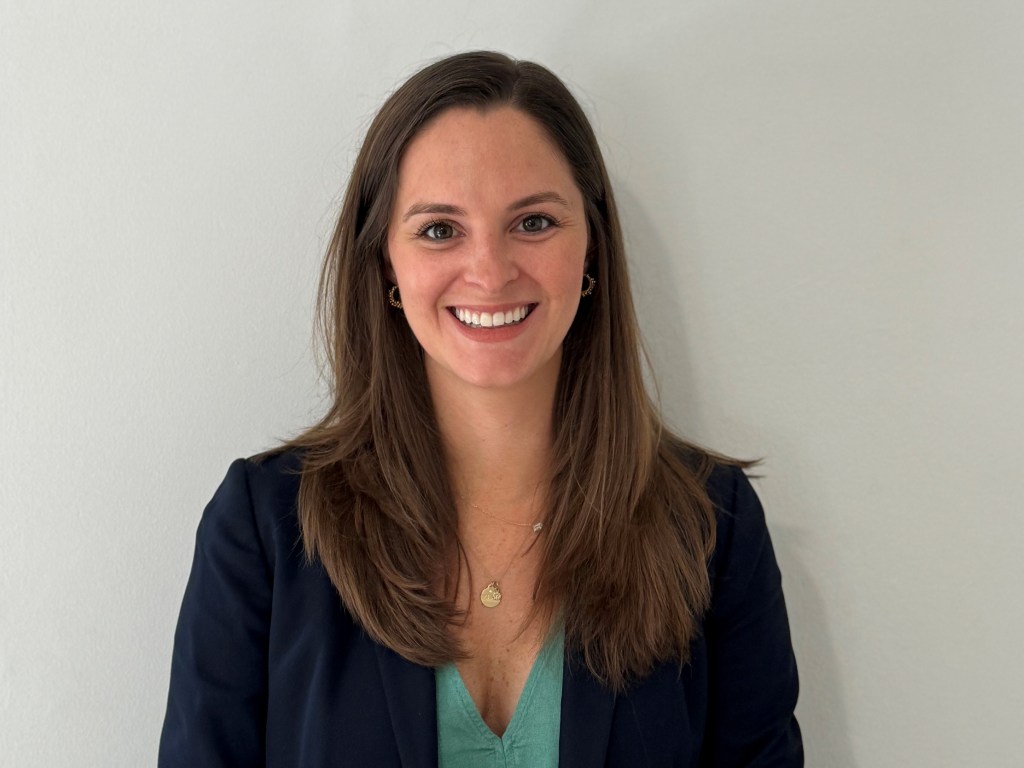
Trumbetti: By the time I began full-time at Skanska on the LaGuardia Airport project, I had already spent four years immersed in the Skanska world through internships and various jobs. In many ways, I was fortunate to gain that hands-on experience while still in school, which gave me the chance to determine whether the construction industry was truly the right fit for me. I discovered that I genuinely loved the combination of technical problem-solving and hands-on, real-world execution.
The moment that really brought the scale and impact of the project home for me came when construction started rising out of the ground. Up until then, it had been mostly planning, excavation and foundation work, but once the bridges, piers and steel were in place, the roadways and terminal began to take shape. That’s when I realized just how massive the undertaking was. This was no longer just a job site. It was a project that would fundamentally transform the region and the city. Watching all the different teams working in parallel and seeing everything come together was unforgettable.
I can’t say I ever seriously questioned whether I belonged. There are frustrating moments, of course, but this work has always felt like what I’m meant to do. Even on the hardest days, I can’t imagine doing anything else.
Who taught you the most in your early years at Skanska, and what did they do that made you better at the job?
Trumbetti: Working at LaGuardia, I was fortunate to be surrounded by strong mentors. My direct manager, Steve, not only taught me how to manage people but also challenged me to think critically, connect overlapping details and step back to see the ’50-foot view’ rather than reacting to each issue in isolation.
Our overall project leader showed me how not to sweat the small stuff. Construction is demanding. We have long hours and constant challenges, but finding the fun in it, giving yourself grace and remembering why you enjoy the work makes a huge difference over the long haul.
What’s a skill you had to build that isn’t taught in engineering school but determines whether you’re reliable in complex jobs?
Trumbetti: Conflict management. Engineering school doesn’t prepare you for the amount of internal and external conflict that comes with large projects. I don’t love confrontation, but learning how to be comfortable being uncomfortable and how to address issues directly without backing down is essential.
As you grow, you become the person others look to for resolution. You can’t always pass it off to someone else. Finding constructive ways to navigate conflict is what keeps projects and teams moving forward.
Speaking of moving forward, you transitioned from field engineer to project manager. What was the hardest habit to let go of as your role shifted from “make today work” to “make the whole job work”?
Trumbetti: The hardest habit to let go of was trying to control everything. As a field engineer or when you’re managing a smaller scope, you can stay in the weeds and you’re directly responsible for making today’s work successful. As you move into broader project management, that approach just doesn’t scale.
You have to trust your people and trust the process. Micromanaging doesn’t work, and it actually slows the job down. Relinquishing that control was uncomfortable at first, but it’s essential. You build strong teams so they can own their pieces, bring issues forward and solve problems collaboratively. One person simply can’t, and shouldn’t, do it all.
When you see a decision onsite trending in the wrong direction, how do you steer the team toward a better option without breaking momentum or making it a public correction?
Trumbetti: My approach is to aim for buy-in from all stakeholders at the outset rather than issuing corrections later. Whether it’s a superintendent, foreman or craft lead, I ask questions that help the team arrive at the best solution themselves. This creates a shared understanding of why a different approach is better and sets everyone up for success.
Experience plays a big role here, both mine and theirs. Respecting that others bring valuable experience builds trust. Sometimes you do have to make a call and move on quickly, but even then, it’s important that everyone understands the reasoning, so momentum is preserved and relationships stay intact.
What’s one assumption you now insist gets tested early because you’ve seen it turn into costly ambiguity once construction starts?
Trumbetti: Trade stacking and resource assumptions. On paper, it’s easy to say four activities can happen at once. But physically and safely, that may not be realistic. Labor availability, equipment constraints and space limitations all matter.
If those assumptions aren’t vetted early, you end up with scope growth or schedule pressure later. Having experienced estimators and field leaders involved during pursuits helps surface those risks before they become costly problems.
On LaGuardia, you worked at the seam between design and field execution. What was the most instructive “drawings meet reality” moment you ran into, and how did it change the way you read drawings today?
Trumbetti: Reinforced concrete was one of the biggest lessons. A model might show that rebar technically fits, but that doesn’t mean it’s physically constructible. Bar size, lap splices, congestion—it all adds up, and suddenly what worked on paper doesn’t work in the field.
Early in my career, catching those issues at the onset and bringing engineers into the conversation was critical. It taught me that just because something looks clean in a model doesn’t mean it works once gravity, tolerances, sequencing and safety come into play. Today, I read drawings with a much more constructability-focused lens.
For readers unfamiliar with wastewater infrastructure, what’s an anaerobic digester in plain terms? On a project like Hunts Point, what coordination point tends to carry the most risk?
Trumbetti: An anaerobic digester is essentially a sealed vessel that breaks down biodegradable waste, things like food waste and human waste, in an oxygen-free environment. That process produces biogas, which can be captured and reused as a renewable energy source, and a byproduct that’s easier to treat downstream.
The biggest risk is integrating new systems into an operating facility. You’re coordinating construction with ongoing plant operations, controls, commissioning and multiple agencies. Making sure everything works together the day it comes online, without disrupting existing operations, is where most of the complexity lives.
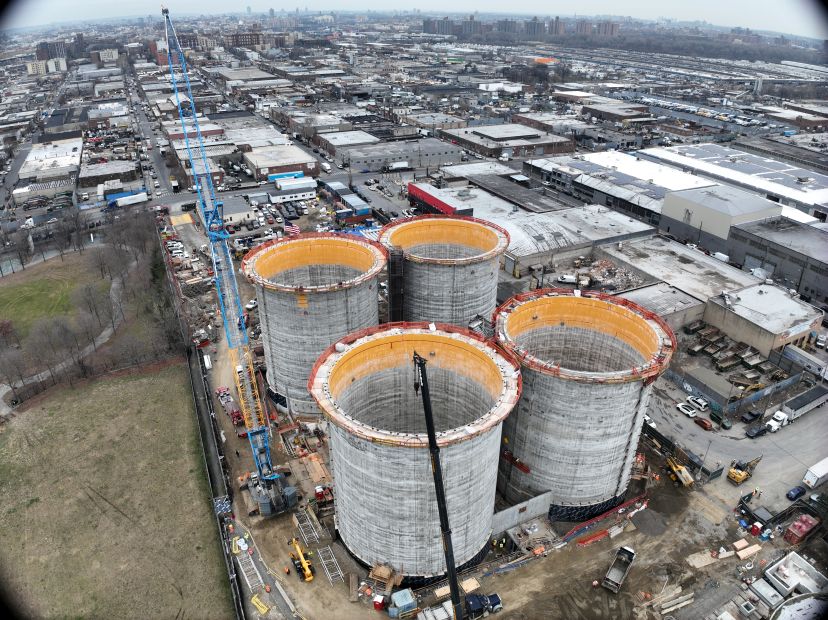
Trumbetti works as project manager at the Hunts Point Wastewater Resource Recovery Facility in the Bronx, where Skanska is primary contractor in a joint venture with R.J. Industries. Key structural work is finished, including the four digester tanks, stair towers, feed pump station, control building and waste gas burners. Image by Kara Fragola, courtesy of Skanska 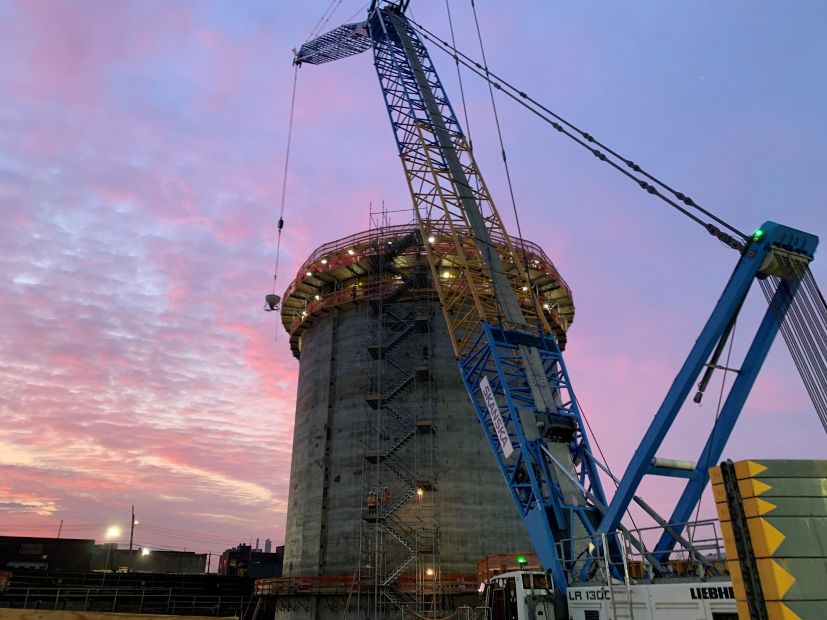
The Department of Environmental Protection has outlined plans for renewable natural gas production at the facility, with specialized systems intended to be fully operational by 2028 to reduce methane flaring. Image by Lexie Close, courtesy of Skanska 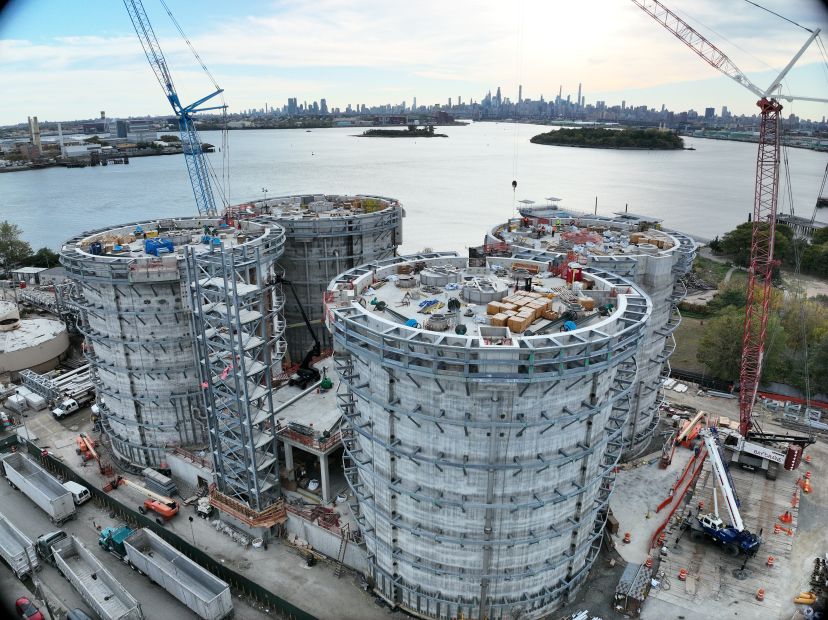
The projected completion for the anaerobic digester facility is this fall. Meanwhile, the Hunts Point access improvement, a $1.7 billion highway project nearby, was completed in November 2025, improving truck routes and reducing traffic congestion near the treatment plant. Image by Kara Fragola, courtesy of Skanska
In high-stakes environments, what’s the most helpful thing the owner’s representative can do to support delivery? And what’s the most damaging thing they do, often unintentionally?
Trumbetti: The single most helpful thing an owner’s representative can do is make decisions quickly, even if they’re not perfect. Timely decisions keep the project moving.
The most damaging thing, often unintentionally, is indecision. Hesitation can stall work, create rework and put the entire schedule at risk. Decisions, whether favorable or not, are what allow teams to plan and execute.
When you’re mentoring younger engineers onsite, how do you help them build judgment, and what do you wish someone had told you in year one?
Trumbetti: Mistakes are part of the job. You’re going to miss things, even I still do. What matters is understanding what happened, why it happened and how to keep it from happening again.
I try to sit down with younger engineers after issues come up and walk through the lessons. Sharing my own early mistakes helps normalize the learning curve. I never want someone to feel beaten down by a mistake, but it can be overwhelming when faced with the real impacts on safety, cost, quality and schedule.
READ ALSO: Prioritizing Well-Being in Workplace Design
As a woman in a field-facing role, where do you see the credibility bar set differently—whose judgment gets trusted, whose directives get followed? What’s your practical playbook for addressing that dynamic in real time on a live job?
Trumbetti: In the field, working with craft and superintendents, I haven’t felt the credibility bar set differently because I’m a woman. If anything, being younger has been a bigger hurdle. I approach the field with respect, assuming they have more to teach me than I have to teach them.
In formal business settings with subcontractors or owners, I focus on letting my work speak for itself. My approach is simple: Come prepared, stay consistent and deliver results. I trust the support around me, and over time, people recognize your contributions and capabilities.
Looking ahead, what do you think will most change the experience of women in construction over the next five to 10 years—what’s improving for the next generation, what’s still stubbornly stuck, and what should the industry do to keep and promote talent?
Trumbetti: Work-life balance is already improving, along with stronger maternity and paternity leave policies. That shift benefits everyone. We’re also seeing more women move into senior leadership roles, which makes a real difference for younger women coming up behind them.
Industry-wide, one area that continues to evolve is recognizing that priorities today aren’t the same as they were 10 or 20 years ago. To retain talent, the industry must support full lives outside of work and embrace open, honest conversations when adjustments are needed at different stages of life. That kind of openness is what allows the next generation to stay, grow and thrive.



You must be logged in to post a comment.