

Why Some South Florida Businesses Are Choosing Office Ownership
FIBA Americas and Grupo Eco executives discuss the region's lease-versus-own equation.

For established businesses planning to remain in South Florida long term, the office decision can extend beyond location to whether to lease or own. Occupancy costs, financing conditions, future space requirements and the length of a company’s commitment to a market can all factor into that calculation.
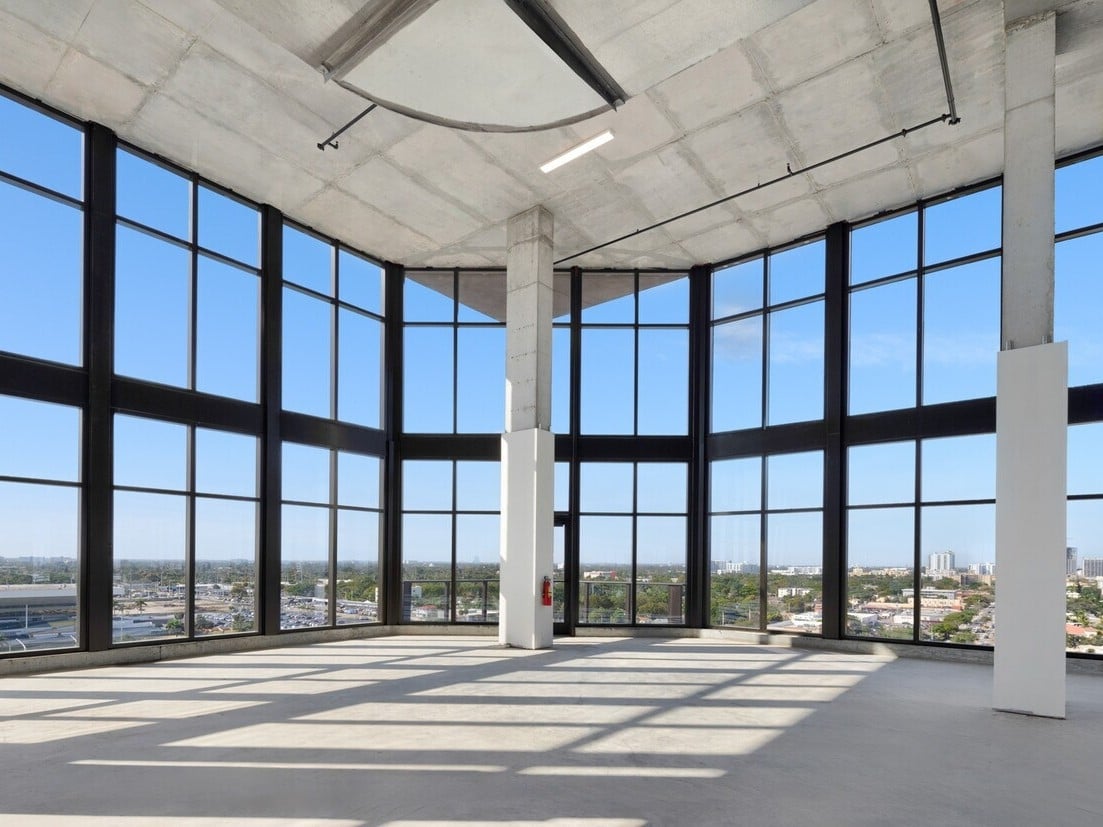
FIBA Americas recently purchased an office building at Atlantic Village Professional Center in Hallandale Beach, Fla., after leasing space in Coconut Grove. The acquisition gives the organization a larger footprint and ownership of its headquarters space as it establishes its next regional base in South Florida.
Atlantic Village Professional Center is part of Grupo Eco’s Atlantic Village mixed-use development. The FIBA transaction offers a look at the considerations facing owner-users as they weigh the flexibility of leasing against the potential long-term benefits and responsibilities of owning commercial space.
Commercial Property Executive spoke with Jaime Gutierrez, content & digital communications head at FIBA Americas, and Grupo Eco CMO Maggy Sutton about what drove the purchase, which businesses are considering office ownership and when leasing still makes more sense.
What prompted FIBA Americas to reconsider its Coconut Grove office arrangement, and when did purchasing become a serious option?

Gutierrez: We had been leasing in Coconut Grove, and as we evaluated our next three, five and 10 years, we realized we wanted to establish something more permanent in South Florida. Purchasing became a serious option once we understood that we could not only secure the space we needed to grow, but also acquire an asset that could provide long-term value and stability for the organization.
The move also gave us an opportunity to upgrade our physical footprint. We went from approximately 4,205 square feet in Coconut Grove to 6,353 square feet at Atlantic Village, so we were able to transition from renter to owner while also gaining significantly more room for our headquarters and future needs.
What were the key considerations when comparing a purchase in Hallandale Beach with renewing your existing lease or leasing elsewhere?
Gutierrez: Location, long-term value and our ability to grow were the biggest considerations. We travel extensively and regularly welcome people from across the Americas for meetings, so accessibility was extremely important. Hallandale Beach puts us between Miami and Fort Lauderdale, with convenient access to both international airports and the many destinations our employees and office visitors use while they’re here.
We were also thinking about the experience beyond the four walls of the office. Atlantic Village gives our team and our guests access to restaurants, fitness, wellness and other conveniences within the same destination.
At Atlantic Village, how do the costs of ownership compare with those of leasing Class A space in the area?
Sutton: When you compare total annual carrying cost of office ownership—common charges, real estate taxes, insurance and debt service—against current Class A asking rents in this corridor, ownership frequently comes out at or below the cost of leasing.
For what types of companies does office ownership make the most sense, and when is leasing still the better option?
Gutierrez: It really depends on where a company is in its growth cycle and how much certainty it has about its long-term plans. Leasing can make sense for a business that needs flexibility or isn’t sure what its space requirements will look like several years from now. Ownership becomes more compelling when an organization knows it wants to remain in a market and can make a longer-term commitment to its location.

Sutton: Ownership works best for stable, profitable, professionally managed businesses with predictable headcount—law firms, medical and dental practices, wealth management and family offices, accounting firms, insurance and title companies, international trade and logistics operators, and increasingly nonprofits and associations with permanent regional mandates. The common denominator is a business that knows what it will look like in 10 years and generates enough consistent cash flow to service debt comfortably.
Leasing remains the right call for high-growth companies that could double or halve in 18 months, for firms entering the market and still validating it, for businesses that need capital deployed in operations rather than real estate, and for anyone whose space requirements are genuinely uncertain. Ownership rewards predictability. If you don’t have it, don’t buy.
How has owner-user demand at Atlantic Village changed in recent years, and what has surprised you about that shift?
Sutton: Five years ago, the owner-user buyer was a niche—mostly medical practices. Today it’s a broad cross-section of professional services and the conversation starts earlier: buyers now approach us before their lease expires rather than after they’ve received a renewal quote they can’t accept.
There’s also a succession dimension we didn’t anticipate—owners approaching retirement like the idea of holding the real estate personally and leasing it back to the practice they eventually sell. That’s a very durable motivation.
How does Hallandale Beach compete with more established South Florida office submarkets for companies seeking a permanent location?
Sutton: Geographically, Hallandale Beach sits at the center of the region—direct access to I-95 and US-1, roughly equidistant between Miami and Fort Lauderdale, minutes from Aventura, close to both airports. That’s a genuine advantage for a firm whose clients and staff are distributed across two counties.
The differentiator, though, is that Atlantic Village is a mixed-use destination, not an office tower with a lobby café.
READ ALSO: CRE Maturities Move From Delays to Decision Time
What do companies purchasing office condominiums at Atlantic Village tend to have in common?
Sutton: What they share is more revealing than what they do. They’re typically owner-operated or partner-owned, so the person signing the check also benefits from the appreciation. Many have a significant bilingual, cross-border component. And nearly all of them are making a location decision tied to where the principals actually live—the Aventura, Hollywood, Hallandale and Golden Beach corridor—because the commute is now part of the compensation package.
What responsibilities and potential limitations should businesses understand before buying an office condominium?
Sutton: You are now a member of an association. You share governance, you’re subject to its rules and you have obligations to your neighbors. Office ownership is the right answer for a great many businesses. It isn’t the right answer for all of them.





You must be logged in to post a comment.