


Why Industrial’s Booming on the Southern Border
Tariffs and turmoil did not kill these markets. Quite the opposite.

Several years post-pandemic, many U.S. industrial markets are finally cooling, due to a mix of strong deliveries and a slowing economy. Along the U.S.-Mexico border, however, the shifting trade patterns and volatile tariff policies that are disrupting other metros are actually fueling commerce.

Nearshoring and reshoring, which strongly boosted industrial markets both north and south of the border, got more complex this year due to a combination of economic unknowns and rising geopolitical strife. For a while, in early and mid-2025, trade tensions all but assured that border boomtowns such as El Paso or Laredo, Texas, would hit a development snag. The risk, it seems, came and went.
Land ports large and small, from San Diego to South Texas, are still flourishing, capitalizing on nearshoring and a surge of cross-border trade and logistics activity. In particular, El Paso has emerged as a front-runner. At the end of the third quarter, vacancy in the market was flat compared to the previous quarter, with net absorption of nearly 1 million square feet over three months, according to a recent CBRE report.
The average tariff on Mexican goods today remains well below those imposed on other major trade partners like China, the E.U., India, etc. Critically, as much as 80 percent of goods entering the U.S. from Mexico do so tariff-free under the existing USMCA.
—Brian Brooke, Senior Vice President, Trammell Crow Co.
A first logistics wave
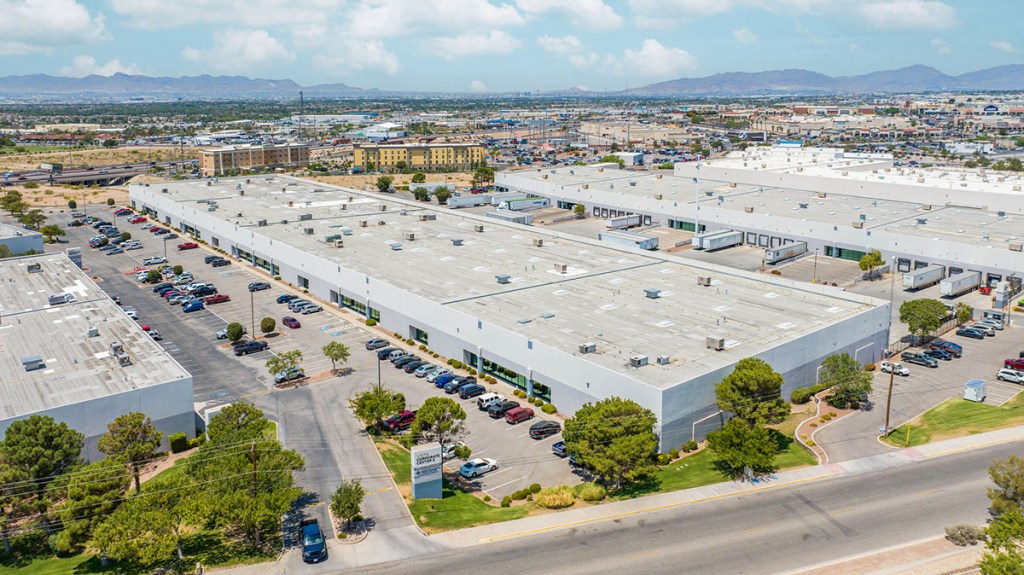
Tariffs imposed during the first Trump presidency marked a turning point for the area, according to Christian Perez Giese, executive vice president & director with CBRE’s industrial and logistics arm in El Paso and Ciudad Juárez, Mexico.
“We saw a shift starting in 2018, going into COVID-19. Deal size grew to 200,000 square feet or more. The warehousing side began holding more inventory and acting as true distribution sites, reflecting more sophisticated manufacturing in Northern Mexico.”
READ ALSO: Tariff Uncertainty Revs Up Demand for Manufacturing Space
Distribution centers started needing larger footprints for products such as auto parts, data-center components and electronics, recalled Ryan Keathley, a managing director with Blackstone’s Link Logistics.
“Pre-COVID, raw material would sit on the U.S. side, then cross into Mexico for value-add manufacturing. The finished good would reenter the U.S. and quickly move on,” Keathley said. “Now, in many cases, that good stays at the border, and the inventory supply chain starts there. So the U.S. side operates as a first-mile distribution point. We hadn’t seen this before, and it’s becoming an important aspect of the market.”
Texas border markets will continue to play a vital role when it comes to the logistics side of the equation.
—Ching-Ting Wang, Head of Southeast Research, Newmark
The need for proximity

In 2023, Mexico became the U.S.’s largest trading partner. According to Trammell Crow Co., it all comes down to three key factors: a favorable workforce, lower manufacturing wages and a pro-U.S. trade sentiment.
“The movement toward nearshoring and increased supply chain resilience that started in 2020 with COVID-19 has been amplified recently with a new push toward nationalist and protectionist policies among many developed countries,” Brian Brooke, a senior vice president with Trammell Crow Co., pointed out.
“We expect this attitude to drive more manufacturing to the Western Hemisphere, which we believe will benefit border markets, with both manufacturers and distributors seeking economical, well-located industrial space that can facilitate cross-border trade.”
Nearshoring has gained enough momentum, and as tariffs continue to take effect and geopolitical shifts persist, Keathley expects demand for U.S.-side manufacturing to grow. As trade remains strong, developer appetite near the border should stay healthy.
READ ALSO: Where Tariffs and Reshoring Benefit Industrial CRE
“The under-construction pipeline in Texas border markets is predominantly speculative, with 78 percent of projects classified as such, and 22 percent as build-to-suit,” according to Ching-Ting Wang, head of Southeast research with Newmark. “This means that developers remain bullish on these markets, willing to assume leasing risk due to solid demand driven by trade, nearshoring and onshoring.”
Opportunities across Texas
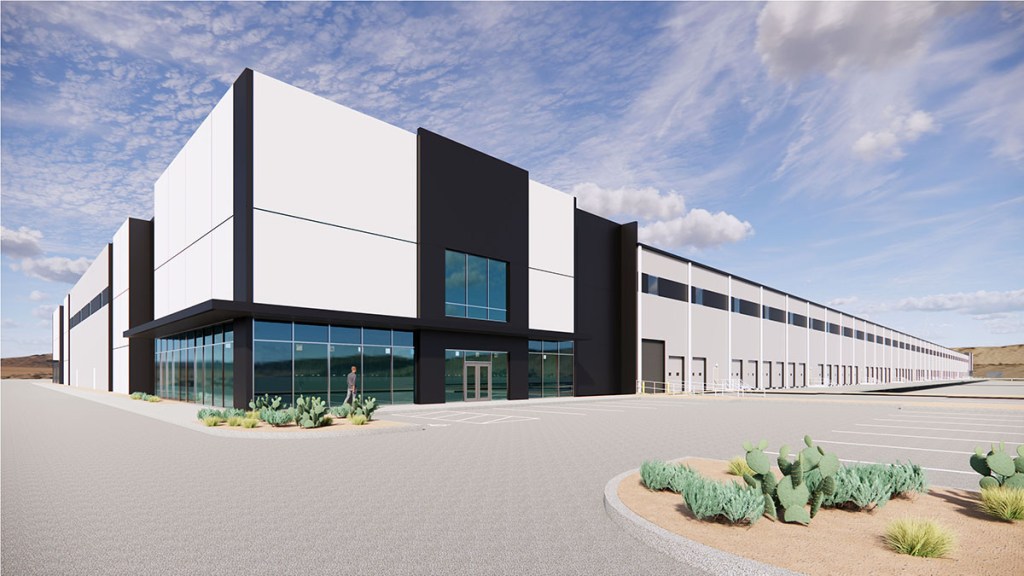
Trammell Crow Co. recently expanded in the El Paso area, breaking ground on the 800,000-square-foot Speedway Logistics project in a joint venture with Barings. Yet the company is looking to expand in other such markets, including Laredo, McAllen or Brownsville, Texas, all of which align with this strategy.
READ ALSO: Small-Scale Industrial’s Broad Appeal

Wang also projects growth in these towns, expecting logistics demand to continue spreading in the area in the coming years.
“Brownsville is a compelling bet for the next five years, offering higher growth potential compared to more established and larger markets such as El Paso and Laredo,” she commented. “The market is home to three land ports, one airport and one seaport, providing multiple entry points for goods into the U.S.”
Employment growth and an expanding population offer additional arguments for expansion.
Here to stay?
Nearshoring is not a new trend by any stretch, but rather a reemerging driver seen mostly in the Southern U.S. at large and across land ports more specifically. And even as short-term conditions remain uncertain, tailwinds remain strong.
Giese and Wang both noted that the 2026 outcome of the USMCA review will be a major factor shaping future trade activity. Once finalized, the agreement will provide a clearer picture of trade relations between Mexico, the U.S. and Canada and directly influence these border markets.
In the meantime, pipelines are booming.

“Under-construction activity in Texas border markets averaged around 11 million square feet from the third quarter of 2022 to the third quarter of 2025, compared to an average of just 1.6 million square feet from 2015 through 2019. At the end of the third quarter this year, approximately 16 million square feet of projects remained under construction, near the historical high reached earlier in the year,” Wang noted.
Such a pipeline can be a double-edged sword, however, potentially adding to higher vacancies and a delay in absorption. But as demand for U.S.-Mexico trade continues, incoming industrial space should find its place in the market.
“This nearshoring boom is still in its early stages,” Keathley weighed in. “As geopolitical shifts persist, companies will continue to look at relocating their supply chains closer to the consumer, which will also drive U.S. demand for manufacturing. All of it creates more certainty for companies domestically.”






You must be logged in to post a comment.