


Return-to-Office Chugs Along
Last month was the strongest May yet for RTO, according to Placer.ai data.
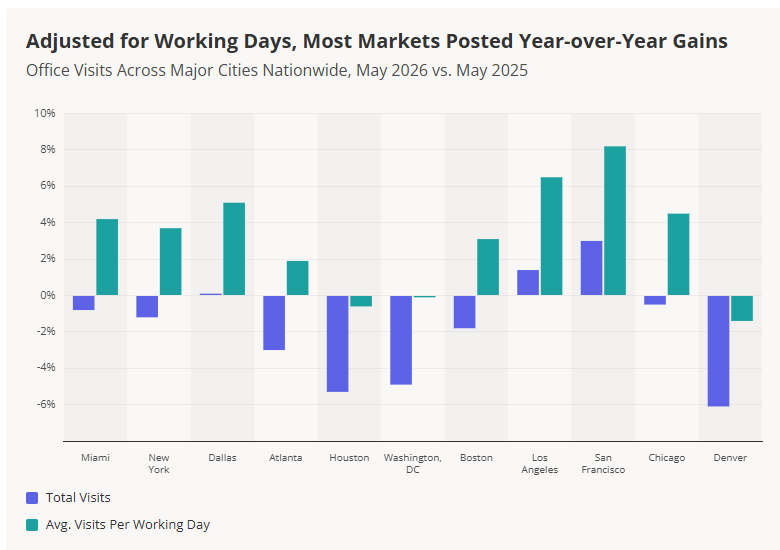
Office attendance in May rose 3.7 percentage points year-over-year after adjusting for the number of working days, according to a Placer.ai report, making May 2026 the strongest May for RTO since the pandemic.
While the raw data suggests that visits to the office dropped in May 2026 by 1.2 percentage points year-over-year, coming in at 38.6 percent below May 2019 levels, it’s actually a function of the calendar.
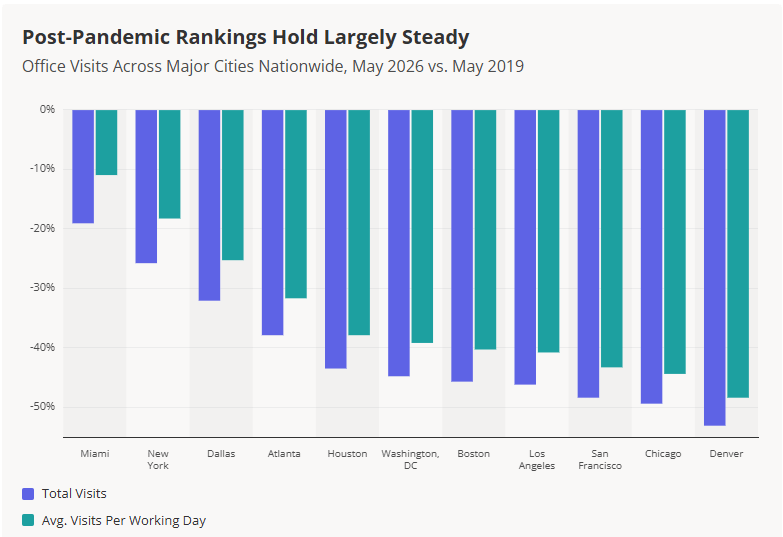
May 2026 included only 20 working days, compared to 21 in May 2025 and 22 in May 2019, Placer.ai noted. When adjusting for business days—days when workers might actually be expected to go to the office—visits were just 32.4 percent below the 2019 baseline, compared to 34.9 percent for May 2025.
READ ALSO: Top City Programs for Office-to-Residential Conversions
“We continue to see a directional improvement in return to office trends compared to 2025 levels, especially when looking at average visits per working day,” Placer.ai Director of Research Elizabeth Lafontaine told Commercial Property Executive.
Placer.ai also reported that companies are still trying to encourage, or force, employees back to the office. Notable efforts along these lines recently include PNC’s five-day mandate, which took effect at the start of May, and EY telling its U.S. tax team to plan for more in-person time this summer.
At the same time, there are stay-at-home pressures. Most notably, gas prices climbed to an average of $4.61 in May as a result of the Iran war, making the commute more expensive for employees who drive to work.
“There are some potential headwinds in 2026 due to rising gas prices,” Lafontaine noted, “which may deter commuters or force companies to become more flexible in their policy enforcement throughout the remainder of the year.”
Miami still at the top for RTO
Miami remained the clear leader for RTO in May, Placer.ai reported, coming in at 11 percent below its pre-pandemic baseline on a per-working-day basis. New York is next at 18.3 percent below. Denver brought up the rear once more, down 48.4 percent from 2019.
When adjusting for the calendar, San Francisco led the field among major U.S. markets in May in terms of RTO gains, with per-working-day visits up 8.2 percentage points compared with last year. In fact, the city—once a poster child for empty office space–enjoyed its strongest leasing quarter this year since 2014, seeing declining office availability and robust net absorption.
“The stronger performance of laggard markets on the West Coast, driven largely by the tech industry, has helped boost national return-to-office numbers,” Lafontaine said.
Los Angeles followed San Francisco at a gain of 6.5 percentage points year-over-year per working day, and Dallas, Chicago, Miami, New York and Boston all saw positive gains. Only three markets stayed slightly negative: Denver, down 1.4 percentage points from a year ago; Houston, down 0.6 percentage points; and Washington, D.C., essentially flat at down 0.1 percentage points.
Denver’s continued softness likely reflects a particularly remote-friendly labor market and record-high downtown vacancy. Still, improving net absorption and slowly strengthening demand for Class A office space in the Mile High City may portend stronger visitation trends ahead, Placer.ai posited.
Placer.ai analyzes foot traffic data from some 1,300 U.S. office buildings in 10 major markets, including newer buildings that were at least partially leased from the end of 2019. In preparing its calculations, the company includes commercial office buildings and those with a retail component on the first floor, but not government buildings or mixed-use buildings that are both residential and commercial.

You must be logged in to post a comment.