

Office Visits Surge in September
Check out the latest update from Placer.ai.
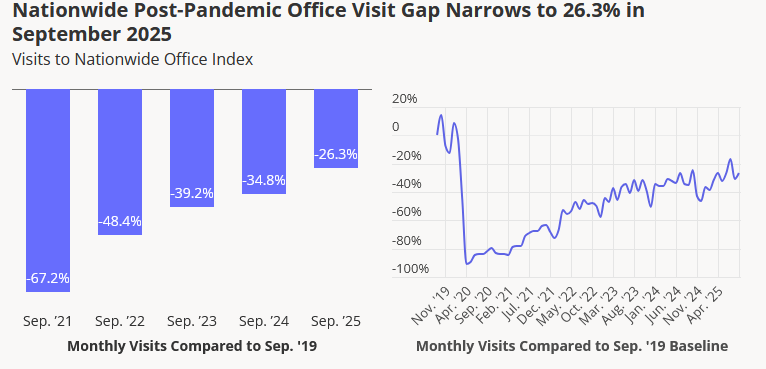
September saw a brisk uptick in office utilization, with visits nationwide coming in at 26.3 percent below 2019 levels—a jump from August, when visits were 34.3 percent below 2019, according to the latest Placer.ai office building index.
Office utilization has come a long way toward recovery. A year ago, office visits were 34.8 percent below 2019, Placer.ai noted. In 2021, visits were 62.7 percent below 2019.
September 2025 thus ranked as the third-busiest in-office month since the pandemic, just behind June and July 2025, even when adjusting for the slightly different number of working days between those months, the report explained.
READ ALSO: What’s Driving Corporate Office Moves
Recovery isn’t a straight line, however, as illustrated by the office visit dip in August. The drop was probably seasonal rather than structural, and as fall routines took hold, RTO momentum strengthened once again.
Besides those seasonal gains, Placer.ai chalks up much of the September gain to a wave of return-to-office mandates taking effect nationwide. Companies such as Intel and Toyota are now requiring employees to spend at least four days per week in the office.
Miami, New York City still top utilization
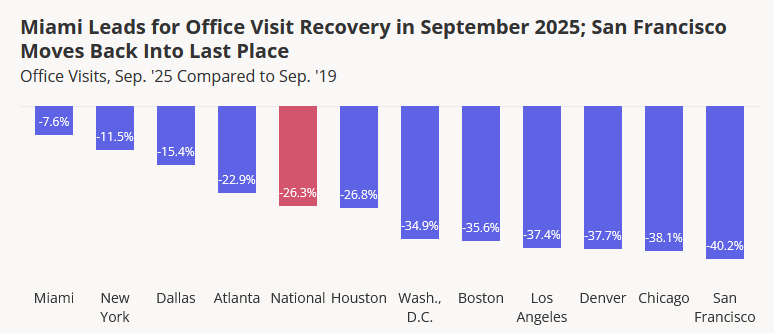
Miami and New York City held onto the top post-pandemic office recovery spots, followed by Dallas and Atlanta, and reflecting broader office space trends in top-performing metros. Miami is a mere 7.6 percent below its 2019 pace of visits, while New York City is 11.5 percent below.
Dallas and Atlanta are both above the national average of 26.3 percent, while the other cities that Placer.ai tracks are below the national average. In order: Houston, Washington, D.C., Boston, Los Angeles, Denver, Chicago and San Francisco.
Placer.ai’s office building index analyzes foot traffic data from about 1,300 office buildings in major cities, though not government buildings or mixed-use buildings that are both residential and commercial.
San Francisco office utilization’s renaissance moment
One indication of a shift in office space utilization is the state of the San Francisco office market, particularly its downtown. In the pandemic and immediate post-pandemic years, the market experienced a steep slump in office space utilization, making San Francisco a post child of low office utilization.
While San Francisco still has the lowest number of office visits among the 11 major cities that Placer.ai tracked, more recently the market has changed direction.
“One of the most surprising findings from this study is the rapid rebound in San Francisco’s office visits,” Placer.ai Director of Research Caroline Wu told Commercial Property Executive. “The city’s impressive 19 percent year-over-year growth is a powerful indicator of the AI boom’s impact.”
Furthermore, she says, recent events like SF Tech Week underscore the renewed value being placed on in-person collaboration.
“Having just spent the last several days touring the San Francisco office market, I can speak to multiple signals of increased demand, including a significant uptick in scheduled tours and inbound calls to brokers we’ve spoken with,” real estate investment platform REALM CEO Travis King told CPE.
The number of tenants looking for space in San Francisco alone has nearly doubled in the last year or so, King says.
“Much of this can be attributed to the return-to-work mandates,” he noted. “More companies are seeing that much of the nuance of business—which has typically been absorbed through informal conversations before and after in-person meetings—is lost in Zoom/Teams meetings.”
Collaboration and ideation are nearly always more productive when done live, and companies that are looking to outrun competitors—especially in the AI space—are realizing that in-office collaboration allows them to move more nimbly, King said.

You must be logged in to post a comment.