
What Makes a CRE Podcast Worth Listening To
Experienced professionals provide guidance and best practices for mastering one of the industry’s most influential mediums.
As commercial real estate communication channels multiply, the way professionals consume information has shifted. News, analysis and deal flow now compete across an expanding mix of newsletters, platforms and short-form updates.
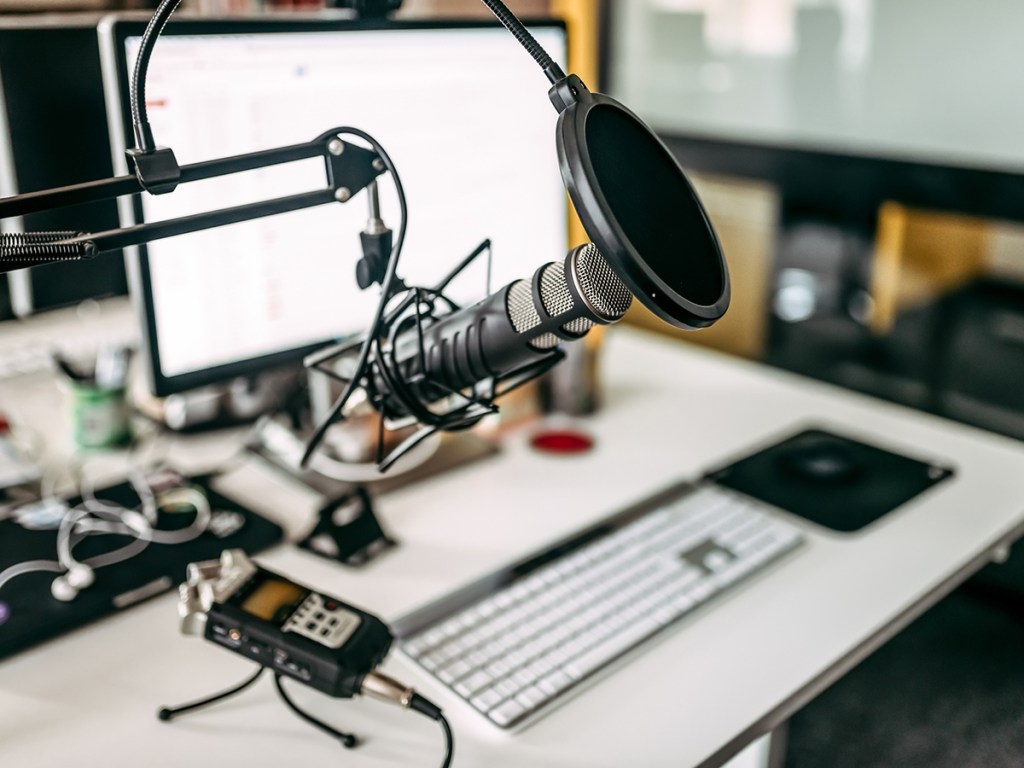
Within that landscape shaped by commercial real estate trends, podcasts have moved from niche experiments to one of the industry’s most effective formats for sustained professional engagement.
The format’s appeal is easy to understand. Audio fits seamlessly into the routines of commercial real estate professionals who spend much of their day commuting, traveling between markets or multitasking through packed schedules. At the same time, podcasts offer something traditional industry media often struggles to replicate: conversational depth. In an industry built on relationships, personality and information flow, that intimacy has become a powerful differentiator.
READ ALSO: When Real Estate Meets Pop Culture, Buildings Go Viral
“There is a magic in voice that creates a deep bond with the listener,” said Hiten Samtani, co-host of The Promote. “It gets into your head like nothing else.”
The result has been a rapid rise in commercial real estate podcasts spanning every corner of the industry, from retail research and industrial logistics to capital markets and urban development. But as the space has grown more crowded, success is no longer defined by presence alone.
The real challenge has shifted toward consistency and relevance, creating conversations that feel worth returning to in a business where time, trust and attention are all in short supply.
What makes CRE podcasts uniquely challenging?
The challenge of commercial real estate podcasting goes beyond the competition for attention—it stems from the complex nature of the industry. Unlike broader business or lifestyle content, commercial real estate podcasts operate in a landscape defined by technical language, fragmented asset classes and shifting macroeconomic conditions.

Hosts are expected to move fluidly between topics like capital markets, insurance underwriting, leasing structures, office real estate trends and industrial logistics, while still maintaining a conversational tone suited for audio.
That balancing act has become more complex as audiences broaden beyond niche professionals. Today’s listeners include investors, developers, attorneys, students and advisors, each entering with different levels of fluency.
“The people that are listening are not industrial real estate brokers for 22 years,” said Justin Smith, senior VP at Lee & Associates and host of Industrial Insights. “Everybody is at a different level of experience and a different segment of the industry. When in doubt, take a moment and explain things that are acronyms or that might be industry jargon.”
Across interviews, that need for translation emerged as a defining feature of commercial real estate podcasting. Successful hosts are not just broadcasters—they act as interpreters, converting institutional complexity into accessible conversations without flattening nuances.
That becomes even more important in technically dense segments of the industry. Capital markets conversations routinely involve debt structures and valuation metrics, while industrial and retail discussions require navigating supply chains, consumer behavior and macroeconomic forces. Yet audiences still expect clarity over abstraction.
READ ALSO: The Power of AI: Reshaping CRE One Agent at a Time
For Spencer Levy, global client strategist & senior economic advisor at CBRE and host of The Weekly Take, content only works if it holds relevance at a granular level. “Our top two episodes in 2025 covered Property & Casualty Insurance and Industrial Outdoor Storage,” he said. “On paper, those are pretty niche topics. They outperformed episodes with far bigger brand names.”
Still, technical depth alone is not enough. As James Cook, executive director of Americas retail research at JLL and host of Where We Buy, noted, audio requires discipline in filtering information. “Anything that’s too data-heavy doesn’t make sense on a podcast. I try to keep it to the big takeaways and a handful of key statistics.”

Audience specificity, intimacy and authenticity
As commercial real estate podcasting has matured, audience clarity has become a defining differentiator. Successful shows are not built for maximum reach, but for a defined listener and sustained trust.
“You have to have a point of view. You have to have something to say that is uniquely yours,” said William Krasne, co-host of The Promote. “If you’re speaking in platitudes or generalities, it’s really hard to break through.”

That philosophy has shaped The Promote from the beginning. Unlike many industry shows that rely heavily on guest outreach and publicity circuits, the podcast operates on an invite-only model. “We do not accept guest pitches or segment pitches. Everything we cover is based on what Will and I are seeing out there, and our guests are by invite-only,” Samtani added.
The strategy reflects a broader shift happening across commercial real estate media, where audiences have become increasingly sensitive to overly promotional content. While the industry has long relied on relationship-building and personal branding, podcast listeners appear far less tolerant of conversations that feel scripted, self-congratulatory or dominated by talking points. Many hosts said listeners can immediately sense when a guest is using a podcast primarily as a marketing vehicle.
“Our first responsibility is to the listener, not to the guest,” Samtani said. “That sets the tone for everything we do.”
That listener-first mindset also shapes how other hosts select guests. Cook approaches every episode with a clearly defined audience in mind.
“My listeners work in the retail real estate business, and I try to pick guests and topics that I know they would be interested in. An episode’s topic is good if I know it will bring value to the listener.”
The emphasis on authenticity may also help explain why podcasts have become such an effective relationship-building tool within commercial real estate. Unlike traditional media appearances or conference panels, podcasts create a sense of familiarity that develops gradually over time.
“Podcasting is incredibly intimate,” Levy said. “Many people listen alone—in the car, on a walk, or while working out. Over time, regular listeners feel like they know you and your guests.”
The fine line between structure and script
That sense of audience precision and editorial discipline does not end with positioning—it directly shapes how commercial real estate podcasts are structured, produced and executed.

Once hosts define who they are speaking to and what kind of conversation they are building, the next challenge lies in maintaining that clarity inside an audio format that rewards flow but punishes excess.
Across interviews, one of the most consistent tensions was between structure and spontaneity. While every successful podcast relies on some form of framework, overly rigid formats tend to flatten the very conversations they are trying to elevate.
For Levy, discipline in pacing is essential—but so is knowing when to abandon the script. “We try to keep episodes around 30–40 minutes, which aligns pretty closely with where listener drop-off typically begins. As for structure… don’t tell my producers… but they put together excellent outlines and question lists, and the best episodes are usually the ones where I barely look at them. The ideal structure is a natural conversation.”
That balance between preparation and fluidity appears across most successful commercial real estate podcasts. Rather than scripting interviews, hosts rely on frameworks that allow for deviation when the conversation becomes more interesting than the plan.
Cook described that structure as intentional but light-touch. “It’s business up front and party in the back,” he said, referring to the need for a clear introduction that quickly gives way to a more open conversational rhythm. The goal, he added, is not complexity in format but clarity in delivery.
Behind the scenes, production choices also play a defining role in shaping tone. For Samtani, the difference between a polished interview and a genuinely engaging conversation often comes down to chemistry and sound design working together rather than against each other.
That emphasis on chemistry extends into how hosts think about interviewing itself. Smith described his approach as improvisational rather than scripted. “I follow the improv rule where you have the words ‘yes’ and you build off of the conversation.”
What emerges across all approaches is a shared principle: execution is not about control, but about creating conditions where the conversation can unfold naturally. Preparation defines the boundaries, but chemistry determines what happens inside them.
In that sense, structure in commercial real estate podcasting is less about scripting content and more about engineering flow—tight enough to guide the conversation, but loose enough to let insight emerge in real time.
Translating complexity into conversation

If structure defines the boundaries of a commercial real estate podcast, execution is what determines whether those boundaries hold up in real time. The difference between an engaging episode and one that fades quickly depends less on the topic or guest and more on how the conversation is carried forward.
Much of that execution starts before recording, in the way guests are prepared for the format itself. For Levy, that step is as important as the interview itself.
“We do the usual homework… research the guest, develop a thoughtful topic list and collaborate closely in advance. Just as important is making sure guests are comfortable with how the podcast works.” That early alignment allows the conversation to move faster once the mics are on, without defaulting to rehearsed talking points.
Smith approaches execution as a form of real-time adjustment rather than adherence to a plan. Preparation may include research and AI-assisted briefings, but once the conversation begins, the focus shifts entirely to responsiveness.
“I try to think about what they’re telling me and where I’ve seen something like it. I love asking for examples… how did that come to be, when did that happen, what was going on at that time?” The goal, he explained, is to continuously steer answers away from abstraction and toward lived experience.
That same responsiveness extends to how conversations are shaped in the moment. Krasne described execution less as asking questions and more as resisting the instinct to guide guests toward predictable narratives. “We want them to sell themselves, not us to sell them,” he said. In practice, that means pushing beyond polished responses and staying with a topic long enough for specificity—not messaging—to surface.
For Samtani, execution is also about managing energy and direction without flattening spontaneity. Guests are selected carefully, but the conversation itself is allowed to stretch beyond its initial frame. That flexibility, he suggested, is what often produces the most revealing moments—when a planned segment becomes secondary to an unexpected detail worth following.
Across all approaches, a consistent pattern emerges: execution is not about sticking to better questions, but about knowing when to stop relying on them. The strongest episodes are often those where the preparation has done its job quietly in the background, allowing the conversation to move forward without visible scaffolding.
In that sense, execution is where all earlier decisions converge—audience definition, tone, structure and guest selection. But it is also where those decisions are tested. Because in audio, no amount of preparation matters if the conversation cannot hold itself in motion once it begins.



You must be logged in to post a comment.