

Mexican Steel Manufacturer Picks Houston
The company will establish its first U.S. operations at Liberty Development Partners’ rail-served industrial park.
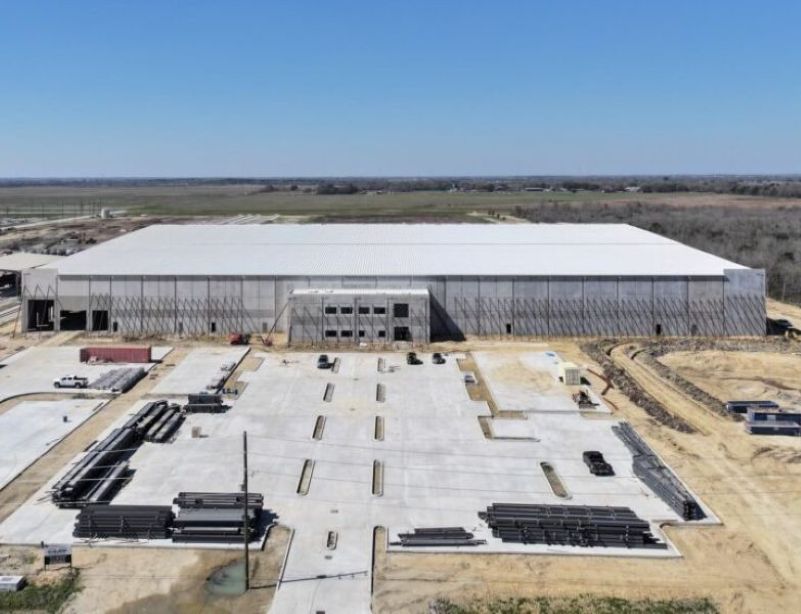
Serviacero USA has purchased a rail-served site at Gulf Inland Logistics Park, which is managed and developed by Liberty Development Partners, for an undisclosed price. The park is near Dayton, Texas, in metro Houston.
Serviacero is a Mexican specialist in steel products, especially steel bar grating and tubular products for such industries as distribution, construction and energy. The company plans to establish its first manufacturing site in the U.S. at Gulf Inland.
Liberty Development completed the first phase of Gulf Inland, which spans 200 acres, late in 2025. Phase 2 is now underway and already offers rail-served and non-rail-served sites, with the overall aim of making the park into a high-capacity logistics hub, as development moves to meet demand.
The project’s rail infrastructure is particularly important, according to the developer, giving tenants the flexibility to distribute by rail as well as truck or, ultimately, ship. Yards 1 and 2 are fully operational, totaling 1,000 railcar storage spaces. Three more yards are set to open this year, bringing the total to over 2,000 railcar storage spaces by the end of 2026.
READ ALSO: Busy Ports Support Industrial Market Recovery
The park features access to the two largest U.S. Class I Railroads, BNSF and the Union Pacific. Gulf Inland’s location at the intersection of the Grand Parkway and U.S. Highway 90 provides access to Interstates 10, 59, 45 and Texas State Highway 146. It is also within 100 miles of five Texas ports: Port Houston, Port of Beaumont, Port Arthur, Port of Galveston and Port Freeport.
US manufacturing on the rise
Tariff policies especially are still something of a wild card when it comes to investment and supply-chain strategies, but last year’s One Big Beautiful Bill Act is likely to have significant long-term effects on the U.S. manufacturing sector, spurring more development of such facilities domestically, according to Yardi Matrix.
OBBBA includes provisions to encourage the stateside production of goods, such as the restoration of 100 percent bonus depreciation for equipment and facilities placed in service after Jan. 19, 2025. The changes should provide benefits to manufacturers in the near future, while other parts of the new tax code may help drive longer-term investments, as incentives for reshoring and enhanced interest deductibility kick in.
Manufacturers are already on the move. Another recent example in Texas is MP Materials, which is investing $1.25 billion to build a rare earth magnet manufacturing facility in Northlake, Texas, in the DFW metro market.
Known as 10X, the manufacturing hub will be located on Hillwood’s AllianceTexas campus and occupy multiple buildings on a 120-acre site. The facility will have a production capacity of about 10,000 metric tons of rare earth magnets per year.
The Sun Belt isn’t the only beneficiary of U.S. manufacturing expansion. In February, Johnson & Johnson said it will invest $1 billion in a cell therapy manufacturing facility in Lower Gwynedd Township, Pa. The investment is part of the company’s initiative to invest $55 billion in the U.S. by early 2029.


You must be logged in to post a comment.