


Reframing the Debate Over AI and Jobs
Will AI hurt or help CRE demand? A look at the evidence so far.

For real estate investors, the impact of artificial intelligence is more than a technology or productivity question. Employment has long been one of the fundamental drivers of demand for space and, if AI meaningfully changes the level, composition or geography of employment, the implications for real estate extend beyond digital infrastructure opportunities to office, industrial, housing and other sectors. Understanding how AI is affecting work is, therefore, increasingly important to understanding how real estate itself may be used.
The difficulty is that AI’s effect on employment remains highly uncertain. Forecasts span an unusually wide range—from AI increasing employment by boosting productivity, reshaping roles of existing workers and creating new occupations to fundamentally reducing the amount of human labor required across large portions of the economy. At this stage, confidence in either extreme seems misplaced.
Public expectations, however, lean toward the latter outcome. In a recent survey, 71 percent of U.S. adults said they expect AI to result in fewer jobs over the next 20 years, the third-highest share among 37 countries surveyed. The degree of pessimism is particularly notable given the United States’ position near the center of the AI investment cycle and its potential for relative advantage. That said, the level of concern is understandable given the speed with which AI capabilities are advancing. But it also stands in contrast to the historical experience of previous major technological shifts.
Historical patterns
Past waves of innovation, from the personal computer to the internet, displaced tasks, altered occupations and rendered some skills less valuable. Yet over time, they also lowered costs, increased productivity, created new products and industries and supported higher levels of economic growth and employment. Previous technological shifts created forms of demand that were difficult to anticipate at the outset. Whether AI ultimately follows that pattern or proves meaningfully different is the central question.
For now, the most useful approach may be to separate what is possible from what is observable. The theoretical range of outcomes remains extremely wide, and predictions about AI’s ultimate capabilities should be treated accordingly. But several years into the rapid adoption of generative AI, we can increasingly examine actual labor market data for signs of disruption. The next section focuses on that evidence: what employment trends are showing so far, both across the broader labor market and within occupations considered most exposed to AI.

Early fears have outpaced the evidence
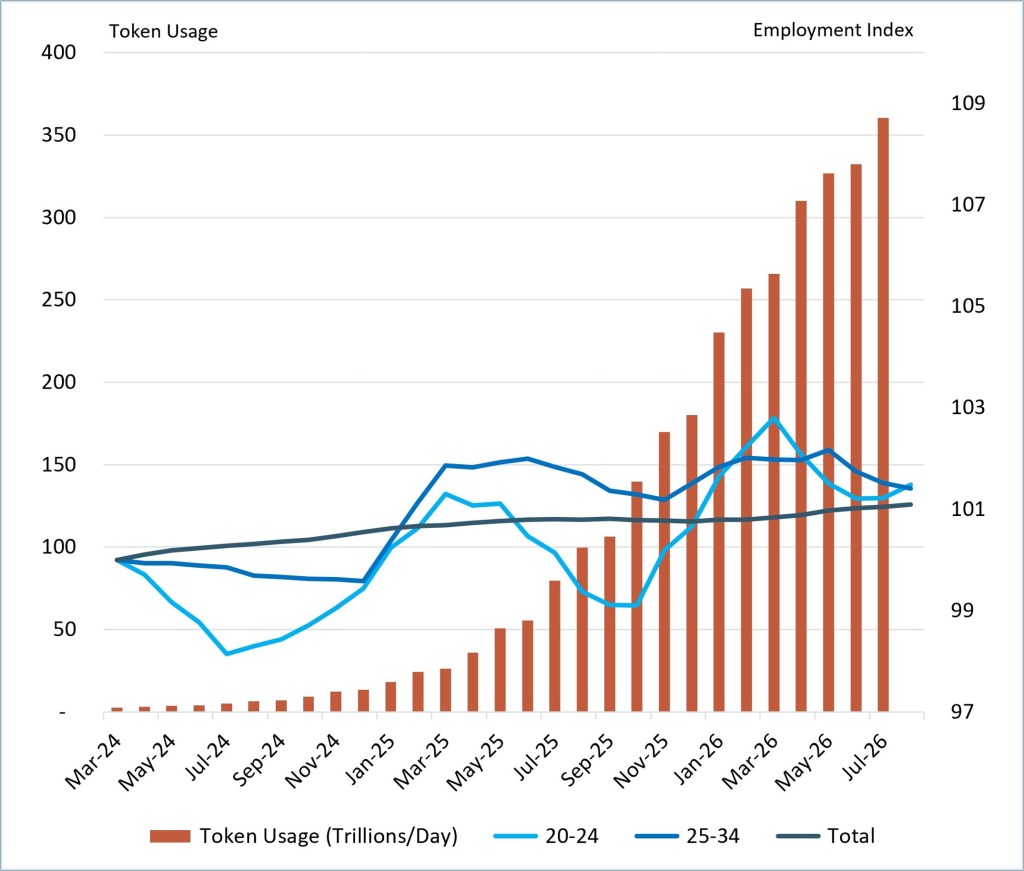
AI adoption continues to increase rapidly, both at home and in the workplace. Measuring that adoption precisely is difficult. Much of the underlying usage data is held privately by model providers, hyperscalers and individual companies, and there is no comprehensive measure of global AI activity. Token consumption provides one imperfect but useful indicator of the magnitude of the change. Estimates suggest global AI token usage has increased from roughly 3 trillion tokens per day in early 2024 to approximately 360 trillion today, and usage may still be in its early stages. Goldman Sachs estimates that the emergence of AI agents could increase token consumption another 24-fold by 2030 as AI increasingly moves from responding to individual prompts to completing sequences of tasks autonomously.
If AI were already leading to broad-based substitution of workers, we might expect an increase of this magnitude to begin appearing in aggregate employment data. Thus far, that has not been the case. As shown in Exhibit 1, total U.S. employment has increased by approximately 1.6 million jobs, or 1.1 percent, since March 2024, even as AI usage has accelerated dramatically. This does not establish that AI has had no effect on employment, as aggregate data can obscure meaningful shifts within individual occupations, but it provides little evidence thus far of economy-wide job displacement.
Employment growth has slowed since 2025, but there are important reasons to be cautious about attributing that slowdown to AI. One of the most significant has been a sharp deceleration in labor force growth. Dallas Federal Reserve research estimates that the number of jobs required each month to keep the labor market in balance fell from approximately 250,000 at the peak of the immigration surge in 2023 to roughly 30,000 by mid-2025, reflecting slower population growth, reduced immigration and changes in labor force composition. More recent Federal Reserve research suggests break-even job growth may have fallen even further. In this context, slower payroll growth is not necessarily synonymous with weaker labor demand. Since May 2025, payrolls have increased by an average of approximately 38,000 jobs per month (in line with the Dallas Fed break-even estimate), while the unemployment rate has declined from 4.3 percent to 4.1 percent.
EXHIBIT 1: AI tokens processed per day vs. employment growth index
A growing body of academic research, firm-level data and business surveys provides a more granular view of where disruption might first appear. The results are not uniform, but taken together, the evidence thus far generally points to relatively modest effects on overall employment, with AI more often changing how work is performed than eliminating the need for workers altogether.
- Academic research on entry-level employment is mixed, but there is little evidence thus far of a broader increase in unemployment attributable to AI. A study examining recent college graduates found no statistically significant increase in unemployment in 2026 relative to prior years. Meanwhile, Stanford researchers using ADP payroll records find no evidence of economy-wide job displacement but do identify a meaningful divergence among younger workers. Employment for workers aged 22 to 25 in highly AI-exposed occupations has lagged their less-exposed peers.
- Firm-level evidence is similarly inconsistent with widespread substitution of labor. Research linking actual AI spending at more than 21,000 U.S. companies with workforce data found that firms making the largest investments in AI increased total headcount by roughly 10 percent more than the control group, with entry-level growth even higher. The researchers caution that these firms were already growing quickly and technology-intensive, making causality difficult to isolate.
- Business surveys point more toward augmentation and retraining than displacement. Survey evidence should be interpreted cautiously, but the results remain informative. Census Bureau research finds that roughly two-thirds of AI-using firms currently use the technology solely to augment worker tasks, while only about 2 percent report AI-related employment reductions. The New York Fed’s 2026 regional business surveys tell a similar story: Despite rapidly increasing AI adoption, layoffs attributed to AI remain rare, while retraining existing employees is by far the most common workforce response.
- Traditional labor market measures also remain difficult to reconcile with broad AI-driven displacement. Employment-to-population ratios remain relatively high and unemployment relatively low across age groups compared with much of the past decade.
Reframing the AI Jobs debate
While the resilience of employment across age cohorts is encouraging from the standpoint of AI-related displacement, it also highlights a different challenge. The U.S. is entering a period in which demographics are likely to constrain labor supply considerably more than investors and businesses have become accustomed to. Rather than an abundance of workers being displaced by technology, the more consequential long-term risk may be a shortage of workers available to support economic growth.
Over long periods, economic growth can be simplified into two fundamental components: growth in the number of workers and growth in what each worker can produce. Over the past four decades, growth in the U.S. labor force has accounted for approximately 37 percent of real GDP growth, with productivity improvements accounting for the balance. Going forward, however, the labor contribution is set to weaken considerably. The U.S. labor force is projected to grow just 0.3 percent annually over the next decade, compared with 0.8 percent over the past decade and approximately 0.9 percent annually over the past 40 years.
Perhaps more notable is what has happened among younger workers. One frequently expressed concern is that AI will affect entry-level positions first, as many of the tasks performed by less-experienced employees may be more exposed to automation. Yet the aggregate age data have not followed that pattern. Since March 2024, employment among workers aged 20 to 24 has increased approximately 1.5 percent, while employment among those aged 25 to 34 has risen 1.4 percent, both outpacing overall employment growth of 1.1 percent over the same period. Age alone is an imperfect proxy for entry-level employment, but these trends provide little evidence thus far of a broad deterioration in employment among younger workers as AI adoption has accelerated.

The implications for economic growth are significant. If the supply of workers grows at only a fraction of its historical pace, maintaining the rates of real GDP growth Americans have become accustomed to will require substantially greater output from each worker. In other words, productivity will increasingly need to do the work that labor-force growth has historically provided.
That suggests the debate around AI and employment may benefit from being reframed. The question is typically posed as “How many jobs will AI replace?” But over the coming decade, an equally important question may be “How can AI substitute for workers the economy will increasingly struggle to find?”
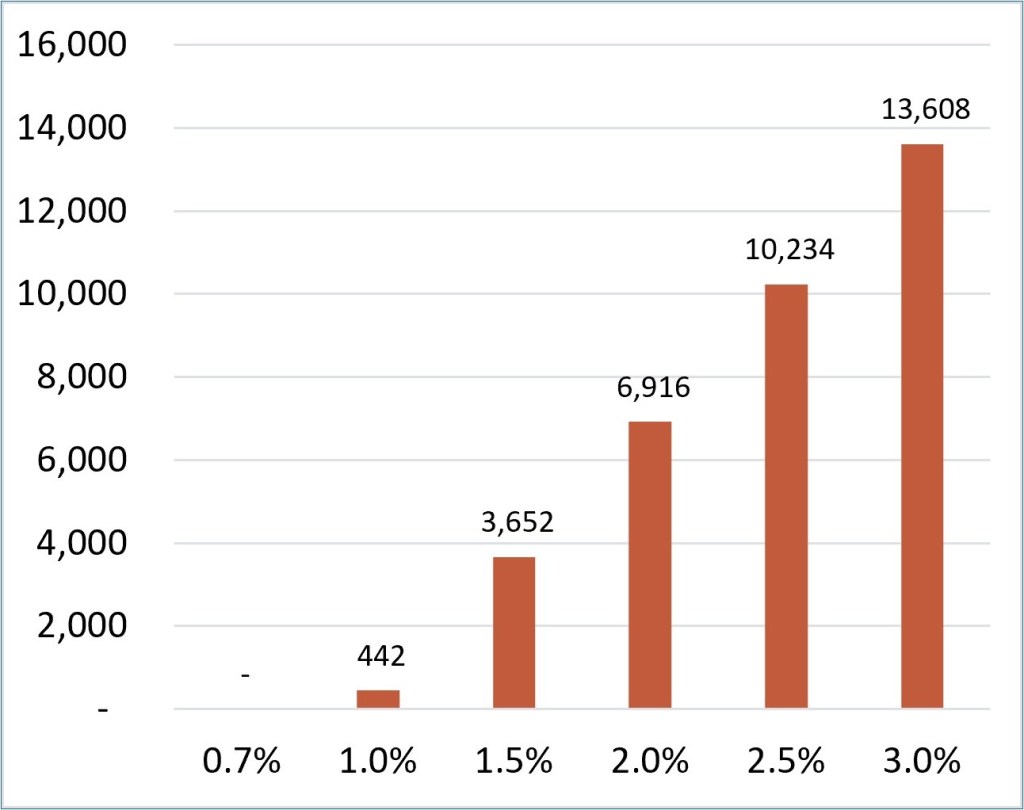
Exhibit 2 quantifies this question. Starting with approximately 159 million U.S. nonfarm payroll jobs today, the exhibit estimates how much labor-equivalent productivity AI would need to provide over the next decade to support different rates of real GDP growth given projected labor-force growth. Viewed this way, the amount of work AI could potentially automate takes on a different meaning. What might appear as job displacement in an economy with abundant labor could instead represent an increasingly important source of productive capacity in an economy constrained by demographics, with expected gaps of millions of jobs depending on the GDP target.
EXHIBIT 2: AI employment substitution needed
over next decade for various GDP targets
The evidence to date suggests that AI is changing the nature of work more than it is reducing the overall need for workers. Employment remains resilient, even in many areas considered most exposed to AI, while firm-level and survey data point more toward augmentation, retraining and changing job responsibilities than broad-based displacement.
That distinction will matter increasingly as U.S. labor-force growth slows. If demographics provide less support to economic growth in the years ahead, productivity gains will need to play a larger role. In that environment, the more important question may not be how many jobs AI eliminates, but how effectively it allows a slower-growing workforce to produce more. For real estate investors, the implications will ultimately depend less on headline fears of job loss and more on how AI reshapes the composition, location and productivity of employment and, in turn, the demand for space.
Mark Fitzgerald is managing director & head of research for Affinius Capital.
Please note: To become a Viewpoint writer, reach out to Therese Fitzgerald at therese.fitzgerald@cpe-mhn.com. All Viewpoints are copyright of Commercial Property Executive. We do not accept AI-written content.




You must be logged in to post a comment.