

Is NYC Construction Spending a National Bellwether?
Office development costs will nearly double this year in The Big Apple, according to a New York Building Congress report.
Despite headwinds, total construction spending in New York City will reach $219 billion from 2025 through 2027, according to a new report from the New York Building Congress. Office development spending is expected to reach $9.5 billion this year, nearly double the value registered in 2024. This reflects current office building trends, with developers responding to shifting workplace needs across the nation’s major markets.
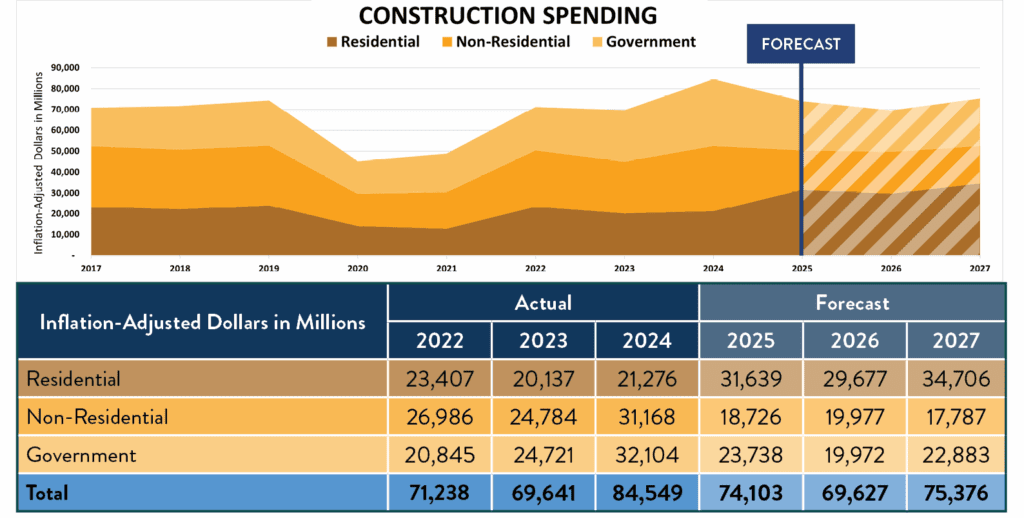
Total annual spending will hit $74 billion this year, dip slightly to $69 billion next year before rebounding in 2027 to $75 billion, the report notes. The sectors which saw the largest year-over-year growth this year are: residential, office, health care and transportation infrastructure.
The surge in New York City construction spending comes as many firms and private sector investors are choosing to delay large expenditures until conditions become more predictable or until interest rates are cut, according to the report. The Big Apple has accounted for 3 percent of all U.S. development expenses on an annual basis in the past 5 years.

“New York City keeps on building. We’re driving $74 billion in construction this year, supporting about 14,000 good-paying jobs across the city. Office investment is surging, betting big on the most talented workforce in the world,” Carlo Scissura, president & CEO of the New York Building Congress, told Commercial Property Executive.
A NYBC spokesperson noted a lot of the projects were in planning and design phases for years before the recent hikes in material costs.
“Since projects take years to finish, it’s likely that they’ll be able to spread out some of these costs through periods where things are more normal and predictable,” the spokesperson said.
Spotlight on office construction
Over the past 10 years, nonresidential construction spending has outpaced residential spending in New York City. However, going forward to 2027, this trend is expected to flip because of the high demand for housing.
One of the bright spots has been the volume of new office construction which has more than doubled in New York City on an annual yearly basis over the past decade. From 2015 to 2024, about 4.8 million square feet of new office space was built per year compared to the prior 10-year period when 2.2 million square feet per year was developed, the report stated.

High-profile office projects cited by NYBC comprise two multimillion-square-foot towers at the World Trade Center, including Two World Trade Center at 200 Greenwich St. and Five World Trade Center at 130 Liberty St.; the 2.5 million-square-foot JPMorganChase global headquarters at 270 Park Ave., which celebrated its grand opening last week; the 1.2 million-square-foot Disney headquarters at 7 Hudson Square, and the 2.6 million-square-foot Grand Hyatt replacement at 175 Park Ave.
These projects “all bode for continued multimillion-square-foot office construction in the 2025-2030 period,” according to the report.
Residential construction always strong
Residential construction in New York City represents 43 percent of all 2025 construction spending, up from 24 percent in 2024. A growing level of office-to-residential conversions is helping fuel the residential spending increase as nearly 19,000 new housing units are expected to be permitted in 2025. The number of building permits is one-third less than in 2024 but double the volume of 2023.
Due to continued housing demand and unit cost pressures associated partly with imported building materials, both new and rehabilitated residential spending are expected to continue to rise for the foreseeable future.
READ ALSO: How Construction Headwinds Are Shaping Development
The NYBC estimates there will be more offices converted to residential buildings, comparing it to earlier efforts in the city’s Financial District, which has a thriving residential community now. Changes in both city and state legislation, including allowing more density and moving up the eligibility date for office building conversions from 1961 to 1991, together with the 467-M tax abatement and the Midtown South Mixed-Use Plan, are expected to help spur more conversions, the organization spokesperson mentioned.
“All of these policies were major parts of NYBC’s prior advocacy efforts and we’re thrilled to see them starting to bear fruit,” the spokesperson added.
Public-sector spending dips
Capital investment in public facilities and infrastructure continues to represent a major source of construction spending in New York City. Public-sector spending will total $23.7 billion this year, driven by the Metropolitan Transportation Authority ($7.3 billion), New York City ($13 billion) and the Port Authority of New York and New Jersey ($1.5 billion). That’s down from $29.3 billion in 2024.
One major Port Authority project—the $10 billion new Port Authority Bus Terminal in Manhattan—is expected to be a major component of the 2025-2027 construction forecast period.
Asked whether NYBC was concerned that cutbacks in government spending, particularly on the federal level, will impact the numerous transportation infrastructure projects underway or planned, the spokesperson said the group was concerned but hopes they are temporary.
“In the short term, projects that are underway can keep moving forward to some extent, but at a certain point, if these freezes last too long, we’ll start to see very costly delays.”


You must be logged in to post a comment.