
How LEED Certification Fared in the Office Sector in 2025
Top projects, leading markets and key trends revealed by last year’s LEED activity.
Even with office fundamentals in flux across U.S. markets, LEED certification activity continued in 2025, especially for assets where owners can point to this as proof of performance. Based on U.S. Green Building Council project data for U.S. office certifications dated in 2025, 392 office projects earned certification last year, representing nearly 63 million square feet of gross area. The LEED pipeline spanned new construction, core-and-shell, commercial interiors and existing building operations.
The headline is how strongly Gold continues to anchor the market. Gold accounted for 197 projects and almost 34 million square feet, or 50.3 percent of certifications by count and 54.3 percent by gross area. Silver followed at 113 projects totaling 14.2 million square feet (28.8 percent of projects; 22.7 percent of area). The Platinum cohort was smaller in actual property count—36 projects—but still sizable in footprint at 9.7 million square feet (9.2 percent of projects; 15.6 percent of total area). Finally, Certified rounded out the year with 46 projects and 4.6 million square feet (11.7 percent of projects; 7.5 percent of area).
This mix tells a familiar story: LEED Gold remains the “default ambition level” for many office teams, balancing achievable points with credible market signaling. But the Platinum share of square footage is an interesting subplot: When owners decide to push to the top tier, they often do it on large buildings—high-profile headquarters and marquee towers—so Platinum’s footprint carries more weight than its count suggests.
Behind the rating systems numbers
Across the 392 certifications, activity split almost evenly between Building Design and Construction (BD+C) and Interior Design and Construction (ID+C), with 172 projects each, while Operations and Maintenance (O+M) contributed 48 projects—fewer wins, but often much bigger buildings. That’s clear in the square footage: BD+C represented the largest total area overall, but O+M still accounted for a very material chunk of certified footprint, reflecting the scale of existing-building portfolios and trophy assets that continue to pursue operational performance verification.
The version mix leaned modern: v4 represented the bulk of projects, with v4.1 also meaningful—especially in O+M—plus a smaller tail of v2009 certifications.
Where LEED office certifications landed in 2025
On raw project count, the leaders were the markets you’d expect for corporate density and office inventory: California (67 projects), New York (36), District of Columbia (33), Texas (29), Massachusetts (27).
But when you rank by certified office square footage, a few markets punch above their weight. California and New York still sit at the top, yet Illinois climbs into the top tier on area despite a smaller project count—driven by several very large Chicago assets.
At the city level, certifications clustered in major job centers and development hubs, consistent with office real estate trends. New York City and Washington, D.C. led with 29 projects each, followed by Chicago (18) and San Diego (17), then Boston (12) and Austin (11). The pattern matches how sustainability investment shows up in office: it concentrates where tenants (and capital) demand it most, and where developers are still delivering large, differentiated projects.
The largest office projects awarded LEED certifications in 2025
In the office sector, the biggest buildings carry outsized weight for owners, tenants and investors: they tend to anchor portfolio NOI, set the comps used for pricing and valuation, and often sit at the top of major tenant tour lists. Here are the five largest certified office projects in the dataset (by gross square footage), which together show how O+M and large-scale core-and-shell dominate the top end:
- Health Care Service Corp. headquarters, Chicago, Ill.: 1,952,678 square feet, LEED v4.1 O+M: Existing Buildings, Silver (certified May 2025)
- World Bank Group headquarters, Washington, D.C.: 1,872,507 square feet, LEED v4.1 O+M: Existing Buildings, Gold (certified January 2025)
- Wolf Point South, Chicago, Ill.: 1,374,899 square feet, LEED v4 BD+C: Core and Shell, Gold (certified August 2025)
- One Madison, New York, N.Y.: 1,300,000 square feet, LEED v4 BD+C: Core and Shell, Gold (certified March 2025)
- Seven Hudson Square, New York, N.Y.: 1,095,378 square feet, LEED v4 BD+C: Core and Shell, Platinum (certified September 2025)
Two takeaways jump out: First, the largest projects skew toward existing-building and core-and-shell pathways, which makes sense: that’s where you find multi-tenant towers and major single-tenant headquarters. Second, Platinum is present at the very top of the size distribution, not just in boutique builds, an important signal for how sustainability is being positioned in premier office.
LEED Platinum spotlight
With 36 Platinum projects totaling 9.7 millionsquare feet, Platinum certifications weren’t rare—but they were deliberate. In USGBC’s dataset, Platinum shows up heavily in BD+C (especially Core & Shell and New Construction) and ID+C, indicating that both developers (base buildings) and major tenants (buildouts) continued to use LEED as a core part of the “Class A+” value proposition. A few Platinum examples illustrate the themes:
7 Hudson Square (New York, NY)
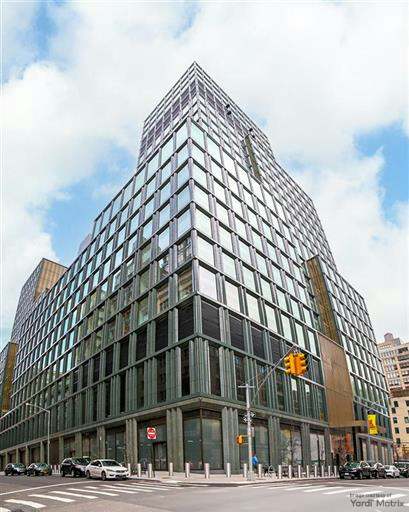
Also known as the Robert A. Iger Building and the new headquarters for The Walt Disney Co., the 22-story “vertical campus” has achieved LEED Platinum certification for both its Core & Shell (86 points) and Interior Design & Construction (88 points). As one of New York City’s largest all-electric office structures, the building eliminates on-site fossil fuel combustion by utilizing high-efficiency air-source heat pumps and advanced waste-heat recovery systems that repurpose energy from production studios. These features ensure the facility complies with the city’s strict Local Law 97 carbon limits while supporting a path toward net-zero operations.
The building’s sustainability is further enhanced by a high-performance façade featuring triple-pane glass and bird-safe coatings. Its design incorporates nine vegetated terraces and two green roofs that manage stormwater runoff through an integrated collection and irrigation system. Beyond environmental metrics, the campus is pursuing Fitwel accreditation to ensure that its 1.2 million square feet of space actively promotes occupant health and wellness and overall workplace well-being.
Project Falcon/Wells Fargo campus (Irving, Texas)
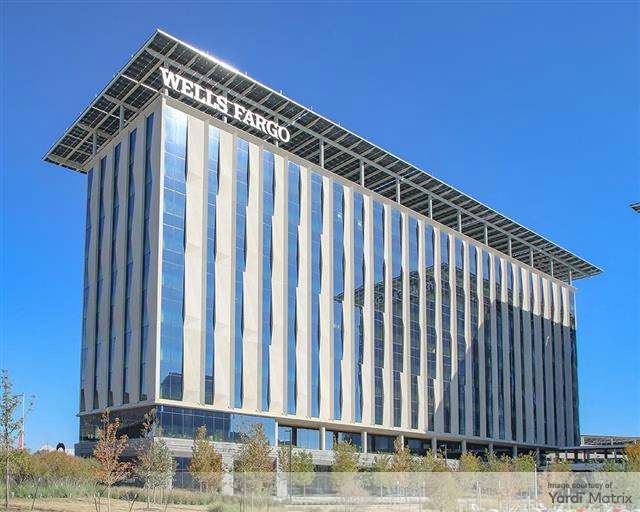
The second largest office property to receive a LEED Platinum certification in 2025 was Project Falcon in Irving (more than 850,000 square feet in the dataset), two 10-story towers owned by Wells Fargo in Las Colinas. The asset is designed to be net-positive energy, meaning it generates more power than it consumes annually through a 5 percent energy surplus sent back to the grid. The campus also incorporates a parking garage fitted with more than 360,000 square feet of solar panels. It uses an all-electric system and a hybrid mechanical setup that is approximately 35 percent more efficient than a baseline system.
Additional sustainability features for the campus include a sophisticated water management system that reclaims gray water from showers for restrooms and diverts stormwater to nearby Lake Carolyn for irrigation, reducing indoor water use by 74 percent compared to a typical building. The building façade features dynamic glass that automatically adjusts its tint to manage solar heat gain and maximize natural light, which cuts electricity demand for lighting by 42 percent. The project also focuses on employee wellness, with native plantings, walking trails and EV charging stations, and has implemented carbon accounting measures to use low-carbon materials during construction.
1900 Lawrence (Denver, Colo.)
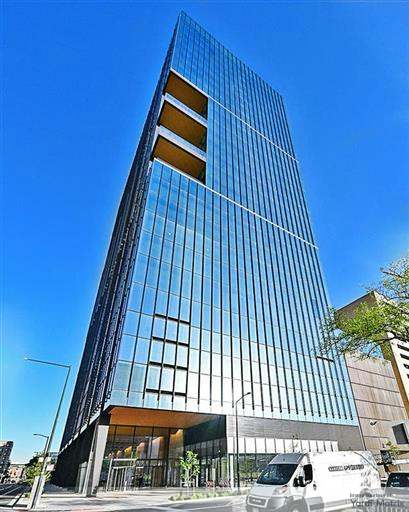
Located in Denver’s Lower Downtown district, 1900 Lawrence officially achieved LEED v4 BD+C: Core and Shell Platinum certification on February 25, 2025, with a score of 84 points. The 30-story office tower is a fully electric structure that utilizes high-efficiency air-source heat pumps and a Variable Refrigerant Flow (VRF) system to provide localized climate control. Its advanced HVAC design features a Dedicated Outdoor Air System (DOAS) with energy recovery that supplies fresh air directly to each floor, completely eliminating air recirculation between different levels of the building.
The building’s high-performance façade is constructed with low-emissivity glass and vertical fins to optimize natural daylighting while reducing solar heat gain. Sustainability is further integrated through extensive water conservation measures, including rainwater capture systems and drought-tolerant landscaping that together reduce indoor potable water use by 45 percent. To support Denver’s urban environment, the campus features a 10,000-square-foot landscaped green roof atop the parking podium, 11 private tenant terraces, and 32 electric vehicle charging stations.
These examples also reinforce why Platinum’s share of total square footage (15.6 percent) is meaningfully higher than its share of projects (9.2 percent). When teams go for Platinum, it often coincides with major corporate consolidations, new trophy deliveries and flagship developments where certification supports leasing velocity, tenant retention and long-term operating resilience.
What the 2025 office LEED mix suggests for 2026
Similar to multifamily LEED activity, Gold is the market’s anchor, while Platinum is the “statement tier”—and both are tied to size and visibility. Owners and developers appear to be using LEED in two complementary ways: As a scalable standard (Gold), especially across repeatable office programs and portfolios where teams want a consistent sustainability credential without over-customizing every building; As differentiation at the top (Platinum), particularly for large headquarters, new towers and high-profile redevelopments where sustainability performance is part of the brand, the lease-up story and the underwriting.
Meanwhile, the presence of large O+M certifications among the biggest projects highlights a practical reality: for much of the U.S. office stock, the fastest path to meaningful impact is operational performance—how buildings run, not only how new ones are delivered. That’s likely to remain a theme as owners compete for tenants that increasingly compare not just rent and amenities, but also energy performance, carbon posture and occupant experience.

You must be logged in to post a comment.