

How CRE Investors Are Adapting to Higher-for-Longer Interest Rates
Those who embrace today’s financing realities, rather than wait for relief, are uncovering opportunities.
This article first appeared in the CPE Sneak Peek Newsletter. Subscribe now for early access to exclusive content, in-depth analysis and key trends!

Waiting is no longer a viable commercial real estate investment strategy. After spending much of the past several years hoping lower interest rates would revive transaction activity and restore the economics that supported the previous cycle, investors are increasingly building their business plans around a less forgiving premise: Expensive capital may be here to stay, so they need to find ways to operate under current financing conditions.
After rapidly raising its benchmark rate between 2022 and 2023—from the 0.25 to 0.5 percent range to the 5.25 to 5.5 percent range, the highest it’s been since 2001—the Federal Reserve has made several cuts, bringing the rate to the 3.5 to 3.75 percent range today. Investors had anticipated another two, possibly three, rate cuts this year, but stubborn inflation has diminished the likelihood of near-term relief and kept another increase within the realm of possibility.
The resulting mismatch between financing costs and property yields continues to challenge the economics of direct ownership. The spread between borrowing rates and cap rates has made real estate less attractive relative to some competing investments, according to Scott Crowe, executive vice president, chief strategy officer & head of equity capital markets at RXR.
Inflationary pressures from commodity prices, AI spending, government deficits, corporate borrowing and lower immigration levels are among the forces supporting the Fed’s cautious position, he noted. And as long as they persist, cheaper debt may remain out of reach.
The refinancing test
The most immediate consequence of higher-for-longer rates is becoming visible as loans mature. Nearly $1 trillion in commercial real estate debt is set to mature this year alone, forcing owners to confront valuations and financing terms that may bear little resemblance to those in place when the loans were originated.
Sellers hoping lower rates would restore property values are likely to face mounting pressure from lenders and investors to return capital or accept losses, according to Jakob Nicholls, managing director at Greysteel.
“As more buyers resurface in bidder pools and sellers face maturity defaults and general capitulation, expect increased transaction volume,” he said.
Distressed office deals, nonperforming loan sales and lender-facilitated short sales are already playing a larger role in the market. Although some owners are repurposing challenged properties, Nicholls believes conversions are a relatively small share of the overall inventory. For now, much of the market’s response is financial rather than physical, with borrowers turning to preferred equity, mezzanine debt and alternative capital solutions at the property or portfolio level.

The appropriate response depends heavily on the asset itself. Owners who believe a property’s operating fundamentals justify further investment may contribute additional equity when the loan matures and its interest rate resets. But those who see little prospect of recovering that capital may instead surrender the property, absorb the loss and move on, according to Xander Snyder, principal commercial real estate economist at First American.
For owners choosing to stay committed to the asset, refinancing has become an exercise in rebuilding the capital stack. When lenders require borrowers to contribute additional equity, reflecting lower loan-to-value ratios—driven by higher interest rates and updated valuations—in many cases, the proceeds from a new loan may be insufficient to retire the existing debt, requiring the owner to contribute new equity, raise mezzanine or subordinate financing, negotiate a restructuring or sell the property.
Those decisions are gradually clearing the way for more transaction activity.
“The investors that are most active today have already adjusted their return thresholds and business plans to account for higher interest rates,” Nicholls said. “Those investors that are holding out for rate cuts have been on the sidelines but won’t—and, in some instances, can’t—continue to sit on dry powder indefinitely.”
When lending beats owning

Crowe considers private real estate lending one of the sector’s most attractive opportunities today, with some investments generating mid-teen returns.
“It’s very difficult to see how owning a typical real estate asset could exceed that, unless interest rates come down and some cap rates compress,” Crowe commented.
Private credit is expensive, but its availability has helped prevent refinancing shortfalls from becoming an even broader wave of distress.
“It’s not cheap money, but it’s available, and it’s created a buffer for this recapitalization wave that otherwise would have ended up in distress,” he added.
That does not mean private capital can solve every property’s problem. Subordinate debt adds to the cost of the capital stack and only makes sense when an asset can generate enough income or create enough value to support it. Despite that, investors are increasingly willing to finance the adjustment rather than wait for elevated rates to end.
Repricing creates a new entry point
For buyers, lower property values are the main counterweight to elevated borrowing costs. Assets acquired near the peak of the market in 2021, 2022 and part of 2023 are particularly vulnerable because their original capital structure often assumed cheaper debt, higher valuations or both.
“I don’t care where you bought, I don’t care what you bought, they’re all underwater,” argued Matthew Rosenthal, founder & managing director at Eastham Capital.
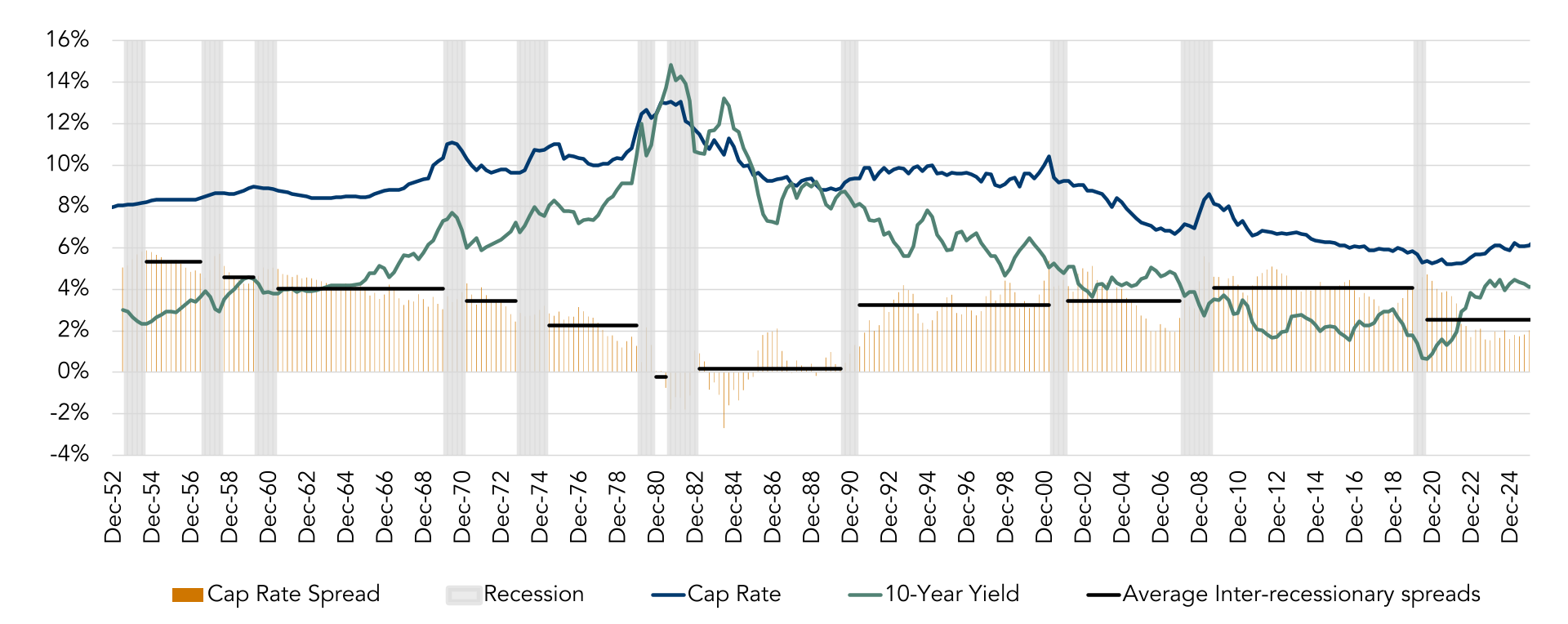
Will Cap Rates Reset?
All-Property Cap Rate, 10-Year Yield, Spread Between Cap Rate and 10-Year Yield
The resulting pressure is producing acquisition opportunities among owners with loans originated five to 10 years ago that are now nearing maturity. Buyers with available capital can target motivated sellers and acquire properties at a basis that better reflects current financing conditions. That repricing is one reason transaction activity has regained some momentum over the past year, Snyder noted.
The adjustment, however, is far from uniform. Crowe estimates that real estate asset values vary up or down as much as 30 percent, depending on the asset’s sector, quality and underlying fundamentals.
“The doubling in interest has had a significant impact on cap rates, which have gone from the mid-threes to the mid-fives,” he said. “That’s a big headwind on real estate values, as even in the face of higher NOI that numerator has been offset in large part by the denominator, the cap rate going up. So, the biggest part of the story for the first part of this decade has been a big increase in interest rates. Markets are still digesting that, and it has led to really muted returns out of real estate.”
But interest rates do not determine values on their own. Historically, they explain roughly 25 percent of cap-rate movement, according to Snyder. Credit availability, leasing prospects, supply conditions and asset-level performance shape what buyers are willing to pay.
Cap rates have increased by 1.5 to 1.9 percent for office properties, corresponding with value declines of 19 to 22 percent, Snyder noted. Industrial cap rates have risen by roughly 1.1 to 1.2 percent for a 15 to 19 percent decline in values. Retail values have fallen between 6 and 12 percent, while multifamily valuations are roughly 22 to 23 percent lower.
“It is entirely possible that cap rates will continue to rise, although I believe a plateau is more likely in the near term for most asset classes,” Snyder said.
I long-term interest rates reset to the 5 to 6 percent range, cap rates would likely adjust upward, but that outcome is also dependent on credit availability and leasing fundamentals. The same rate environment can produce very different results for a well-leased property in a supply-constrained market and an asset facing tenant losses or significant capital needs.
Investors continue to rely on traditional valuation measures, including price per square foot, price per unit, cap rates and price per megawatt for data centers. Greater emphasis, however, is being placed on the distinction between stabilized and going-in yields, as well as the gap between the purchase price and the total cost of completing renovations or repositioning.
“The valuation tailwinds that supported much of the commercial real estate market during the 2001-2008 and 2010-2021 cycles are far less certain today,” Snyder added, suggesting that as a result, a larger share of investment returns will need to come from income growth and operational improvements.
Optionality replaces rate-cut bets
The change influences how investors structure acquisitions and how long they expect to own them. It’s difficult to measure what proportion of investors are extending their hold periods. However, the strongest operators remain disciplined and underwrite investments over time horizons in which they can confidently create value through operations—often 10 years or longer. “Rather than waiting for lower rates, they are preparing for a future in which today’s interest rate environment may represent the new normal, with the possibility that rates will move even higher,” Snyder added.
At the same time, some investors are seeking greater flexibility in their financing. Commercial mortgage-backed securities loan terms have shortened from 10 years to five years and, in some cases, even less. Although CMBS represents only part of the lending market, the shift suggests that certain debt investors want the ability to reprice risk sooner if market conditions change.
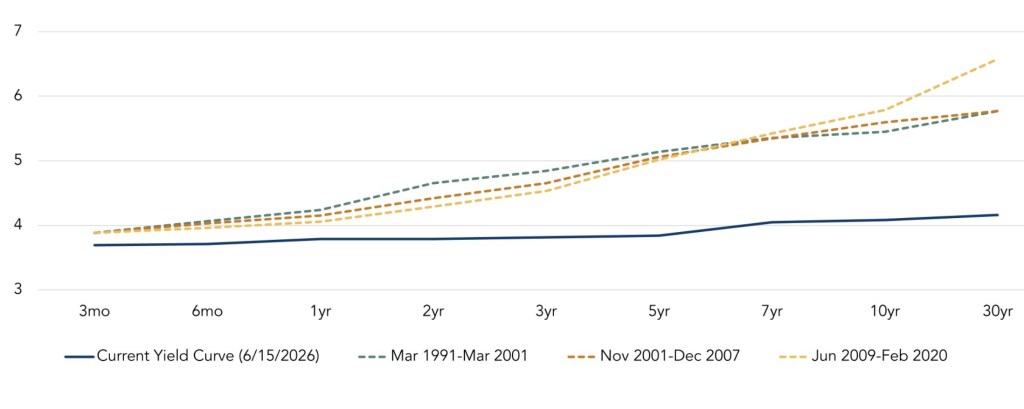
Potential Yield Curve After One Rate Cut
Current and Implied Yield Curves Based on Current Three-Month Treasury Rate and Prior Inter-Recession Average Yield Curve Shapes.
Equity investors are also prioritizing optionality. Some buyers are selecting shorter-term, floating-rate debt even when the property’s rent roll and anticipated hold period might ordinarily support a longer-term facility.
“Most buyers today will not assume significant capital markets improvement in their base case underwriting, but they are looking for optionality on exit,” said Nicholls.
That strategy can allow an owner to refinance or sell if conditions improve, but the investment must still work without that outcome. Rate cuts have become potential upside rather than an essential component of the business plan.
This represents an important change from the earlier stages of the rate cycle. Investors are not necessarily abandoning the expectation that financing conditions will eventually improve, but they’re becoming less willing to pay today for an improvement that may not arrive on schedule.
READ ALSO: Inside CRE’s Softening Insurance Market
Following cash flow and constrained supply
Asset and market selection are being recalibrated accordingly. Rosenthal’s company, which invests in workforce-oriented multifamily housing, has switched its investment focus from heavily supplied Sun Belt markets toward Midwest locations with limited new construction.

Cap rates in those markets have increased modestly, but the firm has been able, in a couple of cases, to assume mortgages carrying rates at 2.5 and 3.5 percent. At the same time, rents have risen between 2 and 3 percent from the previous year.
“We had to put in a little extra equity, but we’re thrilled to do this, and we’re seeing cash flow immediately out of these properties, which was unheard of a few years ago,” Rosenthal said. The strategy demonstrates how investors are looking beyond headline cap rates to the full economics of a transaction.
Purchasing assets below replacement cost is another increasingly common approach. A lower basis can give investors room to renovate or reposition an asset without competing directly with the cost of new construction. In multifamily, Crowe sees a major opportunity to modernize properties built between 2008 and 2020 so they can compete more effectively with recently delivered communities.
Repurposing obsolete office buildings for new uses, particularly multifamily, has also become a prominent strategy in New York City, San Francisco, Los Angeles and other major markets. Where zoning, building configuration and conversion costs permit, a new use may restore income to an asset that no longer competes effectively as office space.
However, conversions are not a universal solution. As with other value-add strategies, the discount alone does not create a return, and investors must be able to execute a workable plan after the acquisition.
“All this is leading to less capital flows as investors try to find areas where they perceive higher returns,” Crowe continued. “And as we go through this wave of refinancing, I think the real opportunity is to be a lender or try to find property investment opportunities with NOI growth.”
Generating that growth will not be easy in every sector. Meaningful NOI expansion generally requires higher rents, stronger occupancy, expense savings or some combination of the three. Oversupply in portions of the multifamily and industrial markets, for example, may constrain near-term rent growth and increase the importance of market selection and operational execution.
While higher interest rates have fundamentally reshaped commercial real estate, they have not brought investment activity to a standstill. Instead, they’re rewarding disciplined underwriting, creative capital solutions and operational expertise.
Investors who continue to wait for a return to the ultra-low-rate era may remain on the sidelines, while those adapting to today’s realities can find opportunities in lending, discounted acquisitions, repositioning strategies and markets with durable long-term fundamentals. In this environment, success depends less on predicting when rates will fall than on identifying where value can still be created.


You must be logged in to post a comment.