

Corporate Real Estate Charts a New Course
Amid demands for flexibility and custom solutions, in-house generalists must become specialists.
Biotech and pharmaceutical manufacturer Resilience announced in June that it plans to relocate its corporate headquarters from San Diego to Blue Ash, Ohio, a suburb of Cincinnati. The move positions Resilience near its 608,323-square-foot West Chester manufacturing campus, which it acquired for $212 million in 2023.
Corporate real estate decisions used to be more formulaic. Typically, x number of employees needed y amount of space to do their jobs, and companies inked 10-year leases.
In a post-pandemic, AI-rising world, that approach is increasingly a thing of the past. Space and location planning are becoming more strategic, putting business goals and projections, functionality and employee satisfaction among companies’ top priorities.
Here are five ways corporate real estate footprints and departments are shifting.
1. A sharper focus on the business
McKinsey partner Alex Wolkomir stresses that companies need to design space to reflect how the business operates, starting with what employees actually do with their square footage. Making the space fit the employees is replacing the old approach of employees fitting into whatever space they are given.
“There’s an increasing emphasis on what I’ll call the purpose of space,” Wolkomir said. “In office in particular, companies need something that feels like it’s adding value relative to working from home—in creating the right collaboration, in giving folks tools they might not have otherwise.”
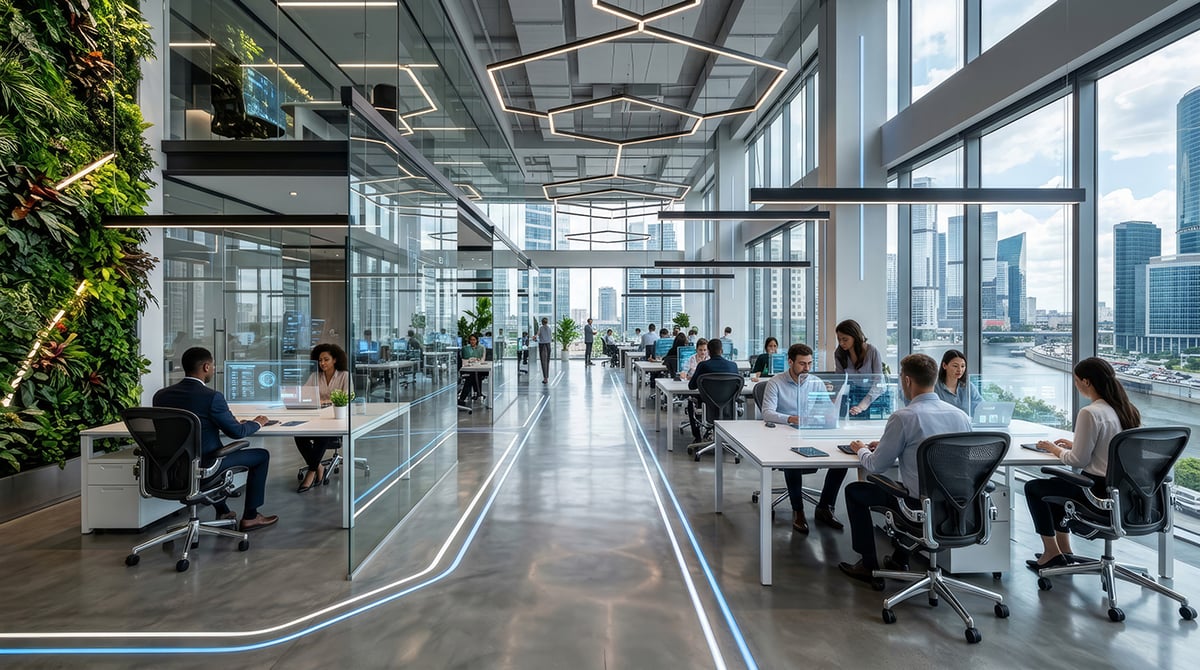
More specifically, corporate real estate planners of the post-pandemic, era of hybrid work are focusing on planned collaboration, such as project rooms for cross-functional teams, writable walls, pin-up space, large displays and easy screen sharing.
Planners are also thinking about promoting unplanned collaboration through informal hubs near circulation paths; visual transparency (i.e., glass walls, sight lines) so employees can see activity; and mixed-use zones where different teams naturally overlap.
Spaces should also feel more like well-amenitized hotel meeting spaces and conference rooms than generic offices, Wolkomir said: “We’re seeing a lot of discussion around this notion of ‘how do you earn the commute’ from folks.”
2. Designing for uncertainty and versatility
Post-pandemic space users and service providers are working on shorter planning timelines, designing for uncertainty and providing as much workplace flexibility as possible.

“Once upon a time, I would develop three- and five-year strategies for clients; those strategies would hold, typically in leasing commitments and workforce commitments and workplace investments,” JLL Global Future of Work Leader Peter Miscovich told CPE. “All of that, I would say, has collapsed. Planning horizons are three months, six months.”
One of Miscovich’s clients knows that it will stay in its headquarters permanently, so it owns that property. The company’s operational centers are owned or leased, depending on circumstances. Its smaller sales offices—more startup-oriented sites—are either under short-term leases or no leases at all using coworking or other flex space instead.
“It’s an ecosystem today that requires precision thinking and better analytics to keep up with the demands of Fortune 100 enterprise occupiers,” Miscovich said.
Owning vs. renting is a more important concern than ever considering the new normal of uncertainty, according to Ron Zappile, who leads Colliers’ Portfolio Strategy Consulting line of business for Occupier Services in the Americas. The decision is almost always based on three variables: certainty about the location, the required space size and the magnitude of the financial obligation.
“The bigger priority is flexibility,” Zappile said. “Organizations are looking for portfolio strategies that allow them to respond quickly to changing workforce patterns and market conditions. Whether an asset is owned or leased, occupiers are increasingly focused on ensuring their portfolios can evolve alongside the business.”
3. Centralizing control
An important trend in corporate real estate involves centralization, according to a recent paper published in the Corporate Real Estate Journal, “Transforming Corporate Real Estate from a Decentralized to Centralized model,” by Zappile and Chris Zlocki, global head of enterprise client strategy and solutions, global occupier services, at Colliers.
According to the paper, businesses with sizable real estate footprints, are increasingly recognizing that a decentralized real estate model can lead to inconsistent decision-making, fragmented data, duplicative costs and missed strategic opportunities. To remain competitive, companies are transitioning toward integrated platforms.
There’s a big emphasis increasingly on what I’ll call the purpose of space. In office space in particular, companies need something that feels like it’s adding value relative to working from home …
—Alex Wolkomir, Partner, McKinsey & Co.
Whether the centralization trend is driving companies to seek more or fewer locations depends on the industry. But in general, some organizations may shift to fewer, more strategically located workplaces, edging toward greater centralization.
“Location decisions are increasingly being guided by access to talent, skills availability and innovation ecosystems, rather than simply maintaining legacy footprints,” Zappile said. “The result is often a network of strategically located hubs that support both business performance and workforce needs.”
Centralization represents real-world savings, according to the report, which tracked a large company through a process that involved embedding a number of CRE practices: portfolio segmentation, key performance indicator alignment, demand and supply intelligence, lease flexibility and structured business reviews.
Each of the mission-critical assets making up 80 percent of the company’s footprint received a strategic assessment that set the company up to realize a 20 percent reduction in costs over the next five years from area and operating expense reductions.
4. Incorporating AI
With AI still in its early stages, its use in corporate real estate comes with caveats. In CBRE’s most recent Occupier Sentiment Survey, which tracks how companies are feeling about their portfolios, AI is the one place where survey respondents are still hedging, said Emma Buckland, CEO of CBRE’s Enterprise business.
“Nearly a third say it’s too soon to know how it will affect their space planning,” she said. “We’re helping clients stay flexible and keep their options open while that picture clarifies.”
AI holds promise for corporate real estate optimization, and across the industry there’s significant experimentation underway—in personal and team productivity, service delivery, data intelligence and how space itself is planned and managed, Buckland told CPE.
“The hard work is figuring out where AI creates the greatest return,” she said. “That is, which use cases move the needle compared to those that are promising but not yet impactful at scale.”
At CBRE, Buckland notes, AI is already embedded across a number of functions, including portfolio analytics, facilities management, occupancy planning, investment analysis and document abstraction.
“Facilities management is one area where the impact is already tangible,” she said. “AI is reducing maintenance alarm noise, so teams can focus on what actually matters, such as predicting equipment failures before they happen or giving clients real-time visibility into how their space is performing.”
In the execution of facilities, companies are starting to use AI-powered software to do a lot of the coordination and scheduling work or to automate response—and execute these functions much faster, Wolkomir said.
“You can imagine a leak or a spill on, say, the third floor,” Wolkomir said. “Someone submits the work order, someone has to respond, the space users have to call up the provider.”
If the leak is coming from a sink where there’s a leak sensor and the sensor detects the leak before it becomes a flood, it automatically generates the work order.
“The system has the three invoices for plumbers who have worked at the building, and it schedules plumber B to come out ASAP,” Wolkmir added. “That reaction starts to look fundamentally different.”
5. Co-creation of space
Rather than “delivering” solutions to corporate clients, corporate real estate executives say they are increasingly asked to co-design occupancies with internal stakeholders.
“You’re arm-in-arm and you’re doing this together,” Zlocki said. “I don’t see it as creating a model for a client. I see us partnering to figure out the optimal model. They’re as active a participant in this as we are.”
Customizing solutions for the business and the business unit also makes collaboration more urgent than ever. “Every company in every sector has a different way of doing business,” he noted.
Corporations and property owners are also viewing their relationship as more of a partnership these days. “A lease these days is a closer, more continuous collaboration between the space user and the service provider, who co-shape how the space is activated and used over time,” Wolkomir said.
Corporate real estate decisions used to be more formulaic. Typically, x number of employees needed y amount of space to do their jobs, and companies inked 10-year leases.




You must be logged in to post a comment.