


CREFC: CRE Finance Sentiment Hits Three-Year Low
Higher borrowing costs and a weakening economic outlook are raising concerns about refinancing and investment activity.
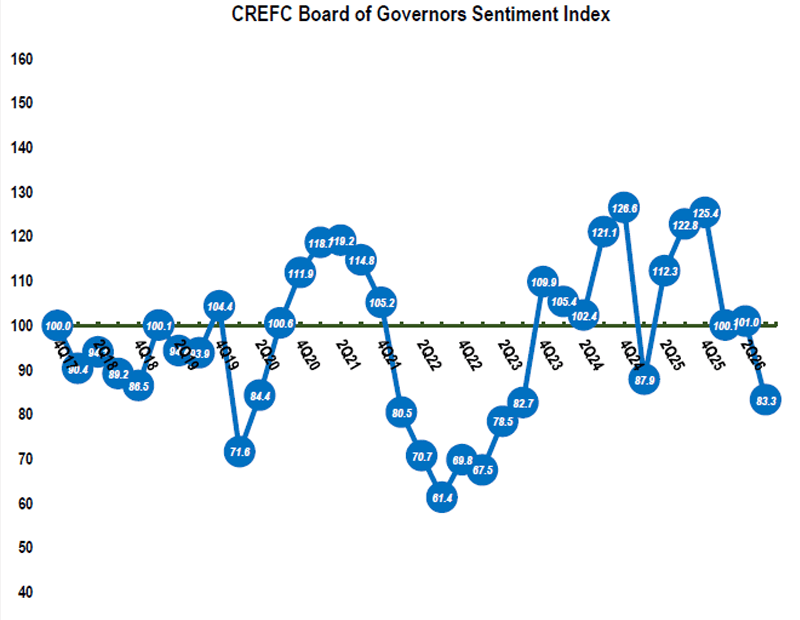
Results of the CRE Finance Council’s third-quarter Board of Governors Sentiment Index survey show CRE finance executives are growing increasingly concerned about a weakening U.S. economy and how it will impact the industry and long-term borrowing costs over the next year.
The index fell 17.5 percent to 83.3 from 101.0 in the second-quarter survey, its lowest reading since the third quarter of 2023 and well below the record high of 126.6 set in the fourth quarter of 2024. Interest rate and economic outlook questions posted the largest declines, accounting for about 30 percent of the drop. But the decline was broad-based with all nine core questions weakening quarter over quarter.
Those concerns are reflected in the economic outlook question, with 62 percent of the respondents expecting the U.S. economy to perform worse over the next 12 months, up from 24 percent in 2Q26. It’s the highest share since the first quarter of 2025.
Conducted from Sept. 21 through Sept. 28, the survey showed an adjusting market to a 10-year Treasury yield at 5 percent, about a full percentage point above its level a year earlier. CREFC Managing Director Raj Aidasani said the 10-year Treasury was about 4.5 percent when the second-quarter survey closed July 6. The Federal Reserve raised the federal funds rate on Sept.16 after the Federal Open Market Committee voted to raise interest rates for the first time since July 2023. The target rate is now at 3.75 to 4 percent.
Asked in the topical section of the survey where they expect the 10-year Treasury yield to close on Dec. 31, 78 percent of respondents expect 5.00 percent or higher.
The survey found rates had the weakest core reading for a second consecutive quarter. Aidasani said BOG Sentiment Index respondents were concerned about the level and volatility of mortgage and cap rates in the second quarter, but 37 percent were neutral about their impact at that time. In the third quarter, the neutral share fell to 5 percent, with 92 percent of respondents expecting a negative impact.
“Respondents’ comments pointed to persistent inflation, energy costs, fiscal deficits and Treasury supply as reasons long-term borrowing costs could remain elevated,” Aidasani told Commercial Property Executive. “For CRE, higher financing costs can reduce the debt that a property’s cash flow can support and complicate valuations and refinancing. Those pressures become more difficult to absorb when expectations for rents and income are also weakening.”
READ ALSO: How Higher Rates Are Reshuffling CRE’s Financing Deck
On credit terms for new CRE loans, 38 percent expect tightening, while 43 percent expect terms to remain about the same.
Core questions look at fundamentals, activity, demand
The report states caution among the respondents spread beyond rates with neutral still being the most common answer on seven of the nine questions. But the share of negative answers increased on eight of the nine. Regarding overall CRE finance industry sentiment for the next 12 months, the negative share nearly quintupled from 8 percent in 2Q26 to 38 percent in the third quarter.
Investor demand was evenly split while borrower demand turned net negative for the first time since the fourth quarter of 2022. The survey found 24 percent expect increased demand for CRE and multifamily financing, down from 45 percent, while 35 percent expect less demand.
On transaction activity, investor demand expectations are no longer net positive for the first time since the second quarter of 2023. Of those responding, 30 percent expect increased demand for CRE and multifamily assets over the next year, while another 30 percent expect less demand.
Aidasani noted the expectations for property fundamentals and prices are less negative than the broader economic outlook.
“Although 62 percent expect a weaker economy, 49 percent expect CRE fundamentals to remain unchanged and 30 percent expect them to worsen,” Aidasani said. “…Those results support a cautious outlook, with outcomes varying substantially by property and market.”
But Aidasani noted opportunities remain for well-capitalized investors to finance viable properties that need new equity or a reset of their debt, “provided the transaction works under realistic assumptions about rates, income and value.”
Refinancing deals expected to rise
Expectations for CRE debt market liquidity over the next 12 months grew more cautious, with 65 percent of respondents expecting no change, compared to 71 percent in the second quarter. However, the percentage of those anticipating a contraction rose from 5 percent to 24 percent, while 11 percent expect improvement.
Aidasani said he expects refinancing to be a major source of activity through late 2026 and early 2027 because of the need to refinance loans originated in 2021 and 2022. The Mortgage Bankers Association’s maturity schedule states approximately $875 billion of commercial and multifamily mortgages will be due over the 2026 calendar year and $652 billion in 2027.
But he noted not all borrowers will be able to replace the full existing loan, which may actually result in additional financing activity.
“Owners who need to repay debt or return capital may sell at reset prices, creating acquisition-financing opportunities even in a cautious market,” Aidasani said. “Financing activity can therefore continue without signaling a broad recovery in new investment.”
There is a growing risk of further distress, particularly in office and multifamily markets where weaker operating performance coincides with a maturity and limited ability to contribute fresh equity, according to Aidasani. He said office refinancing can be difficult for properties facing large lease expirations, substantial vacancy or expensive tenant improvements.
“In multifamily, the vulnerable combination is high leverage, floating-rate debt and income that falls short of the original business plan, particularly in markets facing significant competing supply,” he stated.
READ ALSO: Paul Vanderslice Named CEO of CREFC
Aidasani noted extension expirations, debt-service coverage, leasing progress and the amount of new equity required to refinance as areas to watch. He also said there’s a difference between borrowers unable to make current debt-service payments and those unable to repay their loans at maturity.
“A property may still generate income but fail to support a replacement loan large enough to retire the old one,” he said.
What’s expected for CMBS, CRE CLO?
Asked how expected trends in CMBS and CRE CLO demand and spreads will impact the performance of all CRE finance-related businesses over the next 12 months, respondents’ views turned net negative. The survey found 32 percent expect demand and spread trends to weigh on performance, up from 13 percent in the second quarter of 2026.
Aidasani said issuance can remain active because loans need to refinance, but the mix of financing products matters.
He noted through Oct. 2, private-label CMBS issuance was $103.5 billion, up 11 percent from the comparable 2025 period. Single-asset single-borrower issuance was up about 20 percent, while conduit issuance was down about 14 percent and CRE CLO issuance was up 45 percent.
“Those differences show why aggregate issuance alone is an incomplete measure of financing conditions,” Aidasani said.
Since CMBS spreads don’t move mechanically with Treasury yields, he said credit risk, investor demand and supply will also impact them.
One of the topical questions asked respondents about the CMBS delinquency rate, which was 7.85 percent in August, according to Trepp. More than 60 percent expect the rate to reach 8.0 percent by the end of the year, including 19 percent who think it could be 8.5 percent or higher.
“So far this year, spreads on benchmark AAA conduit bonds have been little changed even as the 10-year rose about a percentage point. If higher rates coincide with weaker property cash flow and more defaults, I would expect greater pressure on lower-rated bonds and collateral with refinancing challenges,” he stated.






You must be logged in to post a comment.